Key Takeaways
- Part geometry, especially size, hollowness, openings, and surface detail, should guide process selection from the start.
- Rotational molding is often worth evaluating for large, hollow parts that benefit from seamless construction.
- Injection molding is generally better suited to smaller, detailed parts produced in high quantities.
- Blow molding is commonly used for hollow, thin-walled containers and similar products.
- The best decision accounts for material performance, volume, tooling, lead time, secondary work, and total lifecycle cost.
Choosing a plastic manufacturing process is an early product-development decision, not a final purchasing step. The wrong process can create avoidable issues with wall thickness, part strength, tolerances, tool cost, production speed, or design flexibility. Reviewing the options before a mold is built gives product teams more room to balance performance with cost. For organizations developing custom parts, a custom plastic parts manufacturer at https://npi-ks.com/services/custom-plastic-parts-manufacturer/ can help evaluate whether the proposed geometry, material, and expected production volume align with a practical process. The goal is not to choose the process with the lowest initial price. It is to select a method that can reliably produce the required part throughout its useful life.
Start With the Part’s Shape and Size
Geometry quickly narrows the available options. Large, hollow, curved, or asymmetrical products place different demands on tooling and equipment than small components with clips, threads, ribs, and tight dimensional requirements. A tank, protective housing, bottle, equipment cover, and pipe may all be made from plastic, but they are not necessarily good candidates for the same process. A useful early review considers form, production volume, lead time, and material requirements together. This guide to manufacturing processes for plastics similarly identifies those factors as central to process selection. Begin by defining whether the part is large and hollow, small and detailed, thin-walled, broad and open, or built around a continuous profile.
Compare the Main Manufacturing Options
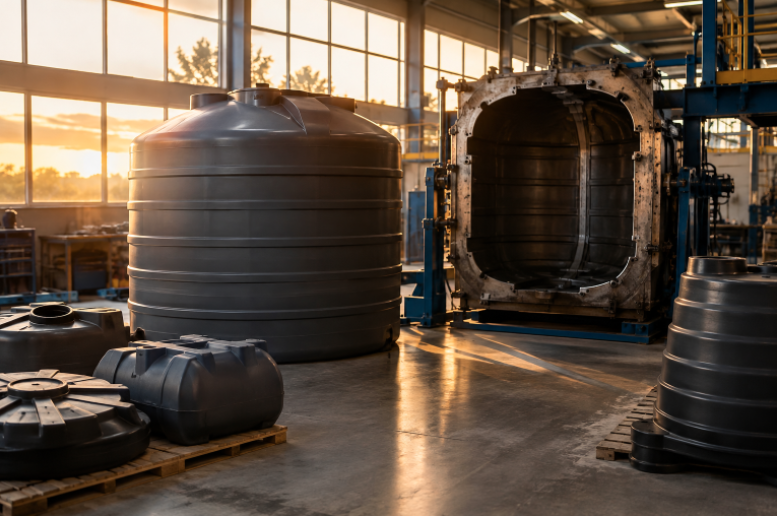
- Rotational molding: Often considered for large, hollow parts such as tanks, bins, housings, recreational products, and outdoor equipment. It can produce enclosed shapes with few or no seams.
- Injection molding: Often used for small to medium parts that need detailed features, repeatable dimensions, and efficient high-volume production.
- Blow molding: Commonly used for bottles, jugs, drums, ducts, and other hollow products with relatively thin walls.
- Thermoforming: Useful for trays, liners, panels, covers, and open-shell designs formed from heated plastic sheet.
- Extrusion: Best suited to products such as tubing, pipe, and profiles that maintain a consistent cross-section along their length.
When Rotational Molding May Be a Good Fit
Rotational molding can be a strong option when a part must be large, hollow, durable, and shaped beyond the forms of a simple bottle or tube. The process distributes heated plastic material inside a rotating mold, allowing material to coat the mold interior and form the part. It is often used for tanks, industrial containers, protective enclosures, playground components, marine products, and material-handling items. Designers may favor this method when they want a hollow part without a long welded seam, need room for curved or irregular shapes, or expect the product to withstand regular outdoor or industrial use. However, rotational molding is not automatically the best choice for parts requiring extremely tight tolerances, very rapid cycles, or exceptionally high annual volume.
When Injection Molding Makes More Sense
Injection molding is typically a better match for detailed parts that require consistent repeatability across large production runs. It is commonly used for housings, caps, clips, fasteners, small structural components, and consumer-product features that need molded-in geometry. The tradeoff is tooling investment. Injection molds can be complex and costly, particularly when they require multiple cavities, slides, threads, or fine surface textures. Those upfront costs can be spread across many parts, which is why injection molding becomes more attractive when demand is steady, and production volume is high.
When to Consider Blow Molding
Blow molding creates hollow products by using air pressure to expand heated plastic inside a mold. It is widely associated with bottles and jugs, but it can also support other hollow forms, depending on the specific blow molding method and tooling arrangement. This approach is especially relevant when the product needs thin walls and efficient production at scale. Wall thickness should still be reviewed carefully, particularly around corners, handles, transitions, and other areas where material distribution may vary. A design should be evaluated at its thinnest critical locations rather than judged only by an average wall measurement.
How Production Volume Changes the Decision
A process that works well for a prototype or short run may not be economical for a long-term production program. Low-volume methods can reduce initial tooling commitments, while dedicated production tooling may lower the cost per part once quantities increase. There is no universal volume threshold because part size, complexity, material, automation, cycle time, and labor needs all change the calculation.
- Estimate first-year demand and expected annual demand.
- Separate prototype, pilot-run, and production quantities.
- Compare tooling costs with projected per-part costs.
- Allow for potential design changes before committing to final tooling.
- Review capacity needs if demand rises faster than expected.
Review Material and Service Conditions
The right manufacturing method must be compatible with a material that can withstand real operating conditions. Consider temperature exposure, impact, UV exposure, moisture, chemicals, oils, fuels, cleaning agents, stiffness, flexibility, and appearance requirements. Food-contact, medical, electrical, or industry-specific requirements may also affect material and process choices. Material selection should include the intended environment, not just the appearance of the finished part. A product used indoors may face very different requirements than one exposed to sunlight, cold weather, repeated impacts, or chemical contact. A broader overview of plastic manufacturing methods and material considerations can help teams frame these tradeoffs during early planning.
Account for Wall Thickness and Structural Design
Wall thickness influences weight, material use, cooling or heating behavior, stiffness, and long-term durability. Consistent walls are often easier to manufacture and can help reduce weak spots caused by abrupt transitions. Where additional strength is necessary, designers may use generous radii, ribs, bosses, reinforcements, or carefully placed inserts.
Practical Design Checklist
- Avoid sharp internal corners where possible.
- Keep wall thickness consistent unless a deliberate change is required.
- Plan openings, fittings, inserts, and fastening points early.
- Confirm draft and demolding needs for the selected process.
- Identify areas that need extra stiffness or impact resistance.
Tooling Cost Is Not the Full Cost
A low-cost tool does not always produce the lowest-cost program. A complete comparison should include engineering, material use, machine time, labor, trimming, finishing, assembly, inspection, scrap, freight, maintenance, and future changes. Teams should also consider the consequences of delayed launches or costly redesigns resulting from choosing a process that does not fit the part.
Questions to Ask Before Requesting a Quote
- How large is the finished part, and must it be hollow?
- What dimensions and tolerances are genuinely critical?
- How many parts are needed annually and over the product life?
- What environment will the product face?
- Will the part require color, texture, graphics, inserts, or assembly?
- What launch date, tooling budget, testing, and documentation requirements apply?
Final Thoughts
The best plastic manufacturing process balances part geometry, material performance, production volume, tooling investment, lead time, and total project cost. Each method has different advantages, so the right choice depends on how the finished component will be used and the level of detail, strength, consistency, and appearance it needs. Large hollow parts may indicate rotational or blow molding, while detailed, high-volume components often favor injection molding. Thermoforming can be a practical option for larger, lightweight parts with relatively simple shapes, while CNC machining may suit prototypes, custom features, or components that require precise dimensions. Manufacturers should also consider material availability, wall thickness, production tolerances, finishing requirements, and the potential for future design changes. Tooling costs and setup time can influence whether a process is economical for a short production run or better suited to ongoing orders. Reviewing the design and manufacturing plan together before tooling begins allows engineers and suppliers to identify potential limitations, compare suitable processes, and clarify production expectations. This early coordination can reduce redesigns, avoidable production delays, material waste, and unnecessary expenses while helping to ensure that the selected method supports both the part’s functional requirements and the project’s budget.
Read more : How Digital Reward Systems Are Changing the Mobile Gaming Experience