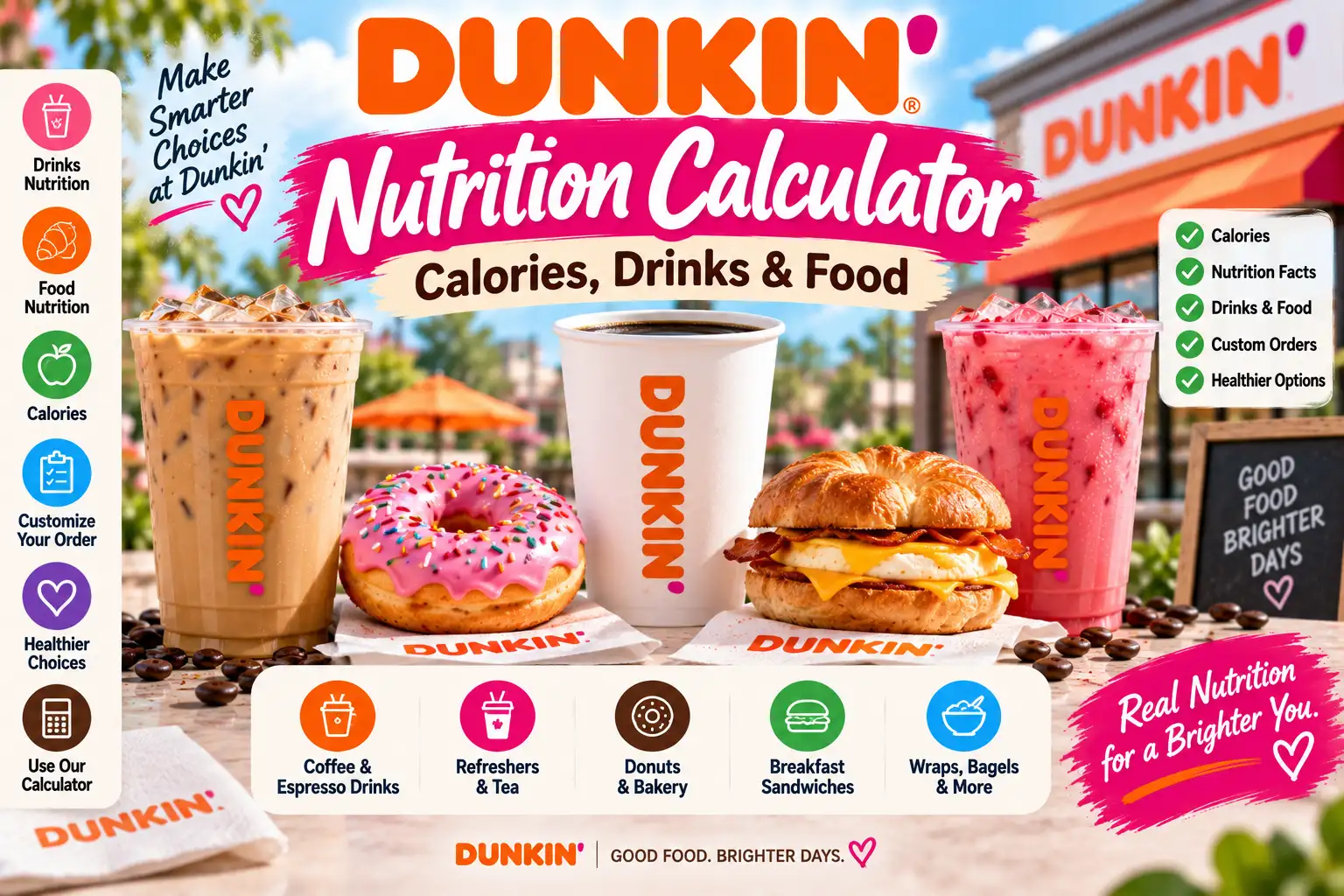
Dunkin’s Nutrition Calculator makes it easy to check calories, sugar, fat, carbs, protein, and other nutrition facts for your favorite Dunkin’ drinks and food. Use it to compare menu options, customize your order, and make informed choices based on your nutritional needs.
Quick Answer
Dunkin nutrition depends on the exact item, serving size, ingredients, and customizations. A plain coffee can have very little added nutrition, while milk, flavor swirls, cold foam, toppings, or food can substantially change an order.
For exact current values, start with Dunkin’s official nutrition information. For a customized order, account for every component instead of using the base drink alone.
TL;DR
- Check the exact size before comparing two Dunkin drinks.
- Milk changes nutrition, especially in lattes and other milk-based drinks.
- Flavor swirls add sweetness and creaminess to beverages.
- Protein Milk is a major 2026 Dunkin nutrition option.
- Calories don’t tell you caffeine, so check both when needed.
- Use Dunkin’s current nutrition and allergen guides for final verification.
Dunkin Nutrition Calculator: How to Calculate Your Order
A useful Dunkin calorie calculator needs to account for the whole order, not just the name of the drink. Start with the base item, select its size, then account for milk, flavor additions, sweeteners, toppings, and food.
Third-party calculators can make this process easier, but they aren’t official Dunkin tools. Current independent calculators let users build orders and total calories, carbohydrates, sugar, protein, fat, fiber, or sodium from published menu values.
Build Your Complete Order
- Choose the exact Dunkin drink or food item.
- Select the correct serving size.
- Record the milk or non-dairy option.
- Add any flavor swirl or flavor shot.
- Include sugar or sweetener.
- Add cold foam, whipped cream, drizzle, or toppings.
- Add each food item separately.
- Multiply individual items when ordering several servings.
- Check the final total against the latest Dunkin nutrition guide.
Example: Building a Customized Iced Coffee
Suppose your order contains:
- Medium iced coffee
- Milk
- A flavored addition
- Cold foam
Instead of using the calorie number for plain iced coffee, calculate the complete customized beverage. Each addition can change the final nutrition profile.
That same approach works for lattes, Refreshers, matcha, frozen drinks, and food orders.
Dunkin Nutrition Facts by Menu Category
Dunkin nutrition covers much more than donuts and coffee. The current U.S. nutrition guide includes detailed information for beverages, sandwiches, bakery products, snacks, and other menu categories.
The most useful way to read the menu is by category. That makes it easier to compare similar items instead of comparing unrelated foods.
| Category | What to Check |
|---|---|
| Hot Coffee | Calories, additions, caffeine |
| Iced Coffee | Size, milk, flavor, toppings |
| Cold Brew | Size, milk, flavor, foam |
| Espresso Drinks | Milk, flavor, size, caffeine |
| Matcha | Matcha blend, milk, flavor |
| Refreshers | Flavor, size, sugar, protein options |
| Protein Beverages | Protein, calories, ingredients |
| Frozen Drinks | Complete blended recipe |
| Tea | Sweetened versus unsweetened preparation |
| Donuts | Variety, filling, frosting, serving |
| Munchkins | Flavor and number of pieces |
| Breakfast | Calories, protein, carbohydrates, sodium |
| Bakery | Serving size and toppings |
Dunkin’s current nutrition document also explains that not every test product, limited-time offer, or regional menu item necessarily appears in the published material.
Dunkin Coffee Calories and Nutrition
Coffee is one of the easiest Dunkin categories to customize. The base beverage can be simple, but cream, milk, sugar, and flavor additions can change the finished drink.
The key is to separate the coffee itself from everything added to it. This prevents a common mistake: using the nutrition value for plain coffee when the actual order contains several additional ingredients.
- Hot coffee: Start with the published value for the exact size.
- Iced coffee: Check the base plus every customization.
- Cold brew: Check whether milk, sweeteners, or foam are included.
- Espresso: Consider both the serving and caffeine content.
- Americano: Espresso and water create a different profile from milk-based coffee.
- Latte: Milk becomes a major part of the finished drink.
- Flavored coffee: Identify whether the addition is a shot or a sweetened swirl.
- Protein coffee: Check the protein beverage listing rather than estimating.
- Seasonal coffee: Verify the current recipe because limited-time products can change.
Dunkin Iced Coffee Calories
Dunkin iced coffee calories depend heavily on what goes into the cup. The base drink and a fully customized iced coffee should never be treated as the same product.
Current independent nutrition calculators list a medium plain iced coffee at around 5 calories, while customized versions can be considerably higher. Those third-party values should still be checked against the current Dunkin source before publication or an important dietary decision.
- Plain iced coffee provides the simplest baseline.
- Milk adds calories and other nutrients.
- Cream changes the drink’s texture and nutrition.
- Flavor swirls add sweetness and creaminess.
- Flavor shots provide a different type of customization.
- Cold foam adds another component to the beverage.
- Whipped toppings can further change the total.
- Larger sizes can contain more of the finished beverage.
- Seasonal iced coffees should be checked individually.
Iced Coffee Example
A medium plain iced coffee and a medium flavored iced coffee with milk and cold foam are different nutritional products.
The second order needs every component included in the calculation. That is why a useful Dunkin calorie calculator should allow customization instead of offering only a static menu number.
Dunkin Cold Brew Calories and Nutrition
Cold brew has become a major part of Dunkin’s coffee menu, but the nutrition story changes once you customize it.
A current third-party calculator lists medium cold brew at 5 calories as a base item, while larger servings and customized versions need their own calculations.
- Plain cold brew provides the simplest starting point.
- Milk creates a creamier texture.
- Flavor additions can change sweetness and calories.
- Cold foam creates a richer finished drink.
- Sweet toppings need to be counted separately.
- Check the exact size before comparing two cold brews.
- Compare customized cold brew with customized iced coffee.
- Include food if you’re calculating your entire order.
- Recheck seasonal cold brew recipes when the menu changes.
Dunkin Latte, Espresso, and Matcha Nutrition
Lattes, espresso drinks, and matcha beverages need more detailed comparisons than plain coffee. Milk, matcha blends, flavorings, and size can all contribute to the final nutrition profile.
Matcha also shouldn’t be treated as simply another type of coffee. Its ingredients and preparation are different, so use the specific product information for the drink you’re ordering.
- Latte: Milk contributes a substantial portion of the beverage.
- Iced latte: Cold preparation doesn’t remove the contribution from milk.
- Cappuccino: Espresso and foamed milk create a different ratio.
- Espresso: A concentrated coffee serving with relatively little added volume.
- Americano: Espresso combined with water rather than a large milk base.
- Matcha latte: Uses a matcha blend rather than espresso.
- Protein matcha: Can use Dunkin’s Protein Milk.
- Flavored latte: Additional flavors can change sugar and calories.
- Seasonal latte: Always check the current formulation.
Dunkin’s 2026 Protein Milk can be added to beverages that permit a milk or non-dairy base, including coffees, lattes, matcha, and Refreshers.
Dunkin Protein Drinks: Protein Milk, Lattes, and Refreshers
Protein beverages are one of the most important current Dunkin nutrition developments in 2026. Dunkin introduced Protein Milk in January 2026 and expanded it across coffees, lattes, matcha, and Refreshers.
Dunkin states that its featured medium Protein Milk beverages, including Protein Refreshers and a Caramel Chocolate Iced Protein Latte, provide 15 grams of protein.
- Protein Milk: Designed for beverages that allow a milk or non-dairy base.
- Protein Refreshers: Fruit-flavored beverages made with Protein Milk.
- Protein lattes: Combine espresso with Protein Milk.
- Protein matcha: Adds Protein Milk to a matcha-based drink.
- Peanut Butter Protein Latte: A 2026 seasonal protein beverage.
- Protein iced coffee: Protein Milk can be used in eligible iced coffee builds.
- Medium Protein Milk beverages: Dunkin cites 15 grams of protein for featured medium lattes and Refreshers.
- Exact calories: Check the specific current product rather than estimating from protein alone.
- Ingredients: Review the allergen and ingredient guide when needed.
Dunkin later introduced additional protein beverages during 2026, including a Peanut Butter Protein Latte with 17 grams of protein in a medium serving according to its July 2026 announcement.
Dunkin Refreshers, Tea, and Dunkin Zero Nutrition
Refreshers and tea have different nutritional profiles from traditional coffee. Sweetened ingredients, fruit-flavored bases, and protein additions can make two drinks in the same broad category quite different.
Dunkin also introduced Dunkin’ Zero in March 2026. Dunkin says a medium provides 20 calories and 0 grams of sugar, with six fruit-forward flavors at launch.
- Check whether tea is sweetened or unsweetened.
- Compare the exact Refresher flavor.
- Protein Refreshers have a different nutritional profile from standard Refreshers.
- Fruit flavor doesn’t automatically mean low sugar.
- Check the serving size before comparing drinks.
- Dunkin Zero provides a separate zero-sugar beverage category.
- Check caffeine separately when selecting an energy-style beverage.
- Seasonal drinks can have different formulations.
- Use current product data rather than an older menu screenshot.
Dunkin Donuts Calories
Dunkin donut calories vary by variety, filling, frosting, topping, and serving. A glazed donut, filled donut, and specialty seasonal donut are different products and should be compared individually.
The most reliable approach is to find the exact donut in the current nutrition guide. Don’t use an old blog post when Dunkin has changed the menu.
- Glazed donut: A classic yeast-style donut with a sweet glaze.
- Cake donut: A denser style with its own recipe.
- Filled donut: Includes an additional filling.
- Frosted donut: Adds a sweet coating.
- Specialty donut: May contain seasonal toppings or fillings.
- Munchkins: Calculate the individual flavor and quantity.
- Donut sticks: Use their specific serving information.
- Seasonal donuts: Verify current availability and formulation.
- Mixed orders: Add each individual serving to calculate the total.
Dunkin Munchkins and Bakery Nutrition
Munchkins make it easy to order individual pieces, but the total depends on the flavor and number ordered. A box is not a single nutrition serving unless the published information says so.
Other bakery products can differ substantially in calories, protein, carbohydrates, fat, and sodium. Compare like with like instead of treating every bakery item as interchangeable.
- Check the Munchkins flavor.
- Count the number of pieces ordered.
- Compare muffins by their specific variety.
- Check bagel nutrition separately from cream cheese.
- Include cream cheese or spreads in the full order.
- Compare croissants with other sandwich breads separately.
- Check specialty bakery products individually.
- Look for the serving size listed by Dunkin.
- Recheck limited-time bakery products against the current guide.
Dunkin Breakfast Nutrition
A Dunkin breakfast order can contain several separate nutrition components. The sandwich, wrap, side, and drink should be considered together if you’re evaluating the complete order.
The current Dunkin nutrition guide lists detailed values for calories, fat, sodium, carbohydrates, sugars, and protein. For example, the published guide lists a regional Bacon, Egg and Cheese Biscuit at 490 calories, 17 grams of protein, and 1,210 milligrams of sodium.
Breakfast Nutrition Example
The published guide lists a regional Bacon, Egg and Cheese Biscuit at 490 calories, 17 grams of protein, and 1,210 milligrams of sodium.
- Compare protein when choosing between breakfast options.
- Check sodium on savory sandwiches and sides.
- Include cheese in the complete calculation.
- Compare biscuit, croissant, bagel, and English muffin builds separately.
- Add hash browns when calculating a full meal.
- Include cream cheese on a bagel.
- Count the coffee or other beverage separately.
- Check regional products carefully.
- Use the current nutrition guide for exact serving information.
How Milk Changes Dunkin Nutrition
Milk is one of the most important customization choices in a Dunkin beverage. It can change calories, carbohydrates, fat, protein, texture, and allergen considerations.
The right comparison keeps everything else constant. If you’re comparing two milks, use the same drink, size, flavor, and toppings.
Whole Milk
Provides a richer dairy texture.
Skim Milk
Provides dairy protein with less fat than whole milk.
Almondmilk
A nut-based alternative with its own nutrition profile.
Oatmilk
Known for its creamy texture and different carbohydrate profile.
Protein Milk
Designed to increase protein in eligible beverages.
Allergen Considerations
Dairy milk requires attention for milk allergies, while almondmilk requires attention for tree-nut allergies.
- Whole milk: Provides a richer dairy texture.
- Skim milk: Provides dairy protein with less fat than whole milk.
- Almondmilk: A nut-based alternative with its own nutrition profile.
- Oatmilk: Known for its creamy texture and different carbohydrate profile.
- Protein Milk: Designed to increase protein in eligible beverages.
- Dairy milk: Requires attention for milk allergies.
- Almondmilk: Requires attention for tree-nut allergies.
- Same drink rule: Change one milk option at a time for cleaner comparisons.
- Exact values: Use the current Dunkin nutrition guide for the finished beverage.
Dunkin’s own 2026 nutrition guidance notes that almondmilk is generally lower in protein than dairy options, while oatmilk can have more carbohydrates; it also identifies Protein Milk as an option for increasing protein.
Dunkin Flavor Swirls, Flavor Shots, Sugar, and Toppings
One of the easiest ways to misunderstand Dunkin calories is to look only at the coffee base.
Dunkin distinguishes between flavor shots and flavor swirls. Its 2026 nutrition guidance describes flavor shots as adding flavor without the added sweetness of swirls, while swirls provide sweetness and creaminess.
- Flavor shots: Add flavor without the same sweetened profile as swirls.
- Flavor swirls: Add flavor, sweetness, and creaminess.
- Sugar: Adds sweetness and carbohydrate.
- Sugar-free vanilla: A current customization option mentioned by Dunkin.
- Extra flavor: More additions can change the total.
- Cold foam: Adds another ingredient to an iced beverage.
- Whipped cream: Adds additional calories and ingredients.
- Drizzle: Treat it as another component.
- Toppings: Include them when calculating a complete order.
A Simple Customization Rule
When comparing two Dunkin drinks, change one component at a time.
For example:
Base iced coffee → add milk → add flavor → add topping
This makes it much easier to see which part of the order changed the nutrition.
Dunkin Caffeine: Calories Don’t Tell the Whole Story
Calories and Caffeine Are Different
Calories and caffeine answer different questions. A drink can have relatively few calories while still containing caffeine from coffee, espresso, tea, or another caffeinated ingredient.
That’s why a useful Dunkin nutrition guide should not treat calories as the only number worth checking.
- Coffee naturally contains caffeine.
- Espresso contributes caffeine even in small servings.
- Cold brew should be evaluated separately from food calories.
- Tea caffeine varies by tea type.
- Energy-style beverages require separate caffeine information.
- Larger drinks can change the amount consumed.
- Adding milk doesn’t automatically remove caffeine.
- Sugar content doesn’t determine caffeine content.
- Check current Dunkin product information when caffeine matters.
Dunkin Sugar, Carbs, Protein, Fat, and Sodium
Calories provide only one part of the nutrition picture. The current Dunkin nutrition guide reports multiple nutrients, including total fat, saturated fat, cholesterol, sodium, carbohydrates, dietary fiber, total sugars, added sugars, protein, potassium, calcium, vitamin D, and iron for many foods.
That makes the full nutrition panel more useful than a calorie-only comparison.
| Nutrient | Why Readers May Check It |
|---|---|
| Calories | Overall energy content |
| Protein | Compare protein-containing foods and drinks |
| Carbohydrates | Understand carbohydrate contribution |
| Total sugars | See total sugar content |
| Added sugars | Separate added sweeteners from total sugars |
| Fat | Compare overall fat content |
| Saturated fat | Review the type of fat listed |
| Sodium | Especially relevant for savory foods |
| Fiber | Compare fiber contribution |
| Caffeine | Relevant for coffee, tea, and caffeinated beverages |
The current official guide also cautions that restaurant assembly and regional differences can cause actual products to vary from standardized values.
Dunkin Allergens and Ingredients
Important Allergen Reminder
Nutrition information is not the same as allergen information. If an allergy or ingredient concern affects your order, use Dunkin’s dedicated allergen and ingredient guide rather than relying on calories or a third-party calculator.
Dunkin’s current allergen guide includes detailed ingredient and allergen information for products such as Protein Beverages.
- Check the official Dunkin Allergen and Ingredient Guide.
- Review the complete ingredient list when an allergy matters.
- Don’t assume two similar drinks use identical ingredients.
- Check milk ingredients carefully.
- Check nut-containing flavors separately.
- Review seasonal products individually.
- Remember that restaurant preparation can involve shared equipment.
- Use current information because ingredients can change.
- Contact Dunkin Guest Support when an allergy question isn’t answered by the published information.
Dunkin’s nutrition document warns that products may be processed on shared equipment that can contact allergens including milk, peanuts, sesame, soy, tree nuts, wheat, eggs, fish, shellfish, and others.
How Accurate Is Dunkin Nutrition Information?
Dunkin’s published numbers are based on standard product formulations, but the company explicitly notes that actual values can vary.
Its current nutrition guide identifies possible causes including seasonal conditions, regional differences, ingredient substitutions, differences in product assembly, restaurant size variations, test products, limited-time offers, and regional menu variations.
That matters when using a Dunkin calorie calculator.
A calculator can accurately total the standardized numbers entered into it. It cannot guarantee that every restaurant will assemble every product identically.
What This Means in Practice
Use Published Numbers for Comparison
Use published numbers for comparison, not false precision.
If you change from a standard item to a seasonal product, regional offering, or highly customized drink, verify the latest information.
For allergy-related decisions, the official ingredient and allergen documentation should take priority over an independent calculator.
Current Dunkin Nutrition Updates for 2026
Dunkin’s 2026 menu has introduced several nutrition-relevant changes, making older calorie articles especially vulnerable to becoming outdated.
Protein Milk launched in January 2026, with Dunkin expanding protein-focused beverages across Refreshers, lattes, coffee, and matcha.
Dunkin’ Zero launched in March 2026. Dunkin states that a medium contains 20 calories and 0 grams of sugar, with six fruit-forward flavors introduced at launch.
The summer menu also introduced additional limited-time beverages and toppings, including Pink Daydream Refreshers, Strawberry Cloud Matcha, Almond Strawberry Shortcake Iced Coffee, and Barbie Pink Strawberry Cold Foam.
Later summer releases included drinks such as the Peanut Butter Protein Latte, which Dunkin says provides 17 grams of protein in a medium.
Why Update Dates Matter
This is why a good Dunkin nutrition page needs a visible update date rather than relying on a permanently static menu list.
How to Choose a Dunkin Order by Nutrition
There’s no single Dunkin order that makes sense for everyone. A better approach is to decide which nutritional information matters most for the particular order.
Start with the complete product, then customize it intentionally.
If You Want a Simple Coffee
- Start with plain hot coffee or iced coffee.
- Choose your preferred size.
- Add milk only if you want it.
- Choose flavor only when you want it.
If You Want More Protein
- Look at Protein Milk beverages.
- Compare the complete drink rather than protein alone.
- Check calories, sugar, and protein together.
- Consider protein-containing breakfast items too.
If You Want Less Added Sweetness
- Consider flavor shots instead of sweetened swirls.
- Look for current sugar-free flavor options.
- Reduce sweetened additions.
- Skip optional sweet toppings.
Dunkin’s 2026 nutrition guidance specifically highlights flavor shots, fewer syrup pumps, sugar-free vanilla, and skipping whipped toppings or cold foams as customization strategies for guests who want to reduce added sugar.
If You Need Allergen Information
- Use the current official ingredient guide.
- Check the complete ingredient list.
- Review shared-equipment warnings.
- Ask Dunkin Guest Support when the published information doesn’t answer your question.
Frequently Asked Questions
What is the Dunkin nutrition calculator?
A Dunkin nutrition calculator is a tool that totals nutrition information for selected menu items and, in more advanced versions, customized orders. Dunkin publishes the underlying U.S. nutrition information, while independent calculators organize that data into searchable order-building tools.
Does Dunkin have an official calorie calculator?
Dunkin provides an official nutrition page and nutrition guide rather than the same type of independent interactive order calculator found on some third-party sites. The official page should be treated as the primary source for current nutrition and allergen information.
How many calories are in Dunkin iced coffee?
The answer depends on the exact size and preparation. A current independent calculator lists a medium plain iced coffee at 5 calories, while milk, flavorings, and toppings can increase the total.
What is the difference between Dunkin flavor shots and swirls?
Flavor shots add flavor without the same sweetness and creaminess associated with flavor swirls. Dunkin’s 2026 nutrition guidance specifically describes this distinction when discussing drink customization.
How much protein does Dunkin Protein Milk provide?
Dunkin says its featured medium Protein Milk latte or Refresher provides 15 grams of protein. Exact nutrition depends on the finished beverage and its other ingredients.
Is Dunkin Zero sugar-free?
Yes. Dunkin states that its Dunkin’ Zero launch beverages contain 0 grams of sugar and 20 calories in a medium. Product availability and formulations can change, so current menu information should be checked.
Where can I find Dunkin allergen information?
Dunkin’s official nutrition page provides access to its Allergen and Ingredient Guide as well as its nutrition information. For allergy-related decisions, use the official ingredient documentation rather than relying only on a calorie calculator.
Conclusion
Dunkin nutrition is easiest to understand when you calculate the complete order rather than focusing on one menu number. Size, milk, flavor swirls, shots, toppings, food, and seasonal recipes can all change the final nutrition profile.
For the most reliable information, start with Dunkin’s current U.S. nutrition and allergen documents, then use a calculator to organize customized orders. Recheck limited-time products and new 2026 offerings as the menu changes.