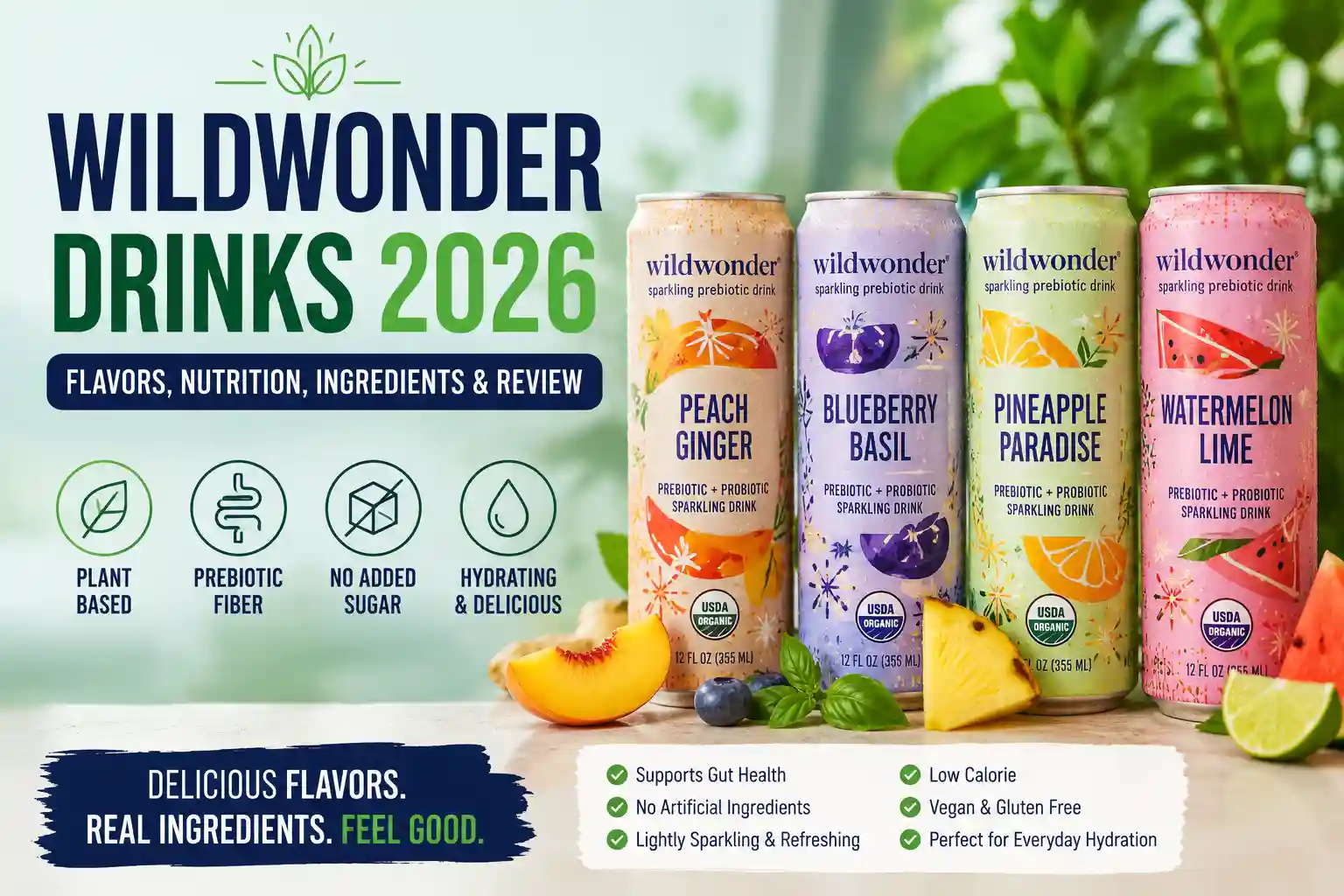
If you have seen the colorful cans of Wildwonder drinks at Target, Whole Foods, Sprouts, or online, you may be wondering what makes them different from ordinary sparkling water or soda.
Wildwonder is a non-alcoholic sparkling beverage brand combining prebiotic fiber, live probiotics, fruit, and botanical ingredients. Current Wildwonder product information lists 5 grams of dietary fiber, 6 grams of sugar, 40 calories, and 1 billion probiotics per can for its core sparkling drinks.
The interesting part is not simply that Wildwonder is another “better-for-you soda.” Its drinks lean heavily into fruit, herbs, flowers, spices, and Asian-inspired botanicals, which gives them a noticeably different identity from cola-style functional sodas.
This guide covers the current flavors, ingredients, nutrition, probiotics, possible digestive drawbacks, prices, retailers, Shark Tank history, competitors, and the biggest question: Are Wildwonder drinks actually worth buying?
Quick Answer: Are Wildwonder Drinks Worth Trying?
Yes, Wildwonder is worth trying if you want a lightly sweet sparkling drink with both prebiotic fiber and live probiotics. A typical current can provides 40 calories, 6 grams of sugar, 5 grams of fiber, and 1 billion probiotics.
The strongest reason to choose Wildwonder over many competitors is its combination of prebiotics + probiotics and its unusual fruit-and-botanical flavors.
The biggest drawbacks are price and taste preference. Wildwonder is less like conventional soda and more like an upgraded fruit-forward sparkling drink. Independent taste testing has also characterized it as less sweet and more appealing to flavored-seltzer drinkers than people looking for a traditional soda experience.
Wildwonder Drinks at a Glance
| Feature | Wildwonder |
|---|---|
| Drink type | Prebiotic + probiotic sparkling beverage |
| Serving size | 1 can |
| Calories | About 40 |
| Dietary fiber | 5 g |
| Total sugar | 6 g |
| Probiotics | 1 billion |
| Probiotic used | Bacillus subtilis DE111 |
| Common prebiotic sources | Jerusalem artichoke, chicory root/inulin; formulation varies |
| Caffeine | None |
| Sweeteners | Organic agave nectar + monk fruit |
| Vegan | Yes |
| Gluten-free | Yes |
| Organic positioning | USDA Organic products |
| Typical direct price | Around $42 per 12 cans for individual flavors |
| Classic Variety Pack | $44 per 12 cans one-time purchase |
| Best for | Fruit-forward, botanical, less-sweet sparkling-drink fans |
Wildwonder’s official FAQ confirms that its current drinks are caffeine-free, vegan, gluten-free, and sweetened with agave nectar and monk fruit rather than stevia or artificial sweeteners.
What Are Wildwonder Drinks?
Wildwonder is a sparkling beverage company founded by Rosa Li. The brand draws inspiration from herbal tonics Li’s grandmother made in China and combines that heritage with California-style fruit flavors.
Instead of building its beverages around cola, root beer, or cream-soda flavors, Wildwonder commonly pairs fruit with less conventional ingredients such as:
- Rose petals
- Turmeric
- Honeysuckle
- Chrysanthemum
- Shiso leaf
- Sichuan peppercorn
- Juniper
- Yuzu
- Passion fruit
- Lychee
That approach explains why Wildwonder tastes different from brands that are trying to imitate traditional soda.
Wildwonder also positions itself between several beverage categories. It is not kombucha, it is not plain sparkling water, and it is not a standard soft drink.
Its basic formula is closer to:
sparkling water + fruit + botanicals + prebiotic fiber + probiotics + light sweetening.
Wildwonder Nutrition Facts
Nutrition is one of the main reasons people search for Wildwonder.
Current nutrition information for products including Apple Yuzu, Pink Pomelo Limeade, Cherry Lemonade, and Guava Rose shows a similar basic profile per can:
| Nutrient | Amount Per Can |
|---|---|
| Calories | 40 |
| Total fat | 0 g |
| Sodium | 0 mg |
| Total carbohydrates | 12 g |
| Dietary fiber | 5 g |
| Total sugars | 6 g |
| Protein | 0 g |
How significant is 5 grams of fiber?
The FDA Daily Value for dietary fiber is 28 grams per day on a 2,000-calorie reference diet. That means 5 grams is a meaningful contribution, although one beverage should not replace fiber-rich foods such as beans, whole grains, fruits, vegetables, nuts, and seeds.
Is Wildwonder low in sugar?
Six grams of total sugar is relatively modest for a sweet sparkling beverage, especially compared with many conventional sodas.
However, “low sugar” does not mean sugar-free.
Wildwonder says its sugar comes from fruit and organic agave nectar, while monk fruit is also used for sweetness.
If you monitor carbohydrate or sugar intake for a medical reason, use the Nutrition Facts label on the specific flavor rather than relying on marketing language.
What Ingredients Are in Wildwonder?
There is no single ingredient list for every Wildwonder flavor. The fruit, herbs, spices, and even parts of the fiber blend can vary.
A good example is Mango Gold, which currently lists:
- Fresh-brewed turmeric
- Mango puree
- Passion fruit juice
- Agave nectar
- Jerusalem artichoke
- Chicory root
- Mango flavor
- Monk fruit extract
- Bacillus subtilis DE111
- Black pepper
The newer Apple Yuzu formula includes:
- Shiso leaf herbal tea
- Honeycrisp apple juice
- Agave nectar
- Cassava root fiber
- Jerusalem artichoke inulin
- Lemon juice
- Yuzu juice
- Yuzu extract
- Monk fruit
- Bacillus subtilis DE111
Prebiotic fiber
Many Wildwonder flavors use Jerusalem artichoke and chicory-root-derived fiber or inulin.
Prebiotics are substances that can be used by microorganisms in the gut. They are different from probiotics because they are essentially the substrate rather than the live organism.
Live probiotics
Current Wildwonder labels identify Bacillus subtilis DE111.
That specificity is useful. With probiotic products, the particular microorganism matters because benefits demonstrated for one probiotic cannot automatically be assumed for every other probiotic.
The NIH’s National Center for Complementary and Integrative Health notes that probiotic products contain different organisms and that their effects may vary by product and person. Strong evidence for many broad probiotic claims is still limited.
Sweeteners
Wildwonder uses organic agave nectar and monk fruit and says it does not use stevia, high-fructose corn syrup, erythritol, or artificial sweeteners in its sparkling drinks.
That may appeal to people who dislike the aftertaste of stevia or certain sugar alcohols.
Prebiotics vs Probiotics in Wildwonder
These terms are constantly grouped together, but they are not interchangeable.
What are prebiotics?
Prebiotics are compounds, often certain types of fiber, that are used by microorganisms in the gut.
Wildwonder’s 5 grams of fiber are therefore doing more than adding bulk to the Nutrition Facts panel.
What are probiotics?
Probiotics are live microorganisms that may provide a health benefit when consumed in adequate amounts.
Wildwonder currently identifies its organism as Bacillus subtilis DE111 and advertises 1 billion probiotics per can.
Does combining both automatically make Wildwonder healthier?
No.
It makes the formulation interesting, but it does not turn Wildwonder into a medical treatment.
NIH guidance emphasizes that research on probiotics is highly product- and condition-specific, and the FDA has not approved broad health claims for probiotics.
That is an important distinction when evaluating phrases such as “gut healthy.”
Wildwonder can provide fiber and probiotics, but no canned beverage should be treated as a cure for digestive problems.
Are Wildwonder Drinks Healthy?
The most accurate answer is: Wildwonder can fit into a healthy diet, but “healthy” depends on what you are comparing it with and what the rest of your diet looks like.
Reasons Wildwonder may be a useful choice
A typical can provides:
- 40 calories
- 6 g sugar
- 5 g dietary fiber
- 1 billion probiotics
- No caffeine
- No alcohol
- No artificial sweeteners according to the manufacturer
- Fruit and botanical ingredients
If you normally drink a high-sugar soda, Wildwonder may offer a lower-sugar alternative while adding fiber.
Why you should not overstate the benefits
A beverage cannot compensate for a diet that is consistently low in whole foods and fiber.
Dietitians discussing probiotic sodas in 2026 have similarly emphasized that overall dietary fiber, plant variety, movement, sleep, and other lifestyle habits matter more to long-term gut health than any single functional soda.
For that reason, a sensible way to look at Wildwonder is:
a flavorful sparkling drink with functional ingredients—not medicine in a can.
Wildwonder Flavors in 2026
Wildwonder’s current online collection lists nine individual sparkling-drink flavors as of August 14, 2026.
They are:
- Apple Yuzu
- Blackberry Violet
- Pink Pomelo Limeade
- Cherry Lemonade
- Raspberry Lychee
- Strawberry Passion
- Guava Rose
- Pineapple Paradise
- Mango Gold
The older Classic Variety Pack contains six of the brand’s original core flavors: Raspberry Lychee, Pineapple Paradise, Strawberry Passion, Mango Gold, Guava Rose, and Cherry Lemonade.
Wildwonder flavor comparison
| Flavor | General Flavor Profile | Best For |
|---|---|---|
| Apple Yuzu | Crisp apple, aromatic citrus, herbal shiso | Bright citrus fans |
| Blackberry Violet | Dark berry, floral violet, lime, juniper | Berry + botanical drinkers |
| Pink Pomelo Limeade | Pomelo, grapefruit, lime, chrysanthemum | Tart citrus lovers |
| Cherry Lemonade | Cherry with lemon acidity | Familiar fruit-flavor fans |
| Raspberry Lychee | Raspberry, tropical lychee, honeysuckle | Fruity-floral beginners |
| Strawberry Passion | Strawberry with tropical passion fruit | Sweet-fruit fans |
| Guava Rose | Tropical guava with noticeable rose | Floral flavor lovers |
| Pineapple Paradise | Pineapple, lime, tangerine, spice | Tropical citrus fans |
| Mango Gold | Mango, passion fruit, turmeric, pepper | Rich tropical flavors |
The descriptions above are based on the brand’s published formulations and flavor descriptions rather than an undisclosed personal taste test.
Which Wildwonder Flavor Should You Try First?
There is no universally best flavor. Your best starting point depends on what you normally drink.
Best easy starting point: Raspberry Lychee
Raspberry Lychee combines familiar berry flavor with lychee and honeysuckle. Wildwonder describes it as tart, fruity, and floral.
It also received a favorable mention in Bon Appétit’s functional-soda testing, where it was the reviewer’s favorite Wildwonder flavor.
Choose it if you like:
- Berry sparkling water
- Lychee drinks
- Fruity flavors
- Mild floral notes
Best tropical choice: Mango Gold
Mango Gold uses mango, passion fruit, turmeric, and black pepper.
This is a better choice if you want something richer and more tropical rather than berry-forward. Food & Wine has also highlighted Mango Gold for its fruit, turmeric, acidity, and pepper combination.
Best floral choice: Guava Rose
Guava Rose pairs pink guava with brewed rose petals.
The rose is not just a name on the can—it is part of the ingredient profile.
If floral drinks are not your thing, this may be a risky first purchase.
Best bright citrus choice: Apple Yuzu
The newest addition to the lineup is Apple Yuzu, combining Honeycrisp apple, yuzu, lemon, and shiso. Wildwonder’s current product page identifies it as a new flavor.
This is the logical place to start if you prefer crisp citrus over tropical sweetness.
Best tart option: Pink Pomelo Limeade
Pink Pomelo Limeade contains a citrus blend of lime, grapefruit, and pomelo, backed by chrysanthemum.
It should appeal most to people who normally choose tart limeade or grapefruit sparkling drinks.
What Do Wildwonder Drinks Taste Like?
Do not expect Wildwonder to taste exactly like Coke, Sprite, Fanta, or a standard fruit soda.
Its flavor identity is closer to:
sparkling fruit drink + botanical infusion + lightly sweet soda alternative.
Independent tasting coverage has described Wildwonder as lightly sweet and closer to flavored sparkling water than conventional soda, particularly when compared with more soda-like functional brands.
Food & Wine’s 2026 dietitian-guided roundup likewise highlighted Wildwonder’s more botanical and complex flavor profile.
You may like Wildwonder if you enjoy:
- Spindrift-style fruit-forward sparkling drinks
- Floral beverages
- Herbal tea
- Kombucha flavors but not strong vinegar notes
- Yuzu, lychee, guava, passion fruit, or pomelo
- Less-sweet beverages
You may not like it if you want:
- A strong cola taste
- Diet-soda-style sweetness
- Heavy syrupy fruit flavor
- Very sweet carbonation
- Completely neutral sparkling water
That distinction matters because many disappointing reviews of functional beverages come from buying the wrong category for your palate.
Wildwonder Side Effects and Digestive Considerations
Wildwonder contains 5 grams of fiber per can, much of it from ingredients such as Jerusalem artichoke or inulin-containing fiber blends.
For many people, that is manageable.
However, fermentable fibers such as inulin can cause gas or bloating in some people, especially when intake increases quickly. Controlled research on chicory-derived inulin has reported flatulence and bloating among the more common gastrointestinal complaints.
A practical way to start
If your normal diet is low in fiber or you know you are sensitive to inulin:
- Start with one can or less rather than several cans.
- Avoid adding multiple high-fiber functional products on the same day.
- Notice how your digestion responds.
- Increase your total fiber intake gradually.
- Drink adequate fluids throughout the day.
Wildwonder itself recommends one to two cans daily, but that is manufacturer guidance, not a universal nutritional requirement.
Who should be more cautious?
Speak with an appropriate healthcare professional before regularly using probiotic products if you:
- Are severely immunocompromised
- Have a serious underlying medical condition
- Are pregnant and have questions about new functional foods
- Are choosing a probiotic beverage for a young child with medical concerns
- Have significant digestive symptoms
- Are managing diabetes and need precise carbohydrate guidance
NIH notes that probiotic safety concerns are more important in people with severe illness or compromised immune systems.
Wildwonder vs Poppi vs Olipop vs Culture Pop
Wildwonder competes in a crowded functional-soda aisle, but these brands are not interchangeable.
| Brand | Main Functional Angle | Fiber | Sugar | Calories | Live Probiotics? | Flavor Style |
|---|---|---|---|---|---|---|
| Wildwonder | Prebiotic + probiotic | 5 g | 6 g | 40 | Yes | Fruit + botanicals |
| Poppi | Prebiotic soda | 3 g in current examples | 5 g | ~30–35 | No advertised live probiotic | Familiar soda + fruit |
| Olipop | High-fiber prebiotic soda | 6–9 g | 2–5 g | 35–50 | Not its main positioning | Classic soda flavors |
| Culture Pop | Probiotic soda | Not centered on added prebiotic fiber | Varies | 45–50 | Yes | Fruit + herbs/spices |
Wildwonder data reflects current product pages. Poppi’s current individual labels commonly show 3 grams of dietary fiber and 5 grams of total sugar, while Olipop’s February 2026 nutrition guide lists 6–9 grams fiber, 2–5 grams sugar, and 35–50 calories, depending on the product line and flavor. Culture Pop says its current 12-ounce cans contain 45–50 calories and billions of CFUs of live probiotics at canning.
Wildwonder vs Poppi
Choose Wildwonder if you specifically want:
- Live probiotics
- More fiber per can in the compared formulas
- Botanical flavors
- No stevia, according to Wildwonder
- Less traditional soda flavor
Choose Poppi if you want something closer to mainstream soda flavors and a lighter fiber dose.
Current Poppi formulations use ingredients such as cassava-root fiber, agave inulin, apple cider vinegar, cane sugar, and stevia, depending on flavor.
Wildwonder vs Olipop
Olipop wins on fiber quantity in many current flavors, with its two lines offering roughly 6 or 9 grams per can.
Wildwonder’s differentiator is the combination of prebiotic fiber and live probiotics.
Flavor is another major difference. Olipop emphasizes nostalgic options such as cola, root beer, cream soda, grape, and other classic soda profiles. Wildwonder leans toward guava, rose, lychee, turmeric, yuzu, and similar combinations.
Wildwonder vs Culture Pop
This is the closest comparison if live probiotics matter to you.
Both brands use fruit and botanicals rather than simply mimicking cola.
Culture Pop currently says its drinks are made with organic fruit juices, herbs or spices, and live probiotics, with no stevia or refined sugar.
Wildwonder’s clearest difference is its 5 grams of added prebiotic fiber alongside the probiotic culture.
How Much Do Wildwonder Drinks Cost in 2026?
Wildwonder is a premium beverage.
As of August 14, 2026, Wildwonder’s website lists most individual 12-can flavor cases at $42 one time, or $35.70 through Subscribe & Save.
That works out to approximately:
- $3.50 per can at the $42 one-time price
- $2.98 per can at the $35.70 subscription price
The Classic Variety Pack is currently listed at $44 for 12 cans as a one-time purchase and $37.40 through Subscribe & Save.
Current Wildwonder price snapshot
| Purchase Option | Price Checked Aug. 14, 2026 | Approx. Cost Per Can |
|---|---|---|
| Individual flavor, 12 cans | $42.00 | $3.50 |
| Individual subscription | $35.70 | $2.98 |
| Classic Variety Pack, 12 | $44.00 | $3.67 |
| Classic subscription | $37.40 | $3.12 |
| Target single can, selected flavors | $2.99 sale / $3.49 regular | Same |
Target was listing selected 12-ounce flavors such as Cherry Lemonade and Mango Gold at $2.99 sale price, normally $3.49, when checked. Retail pricing and promotions can change by store and date.
Is Wildwonder expensive?
Yes.
At more than $3 per can in many purchasing situations, it costs substantially more than ordinary canned sparkling water and many mainstream soft drinks.
That price is probably Wildwonder’s biggest weakness.
If you are uncertain about the botanical flavor profile, buying a single refrigerated can locally makes more sense than committing to a full case.
Where Can You Buy Wildwonder Drinks?
Wildwonder sells its full range through its own website and says individual cans are also available through retailers including:
- Whole Foods Market
- Target
- Sprouts
- Amazon for selected products
- Additional regional retailers
Because inventory varies by location, the best buying strategy is simple.
For first-time buyers
Buy one or two individual cans in a store.
You can test a floral flavor and a fruitier flavor without spending $40+ on a case.
For people who already know their favorite flavor
Direct 12-packs are more practical, particularly if subscription pricing makes sense for your household.
For variety seekers
Choose the Classic Variety Pack or another current variety option.
Wildwonder currently offers several assortment formats rather than a single mixed case.
Wildwonder on Shark Tank: What Actually Happened?
Wildwonder appeared on Season 14 of Shark Tank in an episode that aired on January 13, 2023.
Founder Rosa Li entered seeking $500,000 for 5% of the company.
Guest Shark and DoorDash co-founder Tony Xu eventually agreed on air to invest $500,000 after negotiations over equity and advisory shares.
That is the simple TV version.
There is an important later development.
A February 13, 2025 San Francisco Business Times profile was titled Saying no to Shark Tank was a gamechanger for this CEO and reported Li discussing the decision not to proceed with the Shark Tank arrangement in the usual post-show manner.
So the most precise way to describe the story is:
Wildwonder reached an on-air deal on Shark Tank, but later reporting indicates that the television agreement did not become the straightforward final investment many recap articles imply.
Wildwonder still actively uses its Shark Tank appearance in its marketing and currently sells a Shark Tank Variety Pack.
Wildwonder Pros and Cons
Pros
- 5 grams of dietary fiber per can
- 1 billion live probiotics
- Both prebiotics and probiotics
- Only 6 grams of sugar in current core formulas
- Approximately 40 calories
- Caffeine-free
- Vegan
- Gluten-free
- Distinct fruit-and-botanical combinations
- No stevia or artificial sweeteners according to the brand
- Single cans available at major retailers
- More interesting flavor profiles than many standard sodas
Cons
- Expensive, especially by the case
- Inulin and other added fibers can bother sensitive stomachs
- Botanical flavors will not suit everyone
- Guava Rose and other floral varieties may taste unusual to traditional soda drinkers
- Less soda-like than Poppi or Olipop
- Probiotic marketing should not be confused with guaranteed health outcomes
- Refrigeration is recommended for longer storage and maintaining product quality
Wildwonder says its product has a shelf life of up to one year refrigerated, can be at room temperature for up to two weeks, and should be refrigerated soon after delivery.
Is Wildwonder Worth the Price?
For the right buyer, yes.
Wildwonder offers something genuinely different from an ordinary sparkling water: 5 grams of fiber, live probiotics, fruit juice, herbal ingredients, unusual flavors, and a relatively low sugar load.
It is easier to justify if you already spend money on premium kombucha, functional soda, bottled tea, or specialty sparkling beverages.
It becomes harder to justify if your main goal is simply hydration or carbonation. Plain sparkling water will cost far less.
Wildwonder is most worth it for:
- People replacing a sweeter soda
- Fans of complex fruit flavors
- People who dislike stevia
- Consumers specifically looking for a prebiotic + probiotic combination
- Lychee, yuzu, guava, rose, mango, or botanical-drink fans
- People who already buy premium functional beverages
Wildwonder is probably not worth it for:
- Budget-focused shoppers
- People expecting classic soda sweetness
- Anyone who dislikes floral or herbal flavors
- People who react poorly to added inulin
- Anyone buying it solely because they expect major health changes
Buy Wildwonder because you like the drink first. Treat the fiber and probiotics as added features, not a reason to force yourself to drink something you do not enjoy.
How to Serve and Store Wildwonder
Wildwonder is straightforward to serve, but a few small details improve it.
Serve it cold
The drinks are generally most appealing well chilled. The cold temperature keeps the carbonation crisp and tones down some of the more aromatic botanical notes.
Pour it over ice
This is useful with stronger flavors such as Guava Rose, Mango Gold, or Blackberry Violet.
A large ice cube can slightly soften the flavor as it melts.
Try simple garnishes
Match the garnish to the flavor instead of turning the drink into an elaborate recipe.
Apple Yuzu
Use:
- Thin apple slice
- Lemon peel
- Yuzu peel if available
Raspberry Lychee
Use:
- Fresh raspberries
- Lychee
- Lemon wheel
Pineapple Paradise
Use:
- Pineapple wedge
- Lime
- Orange peel
Guava Rose
Use:
- Guava slice
- Lemon
- A small edible rose garnish
Refrigerate after delivery
The company recommends refrigeration for maintaining flavor and probiotic potency over longer storage.
You may also notice natural sediment because the beverages contain fruit and botanical ingredients. Wildwonder recommends gently swirling the can rather than aggressively shaking it.
Frequently Asked Questions About Wildwonder Drinks
Are Wildwonder drinks actually good for you?
Wildwonder can fit into a balanced diet and provides 5 grams of fiber plus live probiotics in a relatively low-calorie sparkling beverage.
However, probiotic research is strain- and condition-specific. Wildwonder should not be viewed as a treatment for digestive disease or a replacement for fiber-rich whole foods.
How much sugar is in Wildwonder?
Current core Wildwonder sparkling drinks generally list 6 grams of total sugar per can.
The company says sweetness comes from fruit, organic agave nectar, and monk fruit.
How much fiber is in a Wildwonder drink?
A current can provides 5 grams of dietary fiber.
For context, the FDA Daily Value for dietary fiber is 28 grams.
What probiotic does Wildwonder use?
Current ingredient labels identify Bacillus subtilis DE111.
Wildwonder lists 1 billion probiotics per can on its product pages.
Does Wildwonder have caffeine?
No. Wildwonder says its sparkling drinks are naturally caffeine-free.
That makes them easier to use as an afternoon or evening soda alternative than caffeinated cola-style products.
Is Wildwonder alcoholic?
No. Wildwonder’s standard sparkling beverages are non-alcoholic.
The company also describes the drinks as alcohol-free in guidance related to pregnancy, although anyone pregnant or breastfeeding should discuss new functional products with their healthcare professional when appropriate.
Can you drink Wildwonder every day?
Wildwonder markets its beverage for daily use and recommends starting with one to two cans per day.
That does not mean everyone needs that amount. If you are sensitive to fermentable fibers or already consume several fortified products, a smaller intake may be more comfortable.
Can Wildwonder cause bloating?
It can in some people.
Ingredients such as chicory-derived inulin can increase fermentation in the gut and may cause gas or bloating, particularly in sensitive individuals or when fiber intake increases quickly.
Is Wildwonder better than Poppi?
Neither is automatically better.
Wildwonder provides both prebiotic fiber and live probiotics and has more botanical flavors. Current Poppi formulas generally contain less fiber but taste closer to familiar soda and fruit-soda profiles.
Choose based on taste, ingredient preferences, digestive tolerance, and price.
Is Wildwonder better than Olipop?
If fiber quantity is the priority, Olipop typically provides more, with current formulas ranging from about 6 to 9 grams per can.
If you specifically want a beverage containing both prebiotic fiber and live probiotics, Wildwonder has the clearer advantage.
What is the best Wildwonder flavor?
For a first purchase, Raspberry Lychee is one of the safest options if you enjoy berries and lightly floral flavors. It has also been singled out positively in independent taste testing.
Choose Mango Gold for tropical flavor, Pink Pomelo Limeade for tart citrus, Guava Rose for floral notes, and Apple Yuzu for a bright apple-citrus profile.
Where can I buy Wildwonder drinks?
Wildwonder sells directly online and says individual cans are available at retailers including Whole Foods, Target, and Sprouts, with select products also sold through Amazon.
Availability depends on your location.
Does Wildwonder need refrigeration?
For long-term storage, the company recommends refrigeration.
Wildwonder says the drinks can remain at room temperature for up to two weeks but recommends putting them in the refrigerator soon after arrival to maintain quality and probiotic potency.
Final Verdict: Should You Buy Wildwonder Drinks?
Wildwonder drinks stand out because they do not simply copy traditional soda. The combination of 5 grams of dietary fiber, 1 billion probiotics, 6 grams of sugar, fruit, and botanicals gives the brand a distinctive place in the rapidly growing functional-beverage category.
The flavors are the real differentiator. Raspberry Lychee, Guava Rose, Mango Gold, Pineapple Paradise, Pink Pomelo Limeade, Blackberry Violet, and Apple Yuzu offer combinations you rarely see in conventional canned soda. The current lineup has also continued expanding in 2026.
The trade-off is price. Spending roughly $3 to $3.50 or more per can makes Wildwonder a premium purchase rather than an everyday budget drink for many households.
For first-time buyers, the best move is simple: buy one cold can locally before ordering a full case. Start with Raspberry Lychee for fruity-floral flavor, Mango Gold for tropical depth, or Apple Yuzu for something crisp and citrus-forward.
And keep the health claims in perspective. Wildwonder can contribute fiber and probiotics, but the best reason to drink it is still the simplest one: you enjoy the taste and it fits comfortably into your overall diet.