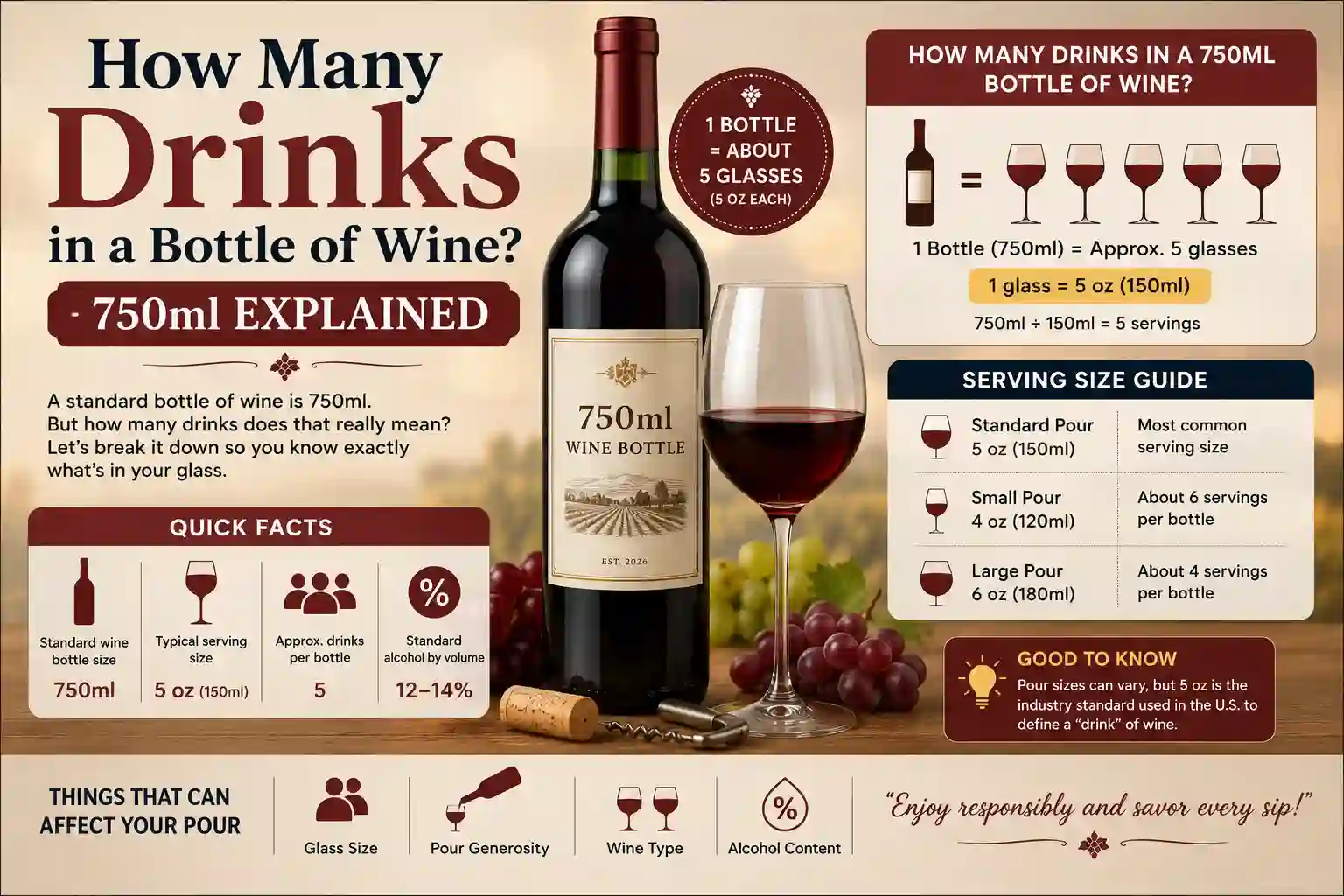
A standard 750ml bottle of wine usually pours about five 5-ounce glasses. But that does not always mean the bottle contains exactly five U.S. standard drinks.
The difference comes down to alcohol by volume (ABV). A 750ml bottle at 12% ABV contains about five standard drinks. At 14% ABV, the same bottle holds nearly six.
That distinction matters when you’re measuring servings, comparing restaurant pours, or planning wine for a gathering.
Last reviewed: August 12, 2026
Editorial accuracy note: This guide uses the U.S. standard-drink definition from the National Institute on Alcohol Abuse and Alcoholism. Calculations are based on bottle volume and labeled ABV. A U.S. standard drink contains 14 grams, or about 0.6 fluid ounces, of pure alcohol.
Quick Answer: How Many Drinks Are in a Bottle of Wine?
For a typical 750ml bottle of 12% wine, the simple answer is:
• Bottle volume: 750ml, or about 25.4 fluid ounces
• 5-ounce pours: about 5 glasses
• U.S. standard drinks at 12% ABV: about 5
• U.S. standard drinks at 14% ABV: nearly 6
• 4-ounce pours: about 6 full glasses
• 6-ounce pours: about 4 full glasses
The important takeaway is simple: glass count and standard-drink count are not always the same thing.
NIAAA specifically identifies a regular 750ml bottle of 12% table wine as about five standard drinks.
How Many Glasses Are in a 750ml Bottle of Wine?
A standard wine bottle contains 750 milliliters, equal to about 25.4 U.S. fluid ounces. Divide that volume by your pour size to estimate the number of glasses.
With a 5-ounce pour, you get just over five serving equivalents. In normal use, that means five full glasses with a small amount remaining. Current wine guides from Wine Folly and Coravin also use roughly five 5-ounce servings as the standard reference.
Wine Bottle Yield by Pour Size
| Pour Size | Approximate Yield From 750ml | Best Used For |
|---|---|---|
| 2 oz | 12.7 serving equivalents | Wine tastings |
| 3 oz | 8.5 serving equivalents | Small tasting pours |
| 4 oz | 6.3 serving equivalents | Modest pours |
| 5 oz | 5.1 serving equivalents | Standard reference |
| 6 oz | 4.2 serving equivalents | Generous restaurant-style pour |
| 8 oz | 3.2 serving equivalents | Very large pour |
| 9 oz | 2.8 serving equivalents | Large restaurant option |
A large wine glass can hold far more than one serving. Glass capacity should never be confused with pour size.
Five Glasses Does Not Always Mean Five Standard Drinks
This is the most important point to understand.
A glass of wine describes how much liquid was poured. A standard drink describes how much pure alcohol that serving contains.
In the United States, one standard drink contains approximately 0.6 fluid ounces or 14 grams of pure alcohol. NIAAA uses 5 ounces of wine at 12% ABV as one common example.
Consider two 750ml bottles:
| Wine | Five-Ounce Glasses | Approx. U.S. Standard Drinks |
|---|---|---|
| 12% ABV | About 5 | 5.1 |
| 14% ABV | About 5 | 5.9 |
Both bottles contain the same amount of liquid.
The 14% bottle contains more alcohol, even though both can still be poured into five similar glasses. NIAAA specifically notes that a 750ml bottle at 14% contains nearly six standard drinks.
How to Calculate Standard Drinks in Any Bottle of Wine
You do not need to memorize every wine strength. Once you know the bottle volume and ABV, you can calculate the approximate alcohol content yourself.
For a regular 750ml bottle, use this simple formula:
25.4 × ABV as a decimal ÷ 0.6 = approximate U.S. standard drinks
The calculation uses approximately 25.4 fluid ounces in 750ml and the U.S. definition of 0.6 fluid ounces of pure alcohol per standard drink.
Example: 12% Wine
25.4 × 0.12 ÷ 0.6 = 5.08
That bottle contains about 5.1 standard drinks.
Example: 13.5% Wine
25.4 × 0.135 ÷ 0.6 = 5.72
That bottle contains about 5.7 standard drinks.
Example: 14% Wine
25.4 × 0.14 ÷ 0.6 = 5.93
That bottle contains about 5.9 standard drinks.
Example: 15% Wine
25.4 × 0.15 ÷ 0.6 = 6.35
That bottle contains about 6.3 standard drinks.
NIAAA also provides a drink-size calculator based on container volume and labeled alcohol content.
How Many Standard Drinks Are in Wine by ABV?
The label’s ABV percentage provides more useful information than the wine’s color.
A light white wine and a strong red can occupy identical 750ml bottles while containing noticeably different amounts of alcohol.
| Wine ABV | Standard Drinks in 750ml |
|---|---|
| 8% | About 3.4 |
| 9% | About 3.8 |
| 10% | About 4.2 |
| 11% | About 4.6 |
| 12% | About 5.1 |
| 12.5% | About 5.3 |
| 13% | About 5.5 |
| 13.5% | About 5.7 |
| 14% | About 5.9 |
| 14.5% | About 6.1 |
| 15% | About 6.3 |
| 16% | About 6.8 |
| 18% | About 7.6 |
| 20% | About 8.5 |
These figures show why saying “one bottle equals five drinks” can be incomplete.
A better rule is:
Five 5-ounce glasses is a volume estimate. Five standard drinks assumes wine near 12% ABV.
Does Red, White, or Rosé Change the Number of Drinks?
Not by itself.
A 750ml red, white, or rosé bottle contains the same liquid volume. If each is poured into 5-ounce servings, all three provide roughly five glasses.
What can change is the ABV.
For example, a lighter wine at 10% ABV contains about 4.2 standard drinks per 750ml bottle. A wine at 15% contains about 6.3.
That makes the bottle label more useful than broad assumptions about color or style.
When accuracy matters, check:
• Bottle volume
• ABV percentage
• Actual pour size
Those three numbers tell you much more than whether the wine is red or white.
What Does a 5-Ounce Wine Pour Actually Look Like?
A 5-ounce pour can look small inside a large wine glass. Modern stemware often leaves plenty of empty space so aromas can collect and the wine can be swirled.
That visual effect makes estimating by eye unreliable. Food & Wine notes that glass shape and capacity can influence how much wine appears to be in the glass.
The easiest home test takes less than a minute:
- Measure 5 fluid ounces of water in a liquid measuring cup.
- Pour it into your usual wine glass.
- Notice where the liquid reaches.
- Remember that level when serving wine.
Do not use the widest point or halfway mark of the bowl as a universal measurement. Wine glasses vary too much.
Useful Visual Reference
A proper infographic for this article should show the same wine glass filled with 4, 5, 6, and 8 ounces.
That makes the difference immediately clear:
• 4 oz: modest serving
• 5 oz: standard U.S. reference for 12% wine
• 6 oz: 20% more wine than a 5-ounce pour
• 8 oz: 60% more wine than a 5-ounce pour
How Many Standard Drinks Are in a 6-Ounce Glass of Wine?
A 6-ounce glass is not automatically one standard drink.
At 12% ABV:
6 × 0.12 ÷ 0.6 = 1.2 standard drinks
At 14% ABV:
6 × 0.14 ÷ 0.6 = 1.4 standard drinks
So a 6-ounce glass of 14% wine contains about 1.4 U.S. standard drinks.
This is one reason counting glasses can underestimate actual alcohol intake.
The difference becomes larger with an oversized pour. A 9-ounce glass of 12% wine contains about 1.8 standard drinks.
Restaurant Wine Pours vs. Standard Wine Servings
Restaurant wine pours do not follow one universal size.
A 2026 Food & Wine discussion with wine professionals found examples around 5, 5.5, and 6 ounces, while some establishments offer larger pours.
This changes both the number of glasses obtained from a bottle and the alcohol in each glass.
Example: 750ml Bottle at a Restaurant
If a restaurant pours 5 ounces, one bottle supplies about five servings.
At 6 ounces, the same bottle provides roughly four full servings.
If that wine is also 14% ABV, each 6-ounce glass contains approximately 1.4 standard drinks.
That is the practical reason to ask about pour size when you need an accurate measurement.
How Many Glasses Are in Different Wine Bottle Sizes?
Not every bottle is 750ml.
Small bottles can reduce leftovers, while magnums and larger formats are useful for celebrations and group service.
| Bottle Size | Equivalent Standard Bottles | Approx. 5-Ounce Servings |
|---|---|---|
| 187.5ml split | ¼ bottle | 1.3 |
| 375ml half bottle | ½ bottle | 2.5 |
| 500ml bottle | ⅔ bottle | 3.4 |
| 750ml standard bottle | 1 bottle | 5.1 |
| 1 liter | 1⅓ bottles | 6.8 |
| 1.5L magnum | 2 bottles | 10.1 |
| 3L double magnum | 4 bottles | 20.3 |
| 6L bottle | 8 bottles | 40.6 |
Large-format wine references likewise identify a 1.5-liter magnum as two standard bottles and roughly ten glasses.
Remember that these are 5-ounce serving equivalents, not alcohol-based standard-drink totals. The latter still depends on ABV.
How Many Drinks Are in a Half Bottle of Wine?
A 375ml half bottle contains approximately 12.7 fluid ounces.
That gives about 2.5 five-ounce serving equivalents. In real use, you can pour two full 5-ounce glasses and still have roughly 2.7 ounces remaining.
The alcohol count is again determined by ABV.
A 375ml bottle of 12% wine contains about 2.5 U.S. standard drinks.
Half bottles can be practical when two people want modest servings without opening a full bottle. They can also reduce leftover wine when only a small amount is needed.
How Many Glasses Are in a Magnum of Wine?
A magnum holds 1.5 liters, which equals two regular 750ml bottles.
That produces about 10 five-ounce serving equivalents.
For an event, the easiest way to think about a magnum is:
1 magnum = 2 standard bottles = about 10 five-ounce glasses
If the wine is 12% ABV, the magnum contains roughly 10 U.S. standard drinks.
Higher ABV increases that alcohol total even though the bottle’s physical serving capacity stays unchanged.
How Many Glasses Are in Champagne or Sparkling Wine?
A standard bottle of Champagne, Prosecco, Cava, or other sparkling wine is usually 750ml, so its physical volume matches a standard still-wine bottle.
The number of glasses depends on the pour.
Using 5 ounces, expect about five serving equivalents.
For a smaller toast-sized pour, one bottle can stretch further. This is why a bottle may provide about six glasses during a Champagne toast but only five larger servings.
Do not assume sparkling wine contains less alcohol merely because the glass is smaller. Check its labeled ABV when calculating standard drinks.
How Many Servings Are in Dessert or Fortified Wine?
Dessert and fortified wines need extra care because they can use smaller serving sizes and higher ABVs.
Port, for example, can reach around 20% ABV, substantially stronger than typical table wine. Wine Folly notes that fortified styles such as Port can approach this range.
At 20% ABV:
3 ounces × 0.20 ÷ 0.6 = 1 standard drink
So a 3-ounce serving of 20% fortified wine is approximately one U.S. standard drink.
A 750ml bottle poured into 3-ounce servings can produce roughly eight full servings. That does not make it an eight-glass table wine; the smaller pour reflects its higher strength and traditional serving style.
Always check the bottle rather than assuming all sweet wines have the same alcohol content.
How Many Bottles of Wine Do You Need for a Party?
Start with the number of legal-age guests who actually plan to drink wine, not the total guest count.
Then decide how many measured servings you need available. This is an inventory calculation, not a recommendation for how much anyone should drink.
At five 5-ounce servings per bottle:
| Wine Drinkers | One 5-oz Serving Each | Two 5-oz Servings Each |
|---|---|---|
| 10 | 2 bottles | 4 bottles |
| 15 | 3 bottles | 6 bottles |
| 20 | 4 bottles | 8 bottles |
| 25 | 5 bottles | 10 bottles |
| 30 | 6 bottles | 12 bottles |
| 40 | 8 bottles | 16 bottles |
| 50 | 10 bottles | 20 bottles |
A Better Way to Plan
Adjust those quantities according to the event.
• Champagne toast: Smaller pours may stretch each bottle beyond five glasses.
• Dinner: Five-ounce serving calculations are easy to manage.
• Wine tasting: Samples should be much smaller than full servings.
• Cocktail party: Some guests may choose beer, cocktails, or no alcohol.
• Brunch: Alcohol-free sparkling drinks can share the beverage table.
• Wedding: Base wine quantities on actual service plans, not total attendance.
Always provide water and attractive non-alcoholic choices. NHTSA specifically recommends alcohol-free beverages for guests and designated drivers when hosting events.
How Many Wine Tasting Pours Are in One Bottle?
Wine tastings usually use much smaller pours because guests may sample several bottles.
You do not need eight different tasting measurements to plan effectively. Three common examples cover most situations.
| Tasting Pour | Approx. Samples From 750ml |
|---|---|
| 1.5 oz | About 16 |
| 2 oz | About 12 |
| 3 oz | About 8 |
Remember that several samples can add up to one or more standard drinks.
For example, three 2-ounce samples of 12% wine equal 6 total ounces. That is approximately 1.2 standard drinks.
For structured tastings, provide water and a way for participants to discard wine they do not wish to consume.
Common Wine Serving Mistakes
Most incorrect bottle calculations come from confusing container size, serving size, and alcohol strength.
Avoid these common mistakes:
• Assuming every wine glass equals one standard drink. Large pours may contain considerably more.
• Ignoring ABV. A 15% wine has more alcohol than a 10% wine at equal volume.
• Using glass capacity as serving size. A large stemmed glass may hold several servings.
• Calling every 750ml bottle “five drinks.” That only works closely for wine around 12% ABV.
• Ignoring restaurant pour size. A 6-ounce serving is 20% larger than a 5-ounce serving.
• Counting guests instead of wine drinkers. Party calculations should reflect actual beverage choices.
• Forgetting non-alcoholic options. Good hosting includes satisfying choices for people who do not drink.
• Using drink count to estimate driving safety. Number of drinks alone cannot determine whether someone can safely drive.
Responsible Wine Serving and Safety
Knowing the number of servings in a bottle is useful for portion awareness and event planning. It should not be used to determine whether someone is safe to drive.
NHTSA states that alcohol progressively reduces the ability to drive safely, with impairment varying by person. The agency recommends arranging sober transportation whenever alcohol is involved.
The 2025–2030 Dietary Guidelines for Americans advise consuming less alcohol for better overall health and identify people who should avoid alcohol completely.
CDC also states that there is no known safe amount of alcohol during pregnancy and no safe time during pregnancy to drink.
For practical serving:
• Check the ABV before calculating standard drinks.
• Measure pours when accurate serving size matters.
• Do not drink and drive. Arrange sober transportation instead.
• Offer water throughout an event.
• Provide alcohol-free drinks for guests who want them.
• Do not serve alcohol to minors.
• Check medication interactions with a doctor or pharmacist when relevant.
• Choose not to drink whenever alcohol is unsuitable for you.
How to Remember the Wine Bottle Math
You only need three numbers for most situations:
750ml = about 25.4 ounces
5 ounces at 12% ABV ≈ 1 U.S. standard drink
750ml at 12% ABV ≈ 5 standard drinks
Then remember the exception:
Higher ABV means more standard drinks, even when the bottle still pours about five glasses.
For example:
• 750ml at 12%: about 5.1 standard drinks
• 750ml at 13.5%: about 5.7 standard drinks
• 750ml at 14%: about 5.9 standard drinks
• 750ml at 15%: about 6.3 standard drinks
If you remember that relationship, most wine-serving questions become simple.
FAQs
How many drinks are in a 750ml bottle of wine?
A standard 750ml bottle of 12% wine contains about five U.S. standard drinks. It also pours about five 5-ounce glasses.
If the wine has a higher ABV, it can contain more than five standard drinks without changing bottle size.
Does a bottle of wine always equal five standard drinks?
No. Five standard drinks is a useful approximation for a 750ml bottle at about 12% ABV.
A 14% bottle contains nearly six standard drinks, while a lower-ABV wine contains fewer.
Is a bottle of wine four glasses or five?
It depends on the pour.
A 750ml bottle provides about five 5-ounce glasses or roughly four full 6-ounce glasses. Smaller servings can produce six or more glasses.
How many standard drinks are in a 13.5% bottle of wine?
A 750ml bottle at 13.5% ABV contains approximately 5.7 U.S. standard drinks.
The calculation is 25.4 ounces × 0.135 ÷ 0.6.
How many standard drinks are in a 14% bottle of wine?
A standard 750ml bottle at 14% ABV contains about 5.9 U.S. standard drinks.
NIAAA similarly describes a 14% 750ml bottle as holding nearly six standard drinks.
Is a 6-ounce glass of wine one drink?
Not necessarily.
A 6-ounce glass at 12% ABV equals about 1.2 standard drinks. At 14% ABV, the same 6-ounce pour equals about 1.4 standard drinks.
How many drinks are in half a bottle of wine?
Half of a standard 750ml bottle is 375ml, or about 12.7 ounces.
At 12% ABV, that amount contains approximately 2.5 U.S. standard drinks.
How many glasses are in a magnum of wine?
A 1.5-liter magnum contains twice as much wine as a 750ml bottle.
It provides approximately 10 five-ounce serving equivalents.
How many glasses are in a bottle of Champagne?
A typical 750ml Champagne bottle contains about five 5-ounce serving equivalents.
Smaller toast pours can produce around six glasses, depending on how much is served.
Can I tell whether I can drive by counting glasses of wine?
No. Glass count is not a reliable measure of driving safety.
Pour size, ABV, timing, individual differences, and other factors matter. NHTSA advises people who have been drinking to arrange a safe ride instead of driving.
Conclusion
So, how many drinks are in a bottle of wine? For a standard 750ml bottle at 12% ABV, the best answer is about five U.S. standard drinks and five 5-ounce glasses.
But five glasses does not automatically mean five standard drinks. Check the bottle’s ABV and measure the pour when accuracy matters. A 14% bottle contains nearly six standard drinks, while larger restaurant pours can contain more than one standard drink per glass.
For everyday planning, remember 750ml + 5-ounce pours = about five glasses. For alcohol content, use volume plus ABV instead of glass count alone.