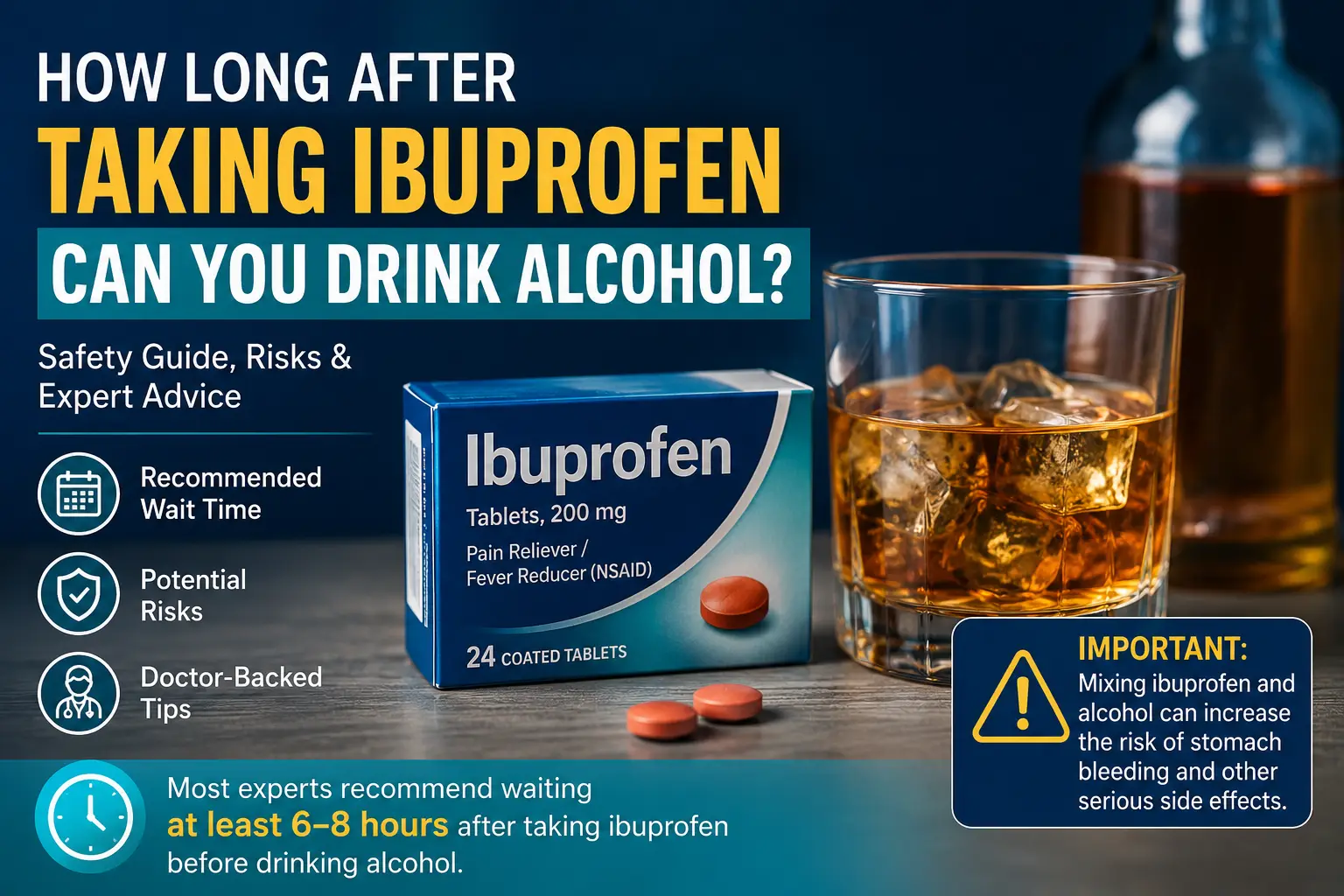
If you took ibuprofen and are wondering when you can safely have a drink, there is no universal number of hours that applies to everyone. The answer depends on your dose, how often you take ibuprofen, how much alcohol you plan to drink, your health, and other medicines you use.
For occasional ibuprofen use, the safest approach is to avoid alcohol while you are taking the medicine, especially if you need repeated doses. If you have a history of ulcers or stomach bleeding, kidney problems, dehydration, or take medicines that increase bleeding risk, alcohol deserves extra caution.
The NHS advises avoiding a lot of alcohol while taking ibuprofen because it can increase side effects.
There is no exact number of hours that can guarantee alcohol is safe after ibuprofen. If you have a medical condition, take other medicines, use high-dose ibuprofen, or plan to drink heavily, speak with a healthcare professional.
There is no official universal waiting period, such as exactly 4, 6, or 10 hours, that guarantees alcohol is safe after ibuprofen.
Ibuprofen leaves the bloodstream relatively quickly, but drug clearance is not the same thing as being free from interaction risk. Alcohol can add to the stomach and bleeding risks associated with NSAIDs such as ibuprofen.
If you took one occasional over-the-counter dose, have no relevant health problems, and are considering a small amount of alcohol later, the risk is different from taking high doses repeatedly and then drinking heavily. There is still no precise hour-based guarantee.
If you can wait until the next day, that is a more conservative choice. If you are taking ibuprofen repeatedly or at higher doses, avoid alcohol and ask a pharmacist or doctor about your specific situation.
- There is no universal 4-, 6-, or 10-hour safety rule.
- Alcohol can increase concerns about stomach irritation and gastrointestinal bleeding.
- Higher or repeated ibuprofen doses require more caution.
- Heavy alcohol consumption creates greater concern than a small amount.
- Ulcers, GI bleeding, kidney disease, dehydration, and interacting medicines increase risk.
- If you can wait until the next day, that is a more conservative choice.
- If you are unsure, ask a pharmacist or doctor about your specific situation.
Why Do Ibuprofen and Alcohol Interact?
Ibuprofen is a nonsteroidal anti-inflammatory drug (NSAID). It works by reducing substances involved in pain, inflammation, and fever.
The problem is that NSAIDs can irritate the digestive tract. In some people, they can contribute to stomach ulcers, gastrointestinal bleeding, or other serious digestive problems. Alcohol can add to that risk, particularly when drinking is heavy or ibuprofen use is prolonged.
The NHS also notes that the risk of serious ibuprofen side effects is higher with higher doses or longer-term use.
The Main Concerns
- Stomach irritation from the combination of alcohol and an NSAID.
- Ulcers or gastrointestinal bleeding, especially in higher-risk people.
- Kidney problems, particularly when dehydration or other risk factors are present.
- Greater concern with high-dose or prolonged ibuprofen use.
- Greater concern when alcohol intake is heavy.
- Additional interaction risks from certain prescription and over-the-counter medicines.
Does Ibuprofen Have a Specific Alcohol Waiting Time?
No. This is where many online articles oversimplify the issue.
You may see advice telling you to wait 4 hours, 6 hours, 10 hours, or 24 hours. These numbers should not be treated as universal medical cutoffs. Official patient guidance focuses on the overall risk of alcohol with ibuprofen rather than declaring one exact number of hours that makes drinking safe.
Ibuprofen does have a relatively short elimination half-life. However, knowing how quickly the drug concentration falls does not tell you that a specific amount of alcohol becomes safe at a specific time.
Think About the Whole Situation
| Situation | More Cautious Approach |
|---|---|
| One occasional OTC dose | Avoid alcohol if possible; a longer gap is more conservative. |
| Several doses during the day | Skip alcohol while using ibuprofen. |
| High-dose ibuprofen | Ask a healthcare professional before drinking. |
| Several days of ibuprofen | Avoid alcohol unless your clinician says otherwise. |
| History of ulcers or GI bleeding | Avoid the combination. |
| Kidney disease or significant dehydration | Avoid the combination and seek professional advice. |
| Blood thinner or other interacting medicine | Check with a pharmacist or doctor. |
| Several alcoholic drinks planned | Avoid combining them with ibuprofen. |
What About 4 Hours After Taking Ibuprofen?
Four hours is sometimes mentioned online because ibuprofen is eliminated relatively quickly. But four hours is not an official “safe to drink” cutoff.
If you took ibuprofen four hours ago, the amount of medication in your body is lower than it was shortly after the dose. That does not mean your stomach, kidneys, or other risk factors suddenly become unaffected.
If drinking can easily be postponed, waiting longer is the more conservative option.
- You took a large dose.
- You have taken several doses recently.
- You have an ulcer or previous GI bleeding.
- You have kidney disease.
- You are dehydrated.
- You take a blood thinner.
- You take aspirin or another NSAID.
- You plan to drink several alcoholic beverages.
What About 6 Hours After Taking Ibuprofen?
Six hours is also sometimes presented as a waiting period, but there is no official rule saying alcohol becomes safe exactly six hours after ibuprofen.
For someone who took one occasional dose, several hours of separation is obviously different from swallowing ibuprofen immediately before drinking. Still, the amount of time is only one part of the picture.
If you are taking ibuprofen regularly, the better question is not “How many hours should I wait?” but “Should I be drinking alcohol while I am using ibuprofen?”
For repeated or high-dose use, avoiding alcohol is the safer approach.
Is 10 Hours After Ibuprofen Safer?
A longer gap generally gives you more separation between the medication dose and alcohol exposure. But 10 hours should not be described as a guaranteed safe drinking deadline.
Some sources use ibuprofen’s relatively short half-life to explain why most of the drug would be eliminated after several half-lives. That is useful pharmacology, but it is not the same as clinical evidence establishing a 10-hour alcohol cutoff.
Your risk can remain higher because of:
- Repeated ibuprofen doses.
- High doses.
- Heavy alcohol consumption.
- A history of ulcers.
- Gastrointestinal bleeding.
- Kidney disease.
- Dehydration.
- Older age.
- Other medicines that affect bleeding or kidney function.
For a person who can simply choose to wait, waiting until the next day is more conservative than relying on a specific hour count.
Does the Ibuprofen Dose Matter?
Yes. Dose and frequency matter.
Taking one occasional 200 mg over-the-counter dose is not the same situation as taking prescription-strength doses repeatedly for several days.
One Occasional Dose
This generally represents less ibuprofen exposure than repeated dosing. Still, alcohol is not automatically risk-free.
Several Doses in One Day
There is more medication exposure, so drinking alcohol becomes a less attractive choice.
High-Dose Ibuprofen
Higher doses are associated with greater risk of adverse effects.
Several Days of Treatment
This is no longer simply a question about the last tablet. Your overall NSAID exposure matters.
Does One Beer or One Glass of Wine Change the Risk?
Yes, the amount of alcohol matters, but one drink does not create a guaranteed safe combination.
NIAAA reports that NSAIDs, including ibuprofen, are associated with gastrointestinal bleeding on their own and that combining them with alcohol can significantly increase that risk.
What Counts as One Standard Drink?
| Drink | Typical U.S. Standard Drink |
|---|---|
| Regular beer | 12 ounces at about 5% alcohol |
| Wine | 5 ounces at about 12% alcohol |
| Distilled spirits | 1.5 ounces of 80-proof spirits |
A large craft beer, strong cocktail, or generous wine pour may contain more than one standard drink.
If You Are Trying to Keep Exposure Lower
- Choose one standard drink rather than several.
- Avoid binge drinking.
- Do not drink on an empty stomach.
- Stay hydrated.
- Do not take additional ibuprofen simply because you plan to drink.
- Stop drinking if you develop significant stomach discomfort.
- Never drive after drinking.
Can You Drink Alcohol the Same Day as Ibuprofen?
There is no universal rule that makes every same-day combination safe or unsafe.
For example, taking one occasional ibuprofen tablet early in the morning and considering one drink much later is a different situation from taking multiple doses throughout the day and planning several drinks that evening.
The dose, frequency, health history, and alcohol amount all matter.
If you need ibuprofen repeatedly throughout the day, it is safer to skip alcohol rather than trying to calculate a precise number of hours between each tablet and each drink.
What If You Take Ibuprofen After Drinking?
The question also works in reverse.
Taking ibuprofen after drinking can still be concerning because alcohol and ibuprofen can both contribute to stomach irritation and bleeding risk. NIAAA notes that alcohol and medications can interact even when they are not taken at exactly the same time.
If you have been drinking heavily, dehydration can also become an issue.
If You Have Already Been Drinking
- Do not assume ibuprofen is automatically appropriate for a hangover.
- Rehydrate with water or an electrolyte drink.
- Eat if you can tolerate food.
- Avoid taking more than the package directs.
- Avoid combining ibuprofen with another NSAID.
- Check other medicines you take for interactions.
- Ask a pharmacist if you are uncertain.
- Seek medical attention for severe symptoms.
Is Ibuprofen a Good Choice for a Hangover?
It can be tempting to reach for ibuprofen when a hangover causes a headache or body aches. But a hangover can involve stomach irritation, dehydration, nausea, and poor food intake, which can make NSAID use less comfortable or appropriate for some people.
Alcohol itself is not a treatment for a hangover. Drinking more alcohol can prolong alcohol exposure and introduce additional risks.
Do not automatically take ibuprofen if you have a history of ulcers, GI bleeding, kidney disease, or another condition that makes NSAIDs unsuitable.
If you regularly need pain medicine after drinking, talk with a healthcare professional about safer options for your situation.
Who Should Be Especially Careful?
Some people have a higher baseline risk from ibuprofen, alcohol, or their combination.
MedlinePlus identifies several factors associated with greater NSAID-related gastrointestinal risk, including older age, poor health, smoking, long-term NSAID use, and drinking large amounts of alcohol.
Extra caution is appropriate if you have:
- A previous stomach ulcer.
- Previous gastrointestinal bleeding.
- Kidney disease.
- Significant dehydration.
- A bleeding disorder.
- Heart or other chronic health conditions.
- A history of serious reactions to NSAIDs.
- Regular high-dose ibuprofen use.
- Frequent or heavy alcohol consumption.
Older adults may also face greater risks from medication-alcohol interactions because they are more likely to use multiple medicines and may respond differently to alcohol and medications.
Which Medicines Can Increase the Risk?
This is an important part of the picture that a simple “wait X hours” rule cannot capture.
MedlinePlus specifically advises patients to tell their doctor if they take anticoagulants, aspirin, other NSAIDs, oral steroids, SSRIs, or SNRIs while using ibuprofen.
Blood Thinners
Medicines such as warfarin can increase bleeding concerns.
Aspirin
Aspirin and ibuprofen are both NSAIDs, and combining NSAIDs can increase side-effect risk.
Naproxen
Naproxen is another NSAID. Do not combine it with ibuprofen unless instructed by a healthcare professional.
Steroids
Some oral corticosteroids can add to gastrointestinal risk.
SSRIs & SNRIs
Certain antidepressants can affect bleeding risk when combined with NSAIDs.
Other Medicines
Some blood-pressure and other prescription medicines may also require caution.
If you take any prescription medicine and regularly drink alcohol, ask a pharmacist to check the full combination rather than checking ibuprofen alone.
Advil, Motrin, and Generic Ibuprofen: Is There a Difference?
For this question, the active ingredient matters.
Advil and Motrin contain ibuprofen, so switching between those brands does not remove the alcohol-related concern.
Generic ibuprofen follows the same basic principles.
The bigger issue is checking the label. Some pain, cold, and flu products contain multiple active ingredients. NIAAA recommends checking medication labels because combination products can contain ingredients that also interact with alcohol.
Before Taking Another Product, Check:
- Active ingredients
- Strength per tablet or dose
- Recommended dosing interval
- Maximum daily amount
- Other pain relievers already taken
- Alcohol-related warnings
What Should You Do If You Accidentally Mix Ibuprofen and Alcohol?
Do not panic. Accidentally having a drink after an occasional ibuprofen dose does not automatically mean you will develop a serious complication.
The sensible response is to stop adding alcohol and avoid taking additional ibuprofen until you understand what you have taken.
If the Combination Already Happened
- Stop drinking alcohol for now.
- Do not take another ibuprofen dose casually.
- Drink water if you can tolerate it.
- Eat something if your stomach feels comfortable.
- Check the labels of other medicines you have taken.
- Monitor for unusual or severe symptoms.
- Contact a pharmacist or healthcare professional if you are worried.
- Seek urgent medical care if serious warning signs develop.
The amount of alcohol and ibuprofen matters, but so do your health conditions and other medicines.
What Symptoms Mean You Should Get Medical Help?
NSAID-related gastrointestinal problems can sometimes occur without obvious warning symptoms. Serious complications can include ulcers and bleeding.
- Vomiting blood
- Vomit that resembles coffee grounds
- Black or tarry stools
- Severe or worsening abdominal pain
- Fainting
- Severe dizziness or weakness
- Trouble breathing
- Blood in the urine
- Significant swelling
- Very little urine or another major change in urination
Do not assume severe symptoms are simply a hangover.
How Can You Lower the Risk?
The simplest strategy is to avoid combining alcohol with ibuprofen, particularly when you need repeated or high-dose treatment.
If you occasionally use ibuprofen, follow the product directions and avoid taking more than recommended. The NHS recommends checking the medicine leaflet and speaking with a pharmacist or doctor when you are unsure about interactions.
Use the Lowest Effective Dose
Use the lowest effective dose for the shortest appropriate period.
Follow Directions
Follow the package directions and do not exceed the recommended amount.
Avoid Other NSAIDs
Do not combine ibuprofen with another NSAID unless instructed.
Avoid Heavy Drinking
Avoid heavy alcohol consumption while taking ibuprofen.
Stay Hydrated
Maintain adequate hydration, particularly when illness or alcohol has caused fluid loss.
Check Interactions
Ask a pharmacist if you take multiple prescription or over-the-counter medicines.
Ibuprofen and Alcohol: The Bottom Line
The most important fact is that there is no universal 4-hour, 6-hour, or 10-hour rule that guarantees alcohol is safe after ibuprofen.
Ibuprofen is an NSAID, and alcohol can increase concerns about stomach irritation, ulcers, and gastrointestinal bleeding. NIAAA specifically identifies ibuprofen and other NSAIDs as medications that can pose greater gastrointestinal bleeding risks when combined with alcohol.
For someone who took one occasional dose, has no relevant health conditions, and is considering a small amount of alcohol, the situation is different from repeated high-dose ibuprofen use followed by heavy drinking.
A precise clock cannot account for every individual risk factor.
If you can wait until the next day, that is the more conservative choice. If you are taking ibuprofen regularly, using a high dose, taking other interacting medicines, or have a stomach, bleeding, or kidney condition, avoid alcohol and ask a healthcare professional for individualized advice.
Frequently Asked Questions
Can I Drink Alcohol 4 Hours After Taking Ibuprofen?
Four hours is not an official safety cutoff. Ibuprofen levels fall over time, but that does not mean alcohol becomes risk-free at exactly four hours.
If you can wait longer, waiting provides a more conservative approach. Your dose, health history, alcohol amount, and other medicines still matter.
Can I Drink Alcohol 6 Hours After Taking Ibuprofen?
Six hours is sometimes suggested online, but there is no universal medical rule declaring six hours safe.
If you are taking repeated or high-dose ibuprofen, the better approach is to avoid alcohol rather than rely on an hour-based calculation.
Is 10 Hours Enough After Ibuprofen?
Ten hours gives more separation than a few hours, but it is not a guaranteed safe drinking deadline.
Ibuprofen’s relatively short half-life explains why several hours can substantially reduce the amount of drug in the bloodstream. It does not eliminate individual risks from alcohol, stomach disease, kidney problems, or other medicines.
Can I Have One Beer After Taking Ibuprofen?
One standard drink exposes you to less alcohol than several drinks, but it does not make the combination risk-free.
If you choose to drink after an occasional dose, keeping the amount small and allowing more time is more conservative than drinking heavily soon after taking ibuprofen.
Can I Take Ibuprofen the Morning After Drinking?
That depends on how much you drank, your current symptoms, your hydration, your health, and other medicines.
After heavy drinking, dehydration and stomach irritation can make ibuprofen a less suitable choice. If you have risk factors for NSAID complications, ask a healthcare professional before taking it.
Is Alcohol Worse With Advil or Motrin Than Generic Ibuprofen?
No major difference exists simply because of the brand name. Advil and Motrin use ibuprofen as their active ingredient, so the same basic alcohol precautions apply.
Always check the label, especially with combination products.
What Is the Safest Choice If I Am Unsure?
Skip the alcohol and ask a pharmacist or doctor.
This is particularly important if you take several medications, use high-dose or repeated ibuprofen, have kidney disease, have had an ulcer or GI bleed, or take medicines that affect bleeding.
Final Takeaway
If you are asking how long can you drink alcohol after taking ibuprofen, do not rely on an internet rule that says exactly four, six, or ten hours. There is no universal waiting period that guarantees safety.
The safest choice is to avoid alcohol while using ibuprofen, especially with repeated or high-dose treatment. If you took one occasional dose and are considering drinking later, the overall situation matters more than the clock.
For personalized advice, a pharmacist can quickly check your ibuprofen dose, other medicines, medical history, and planned alcohol use and tell you whether drinking is appropriate.
- NHS — Ibuprofen for adults: guidance on dosing, alcohol, NSAIDs, and medicine interactions.
- MedlinePlus — Ibuprofen Drug Information: warnings about ulcers, gastrointestinal bleeding, risk factors, and interacting medicines.
- National Institute on Alcohol Abuse and Alcoholism (NIAAA): information on alcohol-medication interactions and NSAID-related gastrointestinal bleeding.
Medical disclaimer: This article is for general educational purposes only and does not replace individualized medical advice, diagnosis, or treatment from a qualified healthcare professional.