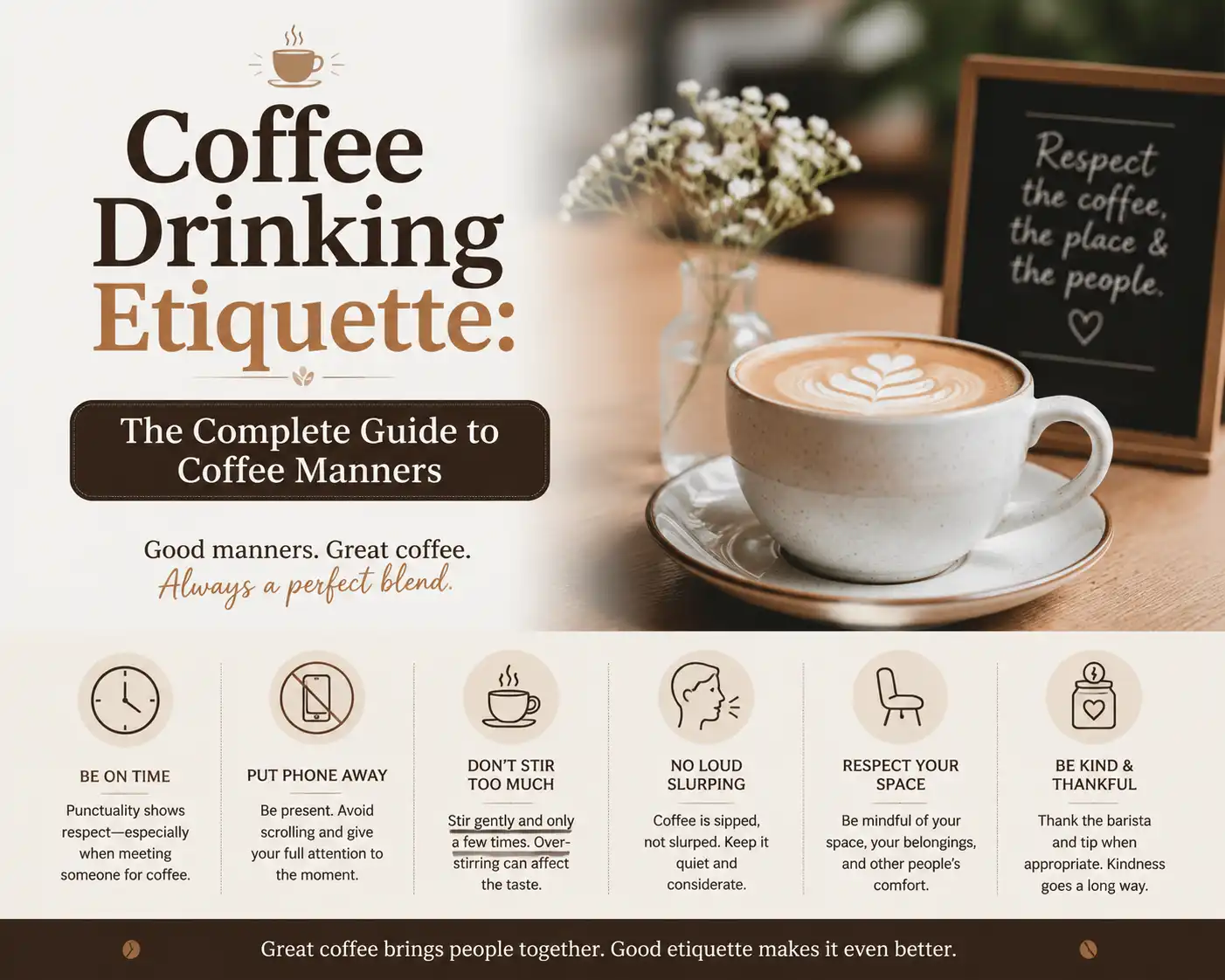
Master modern coffee manners for cafés, business meetings, formal dinners, dates, offices, hosting, tipping, laptops, and international coffee traditions.
Coffee is one of the most casual drinks in American life, but coffee drinking etiquette still matters when you’re sharing a table, meeting a client, hosting guests, or sitting at a formal dinner.
The good news is that coffee manners aren’t about memorizing dozens of stiff rules. They’re mostly about being considerate, handling your cup neatly, respecting shared spaces, and understanding the situation.
This guide covers everyday coffee manners, coffee shop etiquette, business meetings, laptop use, tipping, serving, formal dining, dates, office coffee, and international traditions. You’ll also find practical answers to awkward questions such as who should pay, how long you can stay in a café, whether you should wait to order, and where the spoon goes.
What Is Proper Coffee Drinking Etiquette?
Proper coffee etiquette means drinking neatly, treating people respectfully, keeping shared spaces clean, and adapting to the setting.
In a casual café, that may mean keeping your phone quiet and not taking a large table during a rush. At a formal dinner, it means using the cup, saucer, and spoon properly. At a business meeting, it means arriving prepared, staying focused, and handling payment gracefully.
Coffee drinking etiquette is mostly about being considerate, clean, and aware of your surroundings. Hold your cup naturally, remove the spoon after stirring, keep your phone and audio under control, respect café seating and laptop policies, and clean up after yourself.
For business or social meetings, the person who invited the other person should generally be prepared to pay. At formal meals, use the cup and saucer properly and follow the host’s lead. When traveling, remember that coffee customs vary by culture, so observe local traditions rather than assuming American etiquette applies everywhere.
Coffee Drinking Etiquette at a Glance
| Situation | Best Approach |
|---|---|
| Casual café | Order clearly, keep your area tidy, and respect other customers. |
| Busy coffee shop | Use only the space you need and avoid unnecessary lingering. |
| Laptop work | Follow café rules and keep your setup compact. |
| Business meeting | Arrive on time, stay focused, and be prepared to pay if you invited the guest. |
| Formal dinner | Use the cup and saucer properly and follow the host’s lead. |
| Hosting guests | Ask about preferences before serving. |
| Coffee date | Stay engaged and keep your phone out of the conversation. |
| Office coffee | Clean up, refill shared supplies, and respect labeled items. |
| Takeout | Move away from the pickup area after collecting your drink. |
| International setting | Observe local customs rather than assuming American habits apply. |
The Most Important Coffee Etiquette Rule: Consider the Setting
There isn’t one universal rule for every cup of coffee. A busy chain café, a quiet independent coffee shop, a business meeting, and a formal dinner all have different expectations.
This matters because old-fashioned etiquette advice can sound too rigid for modern coffee culture. A rule that makes sense at a formal dinner may be unnecessary at a neighborhood coffee shop.
☕ Casual Coffee Shop
- Order efficiently.
- Keep your table clean.
- Respect seating limits.
- Use headphones for audio.
- Keep conversations at a reasonable volume.
- Follow posted café policies.
💼 Professional Setting
- Arrive on time.
- Choose a suitable location.
- Keep your phone away.
- Stay on topic.
- Treat staff courteously.
- Handle payment without awkwardness.
🍽️ Formal Meal
- Use the cup and saucer properly.
- Stir quietly.
- Place the spoon correctly.
- Practice neat table manners.
- Follow the host’s lead.
How to Hold a Coffee Cup Properly
For most coffee cups with handles, hold the handle rather than wrapping your entire hand around the cup. This gives you better control and helps protect your hand from heat.
A small cup served with a saucer should be handled more carefully than a large travel mug. You don’t need exaggerated movements or a raised pinky. A relaxed, steady grip is enough.
- Hold the handle with your fingers rather than squeezing the cup itself.
- Keep your thumb on top of the handle for control.
- Use the saucer underneath a small cup when one is provided.
- Lift the cup smoothly instead of dragging it across the table.
- Keep the saucer on the table unless the setting calls for carrying both.
- Don’t grip the rim where another person drinks.
- Use both hands around a large mug only when necessary.
- Be especially careful when carrying very hot coffee.
- Never balance an uncovered hot cup while carrying several items.
- Keep takeaway cups upright to reduce spills.
Should You Stick Out Your Pinky When Drinking Coffee?
No. There is no need to deliberately extend your pinky while drinking coffee.
Keep your hand relaxed and use the cup normally. The exaggerated pinky gesture is more theatrical than proper modern table etiquette.
Coffee Spoon Etiquette: Where Does the Spoon Go?
A coffee spoon is used to stir sugar, milk, or cream, not to drink the coffee.
After stirring, remove the spoon from the cup. If there is a saucer, place the spoon on it rather than leaving it inside the drink.
- Stir gently without striking the sides of the cup.
- Avoid making repeated circular motions that create unnecessary noise.
- Stir sugar and milk until they are incorporated.
- Remove the spoon before taking a sip.
- Place the spoon on the saucer after stirring.
- Don’t leave the spoon standing inside the cup.
- Don’t drink coffee from the spoon.
- Don’t lick the spoon in a formal setting.
- Don’t blow dramatically across the spoon to cool hot coffee.
- Let very hot coffee cool naturally before drinking.
Is It Rude to Leave the Spoon in Your Coffee?
In a formal or traditional setting, yes. Once you’ve finished stirring, remove the spoon and place it on the saucer.
In a casual mug-at-home situation, nobody is likely to care. Etiquette becomes more formal as the setting becomes more formal.
How to Drink Coffee Politely
Coffee is usually a relaxed beverage, so quiet and natural behavior is more important than perfect technique.
Take comfortable sips, keep the cup under control, and avoid behaviors that create unnecessary noise or mess.
- Sip quietly.
- Avoid slurping when you’re around other people.
- Don’t talk while drinking.
- Keep your mouth closed while chewing food.
- Avoid blowing forcefully across a hot drink.
- Don’t make a show of how hot or strong your coffee is.
- Put the cup down before reaching for food.
- Keep your napkin nearby when coffee is served with food.
- Wipe a spill as soon as you notice it.
- Don’t criticize someone else’s coffee choice.
Coffee Shop Ordering Etiquette
Ordering coffee doesn’t need to be complicated, but being prepared helps everyone when the line is busy.
Read the menu before reaching the register when possible. If you need help choosing a drink, ask. Baristas expect questions, especially when a menu has unfamiliar drinks or ingredients.
A Good Coffee-Shop Order
- Drink
- Size
- Temperature or preparation when relevant
- Milk or milk alternative
- Important customization
- Name or order identifier when requested
You don’t need to apologize for having a customized drink. Just give the information clearly.
- Check the menu before reaching the register.
- Ask questions if you don’t understand an ingredient.
- Mention serious allergies before preparation begins.
- State substitutions clearly.
- Avoid changing several parts of your order after payment.
- Step aside after ordering if the shop has a waiting area.
- Don’t block the register while waiting for your drink.
- Check your order without creating a confrontation.
- If there’s a mistake, explain it calmly.
- Thank the employee who helps you.
What If the Café Is Extremely Busy?
Keep the order simple enough to communicate clearly.
If you have a complicated request, that’s fine. The key is not to make the person behind you wait while you decide what you want.
Coffee Shop Seating Etiquette
A coffee shop is a business and a shared public space. Your right to sit somewhere doesn’t automatically mean you should occupy more space than necessary.
This becomes especially important during busy periods.
- Choose the smallest table that comfortably fits your group.
- Don’t use multiple chairs for bags and coats when customers are waiting.
- Keep your belongings close to you.
- Don’t move furniture without permission.
- Follow reserved-seat signs.
- Respect laptop-free areas.
- Follow posted time limits.
- Give up extra space when the café becomes crowded.
- Don’t assume an empty chair belongs to your table.
- Ask before joining someone else’s table.
How Long Can You Stay at a Coffee Shop?
There is no universal time limit.
The right amount of time depends on the café’s policy, how busy it is, how much space you’re using, and whether you’re continuing to purchase.
A quiet café may be comfortable with someone working for a while. A packed café during lunch may need every table for customers who are ordering food and drinks.
If you’re working for several hours and the shop is filling up, consider ordering again, moving to a designated work area, or leaving.
Laptop and Remote-Work Coffee Shop Etiquette
Working from a coffee shop is common, but a café is not automatically your private office.
Before opening your laptop, check the environment. Some coffee shops welcome remote workers. Others restrict laptops during busy hours or designate specific seating areas.
- Check the café’s laptop policy first.
- Use only the table space you need.
- Keep chargers and cables organized.
- Don’t spread papers across neighboring seats.
- Wear headphones for audio.
- Keep video calls quiet.
- Avoid speakerphone.
- Don’t occupy an outlet for hours if others need it.
- Keep your belongings within your own space.
- Be prepared to move if staff ask you to.
- Avoid taking a large communal table alone during peak hours.
- Don’t assume buying one small coffee gives you unlimited workspace.
Is It Rude to Work on a Laptop in a Coffee Shop?
Not automatically. The etiquette depends on the café’s rules and the circumstances.
Working quietly at a permitted table is very different from occupying a large table for four hours during a packed lunch rush.
Coffee Shop Phone and Conversation Etiquette
A coffee shop doesn’t need to be silent, but your phone shouldn’t dominate the room.
Short conversations are normal. Long work calls, speakerphone conversations, and loud videos can quickly affect everyone nearby.
- Put your phone on silent or vibrate.
- Use headphones for videos and music.
- Keep personal calls reasonably quiet.
- Take long calls outside when practical.
- Avoid speakerphone.
- Don’t play social media videos aloud.
- Don’t repeatedly interrupt a conversation to check notifications.
- Keep business calls away from crowded tables when possible.
- Respect customers who are reading or working quietly.
- Don’t assume everyone wants to hear your conversation.
Coffee Tipping Etiquette in the U.S.
Tipping can be confusing because coffee shops use different service models.
A counter-service coffee shop isn’t the same as a full-service café where someone takes your order, brings your food, checks on your table, and clears dishes.
Digital payment screens may also present suggested tips. A prompt is not the same thing as a universal rule.
Consider the Type of Service
| Service Situation | Practical Approach |
|---|---|
| Basic counter service | Tip according to your judgment and local expectations. |
| Table service | A tip is generally expected for good service. |
| Customized or time-intensive order | Consider the extra effort involved. |
| Complimentary coffee | Follow the business’s normal practice. |
| Business meeting | The person who invited the guest should be prepared to pay. |
| Poor service | Consider the circumstances rather than tipping automatically. |
Don’t shame another customer for choosing a different tip.
Tipping etiquette is contextual, and expectations vary between businesses and locations.
Who Should Pay for a Coffee Meeting?
For a professional coffee meeting, the simplest traditional rule is:
This removes the awkward moment when the drinks arrive and neither person knows what to do.
If someone else offers to pay, you can accept graciously. There’s no need for a long argument over a $5 or $6 coffee.
If You Requested the Meeting
- Your coffee
- Your guest’s coffee
- Any reasonable small food item you encouraged them to order
- The tip when appropriate
If You Were Invited
Offer politely if you want to contribute. If the host insists on paying, a simple “Thank you” is enough.
If It’s a Regular Meeting
People can alternate payments or simply pay separately. There’s no reason to create a complicated ritual around repeated coffee meetings.
Business Coffee Meeting Etiquette
A coffee meeting may be casual, but your behavior still communicates professionalism.
Choose a location where conversation is possible. A crowded café with loud music may be fine for a quick introduction but poor for a sensitive client discussion.
Before the Meeting
- Confirm the time and location.
- Arrive a few minutes early.
- Choose a practical meeting place.
- Check whether seating is available.
- Bring whatever information you actually need.
- Put your phone on silent.
When Your Guest Arrives
- Stand or acknowledge them clearly.
- Offer a greeting.
- Ask what they’d like to drink.
- Order together when practical.
- Let the conversation settle before jumping into business.
During the Meeting
- Keep your phone out of sight.
- Listen instead of preparing your next response.
- Avoid talking over the other person.
- Keep the meeting focused.
- Treat café staff respectfully.
- Don’t occupy the table longer than necessary.
When the Meeting Ends
End when the purpose of the meeting has been completed.
You don’t need to keep talking simply because there is coffee left.
What If You Arrive Early for a Business Coffee?
If you’ve arrived first, waiting to order until your guest arrives is often the cleanest option, especially if you’re hosting.
That allows you to ask what they actually want rather than guessing.
If your guest is significantly late, you can order your own drink after confirming they are still coming.
The important thing is to avoid making a simple coffee meeting unnecessarily complicated.
Coffee Etiquette for Job Interviews
A coffee interview is still an interview.
Don’t let the casual setting make you forget that the other person is evaluating your professionalism.
- Arrive early.
- Dress appropriately for the company and role.
- Put your phone away.
- Order something simple.
- Avoid extremely messy food.
- Treat café staff respectfully.
- Keep your voice controlled.
- Listen carefully.
- Don’t stay after the interviewer clearly signals the meeting is over.
- Thank the interviewer before leaving.
A coffee shop can be noisier and less predictable than an office. Prepare for that.
Office Coffee Etiquette
Office coffee creates a different set of manners because the equipment and supplies are often shared.
- Refill the machine when you empty it.
- Clean the counter after making coffee.
- Wipe up spills.
- Wash reusable mugs and dishes.
- Replace supplies when you use the last of them.
- Respect labeled milk and cream.
- Don’t take another employee’s personal drink.
- Keep communal supplies organized.
- Follow office rules for coffee machines.
- Don’t expect someone else to clean up after you.
The Office Coffee Pot Is Empty. What Should You Do?
If you took the last cup, make another pot when that is the office norm.
Walking away from an empty machine and leaving the next person to discover it is one of the easiest coffee manners to fix.
Coffee Etiquette When Hosting Guests
Coffee is a simple form of hospitality. You don’t need a restaurant-style setup to make guests feel welcome.
Start by asking what they actually want.
Some people drink black coffee. Others want milk, cream, sugar, decaf, or no coffee at all.
- Ask guests what they prefer.
- Offer regular and decaf when practical.
- Provide milk or cream separately.
- Offer sweeteners when appropriate.
- Keep water available.
- Serve guests before focusing on yourself.
- Give guests a comfortable place to put their cup.
- Offer a refill without pressuring them.
- Don’t comment negatively on unusual drink preferences.
- Clear used cups when the gathering is finished.
Should You Offer Coffee to Every Guest?
If you’re hosting a gathering where coffee fits the occasion, offering it is courteous.
But don’t assume everyone drinks caffeine. Tea, water, decaf, or another non-caffeinated option can be equally appropriate.
Coffee Table Manners With Food
Coffee often appears alongside breakfast, pastries, dessert, or brunch.
The main rule is to keep the cup, spoon, food, and other tableware organized without reaching across other people.
- Keep your cup in your own place setting.
- Use the saucer when one is provided.
- Place the spoon on the saucer after stirring.
- Don’t reach across another guest.
- Ask someone to pass sugar or cream.
- Put your cup down before using both hands for food.
- Keep napkins available for spills.
- Avoid dipping food into coffee unless the setting is clearly casual.
- Don’t leave a used spoon on the tablecloth.
- Follow the host’s lead in a formal meal.
Formal Dinner Coffee Etiquette
Coffee served after dinner can be more formal than everyday coffee.
Traditional table settings may place the coffee cup and saucer to the upper right of the place setting, while after-dinner coffee may be brought to the table with dessert.
The exact setup varies, so don’t panic if the arrangement looks unfamiliar.
At a Formal Dinner
- Wait for coffee service rather than reaching across the table.
- Use the cup and saucer together when appropriate.
- Stir quietly.
- Remove the spoon from the cup.
- Place the spoon on the saucer.
- Sip naturally.
- Don’t blow aggressively on hot coffee.
- Follow the host if you’re unsure what to do.
When formal etiquette conflicts with the host’s instructions, follow the host.
After-Dinner Coffee Etiquette
After-dinner coffee is often served in a smaller cup than an everyday mug.
You don’t need to finish it quickly. Coffee may be part of the conversation that continues after the meal.
- Wait until coffee is offered.
- Accept or decline without apology.
- Use the smaller cup properly when provided.
- Stir gently.
- Keep the spoon on the saucer.
- Sip rather than gulp.
- Continue conversation naturally.
- Don’t criticize the coffee’s strength.
- Ask for decaf if you prefer to avoid caffeine.
- Thank the host before leaving.
Coffee Etiquette for Dates and Social Meetings
A coffee date should feel relaxed, but basic manners still matter.
The most important thing is attention. Constantly checking your phone can make the other person feel like they’re competing with your notifications.
- Arrive on time.
- Let the other person know if you’re running late.
- Choose a place where you can hear each other.
- Put your phone away.
- Ask questions naturally.
- Don’t interrogate the other person.
- Avoid criticizing their drink choice.
- Offer to pay if you invited them.
- Don’t turn the meeting into a competition over the bill.
- End politely when the conversation is finished.
Coffee Takeout and Drive-Through Etiquette
Takeout coffee has fewer formal rules, but courtesy still matters in crowded pickup areas.
The goal is to keep the line moving and handle hot drinks safely.
- Know your order before reaching the counter.
- Confirm important modifications.
- Move away after collecting your drink.
- Don’t block the pickup area.
- Check the lid before carrying the cup.
- Keep hot drinks upright.
- Dispose of cups properly.
- Don’t leave trash on tables.
- Be patient when the shop is busy.
- Never handle a hot drink carelessly while driving.
Coffee Etiquette at Starbucks, Dunkin’, and Independent Cafés
Not every coffee shop operates the same way.
A large chain may have a predictable ordering system, mobile pickup area, and standardized seating. An independent specialty café may have different expectations around table use, ordering, coffee preparation, or conversation.
Large Coffee Chain
- Mobile-order pickup areas
- Busy morning lines
- Shared tables
- Drive-through traffic
- Limited seating
- Clearly posted store policies
Independent Café
- Smaller tables
- More limited seating
- Specialty preparation
- Barista recommendations
- Different laptop policies
- More personalized service
Never assume that a rule from one café applies to another.
Coffee Etiquette Around the World
Coffee customs are strongly shaped by culture. What seems normal in the United States may be different elsewhere.
Italian Coffee Etiquette
Italian coffee culture often treats espresso as a quick drink rather than a large beverage carried around for hours.
Milk-based drinks such as cappuccino are also associated with particular times and occasions in traditional Italian coffee culture.
When visiting Italy, don’t assume American coffee-shop habits apply.
Turkish Coffee Etiquette
Turkish coffee is prepared differently from filtered coffee and is traditionally served with fine grounds remaining in the cup.
The grounds are part of the preparation, not a sign that the coffee was improperly filtered.
Ethiopian Coffee Traditions
Ethiopian coffee culture can involve formal hospitality, social conversation, and multiple rounds of coffee.
If you’re invited into a traditional coffee ceremony, follow the host rather than applying casual American café rules.
Arabic Coffee Etiquette
Arabic coffee traditions place strong emphasis on hospitality and respectful serving.
Serving customs can vary by country and family, so observe how the host presents and receives the coffee.
Don’t turn cultural etiquette into a list of rigid stereotypes.
Coffee traditions differ between regions, families, restaurants, and generations. Respect the people and setting in front of you.
Common Coffee Etiquette Mistakes to Avoid
Most coffee mistakes aren’t disasters. They’re simply habits that create unnecessary inconvenience for staff or other customers.
Space Mistakes
- Taking a large table when you’re alone during a rush.
- Leaving bags on neighboring chairs.
- Ignoring posted laptop restrictions.
- Treating a busy café like a private office.
Noise Mistakes
- Using speakerphone in a crowded café.
- Playing videos without headphones.
- Talking excessively loudly.
Cleanliness Mistakes
- Leaving dirty dishes behind.
- Leaving an empty office coffee pot.
- Leaving trash on tables.
Social Mistakes
- Arguing aggressively over a drink mistake.
- Treating a digital tip prompt as a universal requirement.
- Correcting strangers over harmless coffee preferences.
- Assuming every café follows the same rules.
Coffee Etiquette: What to Do in Awkward Situations
Real life doesn’t always fit neat etiquette rules. Here’s how to handle common situations without making them uncomfortable.
You Arrived First
Wait for your guest when practical, especially if you’re hosting. That lets you ask what they want and order together.
Your Guest Insists on Paying
Thank them and accept graciously if they genuinely want to pay. There’s no need to wrestle over the receipt.
The Café Is Full
If you’ve been working for hours and customers are searching for tables, reduce your footprint, order again if appropriate, or make room for others.
Someone Is at a Large Table
Don’t immediately assume they’re being rude. Ask politely whether a seat is available.
Your Drink Is Wrong
Explain the problem calmly. Staff can fix a mistake much more easily when you describe it without confrontation.
You Don’t Drink Coffee
That’s completely fine. Order tea, water, decaf, or another suitable drink. The meeting matters more than matching the other person’s beverage.
You Don’t Know Which Cup to Use
Watch the host or server. In a formal setting, following the established place setting is usually safer than guessing.
Coffee Etiquette Do’s and Don’ts
| Do | Don’t |
|---|---|
| Follow café policies. | Assume every café has identical rules. |
| Keep your table tidy. | Leave trash or dirty dishes behind. |
| Use headphones. | Play audio through speakers. |
| Offer to pay when you invited someone. | Assume the guest must pay. |
| Use only the space you need. | Spread belongings across empty seats. |
| Ask about allergies. | Guess about ingredients. |
| Place the spoon on the saucer. | Leave it inside the cup in formal settings. |
| Respect cultural customs. | Treat traditions as universal. |
| Be patient with staff. | Take frustration out on employees. |
| Adjust to the crowd. | Treat a busy café like a private office. |
Coffee Etiquette Checklist
Before your next coffee meeting, café visit, or formal dinner, remember these simple rules:
FAQs About Coffee Drinking Etiquette
How Should You Properly Hold a Coffee Cup?
Hold a cup by its handle when it has one, using a relaxed and secure grip. For a small cup with a saucer, keep the saucer on the table unless the situation requires carrying both.
There is no reason to stick out your pinky or use exaggerated hand movements.
Where Should You Put Your Coffee Spoon?
After stirring, place the spoon on the saucer if one is provided. In formal settings, don’t leave the spoon inside the cup while drinking.
At home or in a casual setting, the rule is less important, but removing the spoon still keeps the cup easier to handle.
Is It Rude to Slurp Coffee?
Loud slurping is generally considered poor manners in most American social and professional settings.
Some coffee cultures use different tasting techniques, so context matters. In a normal café, meeting, or dinner, quiet sipping is the safer choice.
How Long Is It Okay to Sit in a Coffee Shop?
There is no universal time limit. Follow the café’s posted rules and consider how busy the shop is.
If you’ve been working for several hours and customers are struggling to find seats, it’s courteous to reduce your space, make another purchase when appropriate, or leave.
Who Pays for Coffee at a Business Meeting?
The person who invited or arranged the meeting should normally arrive prepared to pay.
If the guest offers, you can accept or politely insist depending on the relationship. For recurring meetings, paying separately or alternating is perfectly reasonable.
Should You Wait for Someone Before Ordering Coffee?
If you’re hosting a business or social coffee meeting, waiting for the other person often makes sense. You can ask what they want and order together.
If they’re significantly late, ordering your own drink is reasonable after you’ve confirmed they’re still coming.
Is It Rude to Work on a Laptop in a Coffee Shop?
No, not by itself. It becomes inconsiderate when you ignore the café’s rules, occupy excessive space, use loud audio, or stay for a long period while other customers cannot find seats.
Can You Put Your Coffee Cup Directly on the Table Without a Saucer?
Yes, in a casual setting. If a saucer is provided, use it under the cup. In formal dining, keeping the cup and saucer together is the more appropriate choice.
Should You Stir Coffee Clockwise or Counterclockwise?
There is no universal rule requiring a particular direction. Stir gently and quietly without hitting the sides of the cup. The important part is minimizing noise and mess.
Is It Rude to Ask for a Different Coffee?
No. It’s perfectly acceptable to politely ask for a different drink, milk, sweetener, or reasonable customization. If there’s a mistake with your order, explain it calmly rather than criticizing the staff.
Should You Finish All the Coffee You’re Served?
No. You don’t have to finish your coffee. If you’ve had enough, simply leave the remaining drink and thank your host or server when appropriate.
Good coffee drinking etiquette isn’t about acting stiff or following outdated rules. It’s about knowing when a situation calls for casual manners, professional courtesy, or more formal table behavior.
The most useful rules are simple: respect shared space, handle your coffee neatly, keep your phone under control, clean up after yourself, and treat staff and other guests well.
Whether you’re ordering an Americano at a chain café, meeting a client at an independent café, hosting friends at home, or drinking Turkish coffee abroad, pay attention to the setting. When in doubt, choose the option that gives the people around you more comfort, space, and respect.