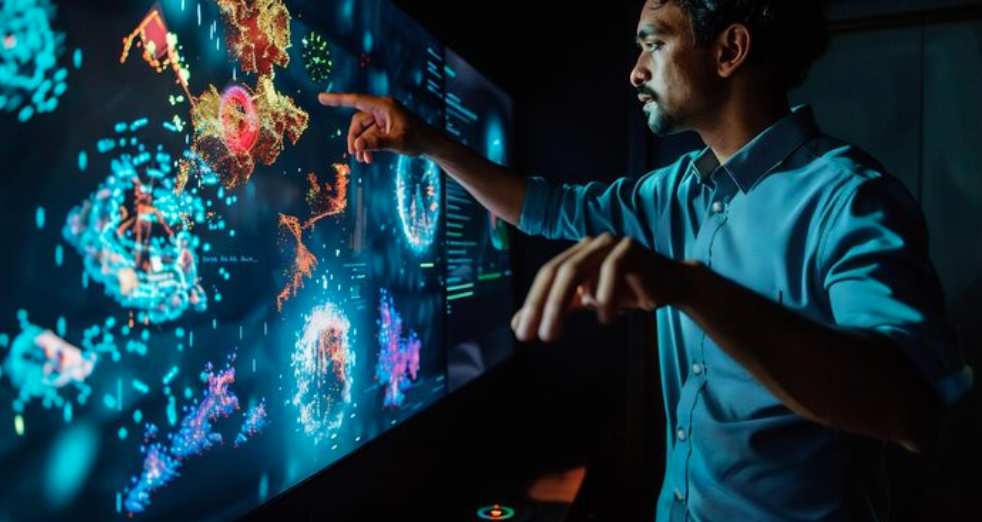
For decades, our digital interactions have been confined to flat screens—smartphones, monitors, and televisions. We looked at information rather than living in it. Today, a paradigm shift is underway. Spatial computing is tearing down the boundary between the physical and the digital, transforming the world around us into an interactive canvas where virtual objects coexist seamlessly with the physical environment.
What is Spatial Computing?
Coined decades ago by researcher Simon Greenwold, spatial computing refers to human interaction with machines in which the device retains and manipulates references to real-world objects and spaces. Unlike traditional computing, which requires a mouse, keyboard, or touchscreen, spatial computing leverages your natural movements, voice, gaze, and gestures.
By combining Augmented Reality (AR), Virtual Reality (VR), Mixed Reality (MR), computer vision, and artificial intelligence, spatial computing maps your physical surroundings. It anchors digital artifacts to specific spots in your room—so a virtual clock can hang permanently on your living room wall, or an interactive 3D blueprint can rest stably on your office desk.
The Pillars Driving the Revolution
Spatial computing is not a single technology; it is an ecosystem built on several advanced breakthroughs:
- Advanced Sensor Fusion & LiDAR: Devices use cameras, depth sensors, and LiDAR scanners to map rooms in real-time, understanding surfaces, lighting, and occlusions (how physical objects naturally block digital ones).
- Computer Vision and AI: Artificial intelligence interprets the physical environment instantly, allowing systems to recognize hand gestures, track eye movements, and identify objects with low latency.
- Spatial Audio: Sound is rendered in three dimensions, making it feel like a voice or environmental effect is originating from a precise physical direction in the room, drastically enhancing immersion.
Transforming Industries Across the Board
The shift from 2D screens to 3D space is redefining how entire industries operate:
- Healthcare and Surgery: Surgeons can view real-time patient vitals, 3D MRI scans, and procedural steps floating directly in their field of view during complex operations, reducing the need to look away at external monitors.
- Education and Training: Medical students, aviation cadets, and heavy-machinery operators can practice high-risk scenarios in simulated spatial environments that react realistically to physical inputs.
- Architecture and Design: Instead of studying blueprints or flat 3D renderings, architects and clients can walk through a to-scale virtual building model projected directly onto an empty plot of land or a boardroom floor.
- Retail and E-Commerce: Consumers can place furniture, appliances, or clothing items digitally inside their homes or onto themselves with exact scale accuracy before making a purchase.
Challenges on the Horizon
Despite its immense potential, mainstream adoption of spatial computing faces distinct hurdles. Hardware constraints—such as battery life, device weight, and thermal management—still limit all-day wearability. Additionally, privacy and data security concerns are paramount; when devices constantly scan and map private homes and public spaces, strict safeguards are required regarding who owns and protects that spatial data. High manufacturing costs also keep advanced hardware out of reach for the average consumer for now.
The Road Ahead
Spatial computing represents the next logical evolution in human-computer interaction. As hardware becomes lighter, headsets evolve into sleek everyday eyewear, and AI grows more intuitive, the line between the physical world and digital layers will continue to blur. We are moving toward a future where computing is no longer a device we pick up, but an invisible, ambient layer enriching every aspect of our physical reality.
Read more : How Customer Communities Influence Long-Term Business Growth