Pregnancy brings plenty of food questions. What can’t you eat when pregnant? What foods should pregnant women avoid? Can you still eat seafood, eggs, cheese, or deli meat? The answers are often less restrictive than they first appear.
The most important foods to avoid during pregnancy are those that raise the risk of foodborne infection, harmful mercury exposure, or alcohol exposure. Other foods are not completely off-limits but need proper cooking, heating, washing, or pasteurization.
A safe pregnancy diet should still include a wide variety of nutritious foods. The goal is not to create a long list of forbidden foods. It is to understand which choices carry more risk and how to replace them with safer options.
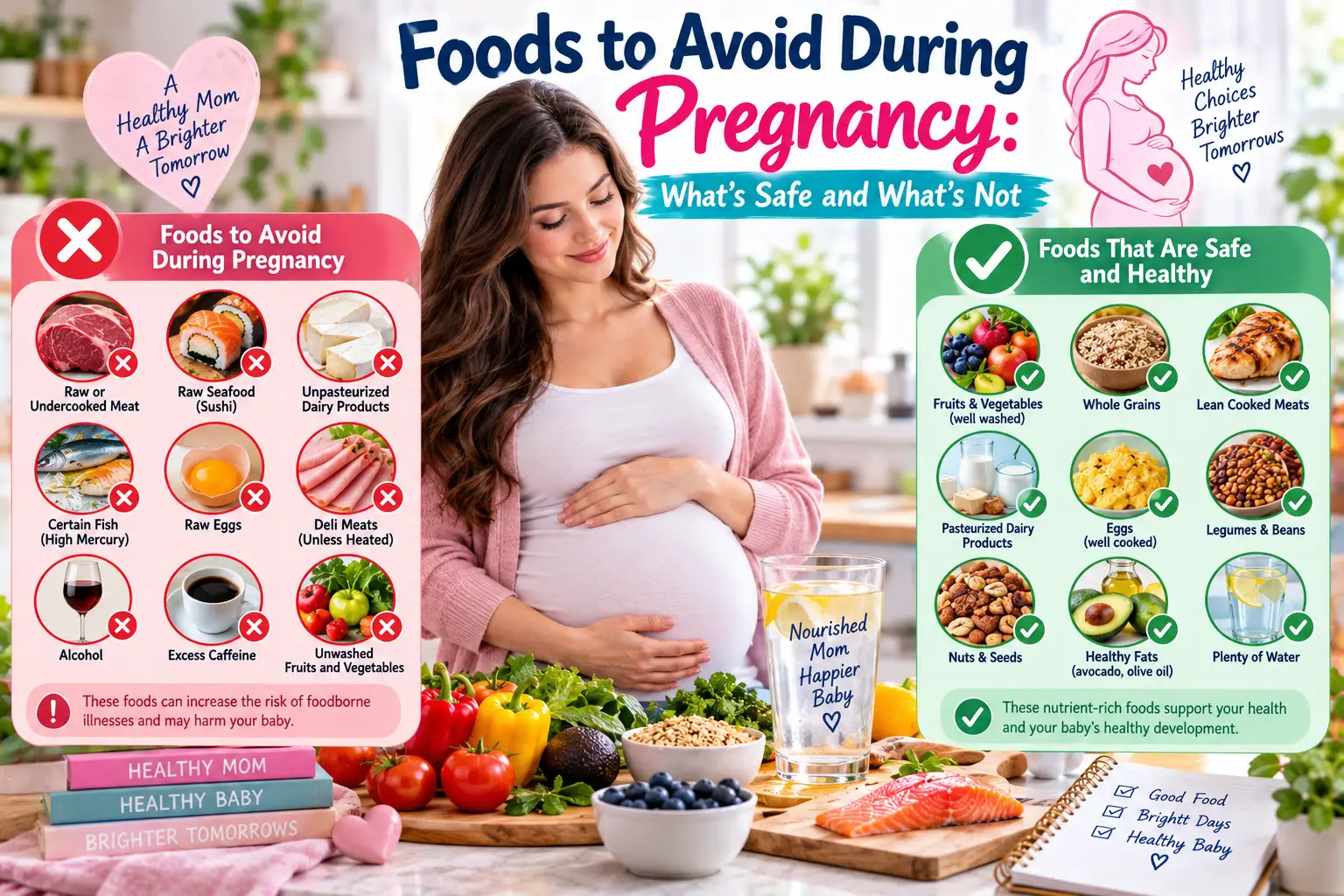
The main foods pregnant women should avoid include raw or undercooked meat, raw fish and shellfish, raw sprouts, unpasteurized milk and juice, certain refrigerated ready-to-eat foods, and high-mercury fish.
Also avoid alcohol during pregnancy, limit caffeine, wash produce carefully, and use recommended safe cooking temperatures. CDC says pregnant women are about 10 times more likely to develop a Listeria infection than other people.
Key Takeaways
What Can’t You Eat When Pregnant? Avoid, Limit, or Prepare Safely
Many lists of pregnancy foods to avoid make every item sound equally dangerous. That is misleading.
Some foods should genuinely be avoided. Others can be eaten in moderation or made safer through proper preparation.
| Food or Drink | Pregnancy Guidance | Safer Option |
|---|---|---|
| Raw meat | Avoid | Fully cooked meat |
| Undercooked poultry | Avoid | Cook poultry to 165°F |
| Raw sushi | Avoid | Cooked seafood or vegetable rolls |
| Raw oysters | Avoid | Fully cooked oysters |
| High-mercury fish | Avoid | Lower-mercury seafood |
| Cold deli meat | Heat first | Heat to 165°F or steaming |
| Hot dogs | Heat first | Heat to 165°F or steaming |
| Raw milk | Avoid | Pasteurized milk |
| Unpasteurized juice | Avoid | Pasteurized juice |
| Raw sprouts | Avoid raw | Thoroughly cooked sprouts |
| Raw eggs | Avoid | Fully cooked or pasteurized eggs |
| Coffee | Limit | Keep caffeine below 200 mg daily |
| Alcohol | Avoid | Alcohol-free beverage |
| Cooked salmon | Safe choice | Include within weekly fish guidance |
| Pasteurized dairy | Generally safer | Check labels carefully |
This distinction makes safe eating during pregnancy easier. You do not need to remove every food that appears on a pregnancy warning list.
Why Certain Foods Are Unsafe During Pregnancy
Pregnancy affects the immune system, which can make certain foodborne infections more serious. CDC specifically identifies pregnant women as being at higher risk from germs spread through food.
This is why pregnancy food safety focuses heavily on cooking, pasteurization, refrigeration, and avoiding contamination.
Important Foodborne Pathogens
Several foodborne pathogens matter during pregnancy.
Listeria monocytogenes
Listeria monocytogenes causes an infection called listeriosis. Pregnant women are about 10 times more likely to develop Listeria infection, according to CDC.
Listeria is unusual because it can survive and grow at refrigerator temperatures. Higher-risk foods may include certain refrigerated ready-to-eat products and unpasteurized foods.
Salmonella
Salmonella can be associated with raw eggs, undercooked poultry, raw meat, sprouts, and contaminated produce.
Food poisoning may cause diarrhea, vomiting, fever, and dehydration.
Toxoplasma
Toxoplasma gondii is a parasite that causes toxoplasmosis. Exposure can occur through undercooked meat and other environmental sources.
Properly cooking meat is an important food-safety precaution.
E. coli
Some strains of E. coli can cause serious intestinal illness. Contaminated meat, produce, sprouts, or unpasteurized products may be sources.
These risks are why food safety precautions matter more than simply memorizing a list of foods.
Raw or Undercooked Meat and Poultry
Raw or undercooked meat belongs near the top of any list of foods not to eat during pregnancy.
Meat and poultry may contain bacteria or parasites. You cannot reliably determine safety by looking at color alone, so use a food thermometer.
Avoid:
- Raw beef
- Steak tartare
- Undercooked hamburgers
- Raw or undercooked pork
- Undercooked lamb
- Raw chicken
- Undercooked poultry
- Raw sausage mixtures
- Meat that has not reached the proper internal temperature
Safe Cooking Temperatures for Meat
USDA recommends these minimum internal temperatures:
| Food | Minimum Temperature |
|---|---|
| Beef, pork, veal, lamb steaks, chops, and roasts | 145°F + 3-minute rest |
| Ground beef, pork, veal, and lamb | 160°F |
| Chicken and turkey | 165°F |
| Ground poultry | 165°F |
| Leftovers and casseroles | 165°F |
These temperatures should be measured with a food thermometer.
Can You Eat Steak While Pregnant?
Yes. Meat during pregnancy does not have to be eliminated.
A whole beef steak cooked to at least 145°F and rested for three minutes meets USDA’s minimum temperature guidance. Ground beef must reach 160°F.
If you prefer meat cooked beyond the minimum temperature, that is also fine.
Eggs During Pregnancy: Raw, Runny, and Pasteurized Eggs
Eggs during pregnancy can be a nutritious source of protein and other nutrients. The concern is primarily with raw eggs and undercooked eggs.
CDC considers raw or undercooked eggs a riskier food choice during pregnancy.
Foods that may contain raw egg include:
- Homemade mayonnaise
- Homemade Caesar dressing
- Hollandaise sauce
- Raw mousse
- Homemade eggnog
- Some tiramisu recipes
- Raw cake batter
- Raw cookie dough
Can Pregnant Women Eat Runny Eggs?
The safer approach is to choose fully cooked eggs or products made with pasteurized eggs.
For recipes where eggs remain uncooked, use pasteurized eggs or pasteurized egg products.
Raw Cookie Dough Has Another Risk
Raw dough is not only about eggs.
Regular raw flour can also contain harmful bacteria. Cook or bake ordinary dough and batter before eating them.
Products manufactured and clearly labeled as safe-to-eat edible dough are different because their ingredients have been processed for that use.
Deli Meat, Luncheon Meat, Hot Dogs, and Meat Spreads
Questions about deli meat during pregnancy are extremely common because older advice often makes lunch meat sound completely forbidden.
The problem is not that deli meat itself is inherently toxic. The concern is possible contamination with Listeria.
CDC recommends reheating deli meats and similar ready-to-eat meats until 165°F or steaming hot.
This applies to:
- Deli meat
- Luncheon meat
- Cold cuts
- Sliced turkey
- Ham
- Roast beef
- Bologna
- Hot dogs
Can You Eat Deli Meat While Pregnant?
Yes, when it is reheated properly.
Heat deli meat until it reaches 165°F or is steaming hot throughout. Then allow it to cool slightly if you prefer before assembling your sandwich.
Can Pregnant Women Eat Hot Dogs?
Yes, but hot dogs should also be heated until steaming hot or 165°F.
Eating them cold directly from the package is the higher-risk choice.
Pâté and Meat Spreads
Avoid refrigerated pâté and refrigerated meat spreads during pregnancy because of Listeria concerns.
Shelf-stable versions that do not require refrigeration before opening are considered safer choices.
Fish and Seafood During Pregnancy
Seafood during pregnancy is one area where people often become too restrictive.
Fish provides protein, healthy fatty acids, iodine, choline, vitamin D, iron, zinc, and other nutrients. FDA advises pregnant women to eat two to three servings, or 8–12 ounces, of lower-mercury fish each week.
The goal is not to avoid seafood. The goal is to avoid raw seafood and high-mercury seafood while choosing safer fish regularly.
Raw Fish, Sushi, Shellfish, and Smoked Seafood
Raw fish may contain bacteria or parasites that proper cooking can destroy.
That makes uncooked seafood one of the major high-risk foods during pregnancy.
Avoid:
- Raw salmon
- Raw tuna
- Sashimi
- Raw-fish nigiri
- Ceviche
- Raw shellfish
- Raw oysters
- Raw clams
- Raw mussels
FDA notes that raw fish and foods made from raw fish are more likely to contain parasites or bacteria than properly cooked fish.
Can Pregnant Women Eat Sushi?
You should avoid sushi containing raw or undercooked seafood.
However, sushi itself is not automatically off-limits.
Safer options can include:
- Vegetable rolls
- Cucumber rolls
- Avocado rolls
- Cooked shrimp rolls
- Fully cooked crab rolls
- Rolls containing cooked lower-mercury fish
Choose restaurants with strong hygiene and refrigeration practices.
Can You Eat Smoked Salmon When Pregnant?
Refrigerated smoked seafood, including refrigerated smoked salmon, can carry Listeria risk.
A safer choice is smoked seafood that is canned, shelf-stable, or thoroughly cooked as part of a hot dish.
Do not confuse cold refrigerated smoked salmon with fully cooked salmon.
High-Mercury Fish to Avoid During Pregnancy
Mercury occurs naturally in the environment and can build up in fish as methylmercury.
Large, long-lived predatory fish tend to accumulate more methylmercury. Excessive mercury exposure is a concern because methylmercury can affect the developing nervous system.
FDA and EPA identify seven fish in the Choices to Avoid category:
- King mackerel
- Marlin
- Orange roughy
- Shark
- Swordfish
- Tilefish from the Gulf of Mexico
- Bigeye tuna
Cooking does not remove mercury from fish because mercury is distributed through its tissue.
What Fish Should You Avoid When Pregnant?
The seven fish above are the main FDA/EPA choices to avoid because of mercury.
Do not confuse bigeye tuna with canned light tuna.
Can You Eat Tuna While Pregnant?
Yes, but the type matters.
Canned light tuna is included among FDA’s Best Choices.
Albacore or white tuna falls into the Good Choices category and should be eaten less often.
Bigeye tuna belongs in the Choices to Avoid category.
What Seafood Is Safe During Pregnancy?
Many kinds of fully cooked seafood are lower in mercury and fit into a healthy pregnancy diet.
FDA Best Choices include options such as:
- Salmon
- Shrimp
- Canned light tuna
- Cod
- Tilapia
- Pollock
- Sardines
- Trout
- Catfish
- Crab
- Scallops
- Haddock
Can Pregnant Women Eat Shrimp?
Yes.
Fully cooked shrimp is a lower-mercury seafood choice and can count toward the recommended 8–12 ounces of seafood per week.
Why Seafood Still Matters
FDA notes that pregnant women often eat less fish than recommended. Its data indicate an average intake of about 4.2 ounces per week, compared with the recommended 8–12 ounces.
Avoiding all fish can therefore be an unnecessary pregnancy food restriction.
Choose low-mercury seafood and cook it properly instead.
Unpasteurized Milk, Cheese, Juice, and Other Raw Products
Unpasteurized foods have not undergone pasteurization, which uses heat or another approved process to reduce dangerous microorganisms.
CDC identifies unpasteurized milk and cheese among foods more frequently associated with foodborne illness during pregnancy.
Is Raw Milk Safe During Pregnancy?
No.
Avoid:
- Raw milk
- Unpasteurized milk
- Dairy foods made from raw milk
Pasteurized products are the safer choice.
Do not assume products are safe because they are described as:
- Farm fresh
- Local
- Organic
- Natural
- Homemade
Look specifically for the word pasteurized.
Cheese During Pregnancy: What’s Safe?
Questions about cheese during pregnancy need more nuance than “avoid all soft cheese.”
The important factors are pasteurization, cheese type, storage, and handling.
Unpasteurized Cheese
Avoid unpasteurized cheese because raw-milk cheese can contain Listeria monocytogenes. FDA specifically identifies this concern for both hard and soft cheeses made with unpasteurized milk.
Soft Cheeses
Common soft cheeses include:
- Brie
- Camembert
- Feta
- Mozzarella
- Cottage cheese
- Cream cheese
Check pasteurization and current food-safety guidance rather than avoiding every soft cheese automatically.
Queso Fresco and Queso Blanco
Take particular care with:
- Queso fresco
- Queso blanco
- Requesón
These fresh cheeses have been associated with Listeria concerns.
Heating higher-risk cheese to 165°F or until steaming hot provides an additional safety step.
What Cheese Can You Not Eat When Pregnant?
The clearest category to avoid is cheese made with unpasteurized milk.
For refrigerated soft cheeses and queso fresco-type products, follow CDC/FDA pregnancy guidance and check both pasteurization and preparation.
Unpasteurized Juice and Cider
Unpasteurized juice can contain harmful bacteria.
This may be especially relevant for juice sold:
- At farmers markets
- At roadside stands
- At cider mills
- At juice bars
- At farms
- Fresh by the glass
FDA notes that untreated juice can contain harmful bacteria and may carry a warning label.
Can Pregnant Women Drink Unpasteurized Juice?
The safer choice is pasteurized juice.
Check the package or ask the seller when the product is fresh-squeezed and its treatment is unclear.
Raw Sprouts and Unwashed Produce
Fruits and vegetables belong in a balanced pregnancy nutrition plan, but they still need appropriate handling.
Problems can occur when produce is contaminated with bacteria or when it is eaten without adequate washing.
Raw Sprouts
Avoid uncooked:
- Alfalfa sprouts
- Clover sprouts
- Radish sprouts
- Mung bean sprouts
- Other raw sprouts
Bacteria may become trapped inside sprout seeds, which means washing the finished sprouts may not remove the contamination. FDA notes that bacteria can multiply to high levels during sprouting even under clean conditions.
Cook sprouts thoroughly instead.
Unwashed Fruits and Vegetables
Avoid eating unwashed fruits and unwashed vegetables.
Washing fruits and vegetables under clean running water can help remove dirt and reduce surface contamination.
Wash produce before:
- Eating it raw
- Cutting it
- Peeling it
- Adding it to salads
- Blending it into smoothies
You do not need household detergent or bleach on produce.
Also remember that cutting through an unwashed melon, avocado, or other fruit can transfer bacteria from the peel to the edible flesh.
Caffeine During Pregnancy
Caffeine during pregnancy does not have the same rule as alcohol.
You usually do not need to avoid caffeine entirely.
The American College of Obstetricians and Gynecologists (ACOG) states that moderate caffeine consumption of less than 200 mg per day does not appear to be a major contributor to miscarriage or preterm birth.
Caffeine can come from:
- Coffee
- Espresso
- Black tea
- Green tea
- Soda
- Energy drinks
- Chocolate
- Some medications
Can You Drink Coffee While Pregnant?
Yes, in moderation.
ACOG notes that around 200 mg of caffeine is approximately the amount in one 12-ounce cup of coffee, though actual amounts vary by brand and brewing method.
How Much Caffeine Can You Have While Pregnant?
Aim to stay below 200 mg per day unless your healthcare provider gives you different instructions.
Count all caffeine sources rather than coffee alone.
Alcohol During Pregnancy
The recommendation for alcohol during pregnancy is much clearer.
ACOG states that no amount of alcohol is currently considered safe during pregnancy, and all types of alcohol can expose the developing baby.
That includes:
- Wine
- Beer
- Liquor
- Hard seltzer
- Cocktails
- Other alcoholic drinks
Can You Drink Alcohol While Pregnant?
The safest recommendation is no alcohol during pregnancy.
Alcohol exposure can affect fetal development, including brain development, and the effects cannot be reliably predicted for an individual pregnancy.
If you drank before realizing you were pregnant, do not panic. ACOG advises stopping once pregnancy is known and discussing concerns with your obstetrician or other healthcare professional.
Safe Cooking Temperatures During Pregnancy
One of the most useful pregnancy food safety precautions is also one of the simplest: own a food thermometer.
You cannot see, smell, or taste all harmful bacteria.
| Food | Minimum Safe Internal Temperature |
|---|---|
| Whole beef, pork, veal, lamb | 145°F + 3-minute rest |
| Ground meats | 160°F |
| Poultry | 165°F |
| Ground poultry | 165°F |
| Fish and shellfish | 145°F |
| Egg dishes | 160°F |
| Leftovers | 165°F |
| Casseroles | 165°F |
| Deli meat during pregnancy | 165°F or steaming hot |
| Hot dogs during pregnancy | 165°F or steaming hot |
USDA recommends measuring temperatures in the thickest part of the food with a thermometer.
Eating Out Safely During Pregnancy
Restaurant food does not need to disappear from your life.
A few questions can help you avoid many unsafe foods during pregnancy.
Ask:
- Is the meat fully cooked?
- Does this dressing contain raw eggs?
- Is the seafood fully cooked?
- Is the juice pasteurized?
- Does the salad contain raw sprouts?
- Is the cheese made from pasteurized milk?
- Can the deli meat be heated until steaming?
- Has this food been kept properly hot or refrigerated?
A restaurant that cannot answer an important food-safety question is giving you a good reason to choose another dish.
Leftovers, Buffets, and Food Storage
Even normally safe foods can become foods unsafe for pregnancy when they sit too long at unsafe temperatures.
Follow basic storage rules consistently.
- Refrigerate perishable foods promptly.
- Keep the refrigerator at 40°F or below.
- Avoid foods left at room temperature for extended periods.
- Store leftovers in clean, covered containers.
- Reheat leftovers to 165°F.
- Keep raw meat separate from ready-to-eat food.
- Discard food when safe storage is uncertain.
These habits reduce the risk of contaminated food regardless of whether you are pregnant.
Foods to Avoid in the First Trimester
Many searches focus specifically on foods to avoid in early pregnancy or foods to avoid in the first trimester.
The important point is that the core safety rules do not end after the first 12 weeks.
Continue avoiding throughout pregnancy:
- Raw or undercooked animal foods
- High-mercury fish
- Raw sprouts
- Raw-milk products
- Unpasteurized juice
- Unsafe ready-to-eat refrigerated foods
- Alcohol
Also continue following caffeine limits and proper cooking practices.
These are foods to avoid throughout pregnancy, not merely first-trimester restrictions.
Your individual needs may change, however. An OB-GYN, obstetrician-gynecologist, healthcare provider, or registered dietitian may recommend additional dietary changes for conditions such as gestational diabetes, anemia, allergies, or severe nausea.
Pregnancy Food Safety vs. a Healthy Pregnancy Diet
A list of things not to eat while pregnant only answers half the question.
Good maternal health and pregnancy nutrition also depend on eating enough nutritious foods.
USDA’s MyPlate guidance for pregnancy encourages variety across fruits, vegetables, grains, protein foods, dairy, or fortified soy alternatives. It also recommends lower-mercury seafood and careful food safety.
A balanced healthy pregnancy diet may include:
- Washed fruits and vegetables
- Fully cooked eggs
- Thoroughly cooked lean meat and poultry
- Beans, peas, and lentils
- Nuts and seeds
- Whole grains
- Pasteurized milk and yogurt
- Safe cheeses
- Lower-mercury seafood
- Fortified soy foods when appropriate
- Foods recommended by your prenatal healthcare team
The Dietary Guidelines for Americans and MyPlate emphasize overall eating patterns, variety, and nutrient-rich choices rather than unnecessary food restriction.
Safer Swaps for Common Pregnancy Food Restrictions
Knowing what to eat instead makes pregnancy dietary guidelines much easier to follow.
| Higher-Risk Choice | Safer Alternative |
|---|---|
| Raw salmon sushi | Cooked shrimp or vegetable roll |
| Raw oysters | Fully cooked oysters |
| Bigeye tuna | Salmon or canned light tuna |
| Cold luncheon meat | Deli meat heated to 165°F |
| Cold hot dog | Hot dog heated until steaming |
| Runny eggs | Fully cooked eggs |
| Raw cookie dough | Fully baked cookies |
| Raw milk | Pasteurized milk |
| Unpasteurized juice | Pasteurized juice |
| Raw sprouts | Fully cooked sprouts |
| Queso fresco served cold | Thoroughly heated queso |
| Alcoholic cocktail | Alcohol-free mocktail |
| High-caffeine coffee | Smaller, half-caf, or decaf serving |
Safer swaps prevent food restrictions during pregnancy from becoming unnecessarily burdensome.
What to Do If You Accidentally Eat a High-Risk Food
Accidentally eating something from a list of foods you should not eat when pregnant does not mean illness or pregnancy complications will automatically occur.
The appropriate response depends on what you ate and whether symptoms develop.
What to Do First
- Note the food and when you ate it.
- Keep the packaging if available.
- Check whether the product has been recalled.
- Watch for symptoms of food poisoning.
- Stay hydrated if you have mild stomach symptoms.
- Contact your prenatal healthcare provider when you are concerned.
Possible symptoms of food poisoning during pregnancy can include diarrhea, vomiting, abdominal cramps, and fever.
For possible listeriosis, pregnancy symptoms may sometimes be mild and include fever, muscle aches, or unusual fatigue.
If you become ill after eating potentially contaminated food, tell the clinician that you are pregnant and describe the suspected exposure.
Foods to Stay Away From While Pregnant: Grocery Checklist
You do not need to memorize every pregnancy food rule.
Use this checklist when shopping:
This approach is more useful than simply labeling dozens of foods as dangerous foods during pregnancy.
FAQs About Foods to Avoid During Pregnancy
What Foods Should I Avoid During Pregnancy?
The main foods to avoid while pregnant include raw or undercooked meat, raw seafood, raw eggs, raw sprouts, unpasteurized milk or juice, high-mercury fish, and certain refrigerated ready-to-eat foods.
Also avoid alcohol and follow recommended limits for caffeine.
What Can’t You Eat When Pregnant?
If you are wondering what can’t pregnant women eat, focus first on foods that pose clear infection or mercury risks.
Avoid raw animal foods, unpasteurized products, raw sprouts, high-mercury fish, and alcohol. Some other foods, including deli meat, become safer after proper heating.
What Should You Not Eat While Pregnant?
The most important foods not to eat while pregnant are foods that may expose you to harmful bacteria, parasites, excessive methylmercury, or alcohol.
Preparation matters. A cold deli sandwich may be a higher-risk choice, while the same meat reheated to 165°F fits current safety guidance.
What Foods Are Dangerous During Pregnancy?
Rather than thinking of all restricted foods as inherently dangerous, think in terms of risk.
Higher-risk choices include raw seafood, undercooked animal foods, unpasteurized dairy, raw sprouts, and high-mercury fish. Proper cooking or pasteurization makes many other foods safer.
Can Pregnant Women Eat Sushi?
Avoid sushi containing raw fish or raw shellfish.
Cooked shrimp rolls, cooked lower-mercury seafood rolls, and vegetable sushi are safer alternatives when prepared hygienically.
Can I Eat Deli Meat While Pregnant?
Yes, but CDC recommends heating deli meat or luncheon meat to 165°F or until steaming hot before eating it during pregnancy.
What Fish Should I Avoid While Pregnant?
FDA’s Choices to Avoid are king mackerel, marlin, orange roughy, shark, swordfish, Gulf of Mexico tilefish, and bigeye tuna.
Choose lower-mercury seafood instead.
What Seafood Is Safe During Pregnancy?
Fully cooked salmon, shrimp, canned light tuna, tilapia, cod, pollock, sardines, trout, scallops, crab, and several other lower-mercury choices can fit into pregnancy meals.
FDA recommends 8–12 ounces per week from lower-mercury choices.
Which Cheeses Should I Avoid During Pregnancy?
Avoid unpasteurized cheese.
Use extra caution with refrigerated fresh cheeses such as queso fresco-type products. Appropriate pasteurized cheeses and properly heated higher-risk cheeses provide safer options.
Can You Eat Eggs While Pregnant?
Yes. Eggs during pregnancy can be part of a nutritious diet when properly cooked.
Avoid untreated raw or undercooked eggs. Use pasteurized eggs for recipes where eggs remain uncooked.
Can You Drink Caffeine While Pregnant?
Yes, in moderation.
ACOG advises keeping caffeine intake below 200 mg per day, counting coffee, tea, soda, chocolate, energy drinks, and other sources.
Why Are Unpasteurized Foods Unsafe During Pregnancy?
Unpasteurized foods have not received the treatment used to reduce harmful microorganisms.
Products such as raw milk, unpasteurized cheese, and untreated juice may therefore carry bacteria that can cause foodborne illness.
What Should I Avoid Eating in the First Trimester?
The core pregnancy food restrictions apply throughout pregnancy rather than only during the first trimester.
Avoid raw or undercooked high-risk foods, unpasteurized products, raw sprouts, high-mercury fish, and alcohol from early pregnancy through delivery.
Conclusion
Understanding what not to eat when pregnant becomes easier when you stop treating every food warning the same way. Some foods need to be avoided, others need to be limited, and many simply require better cooking or handling.
Focus on the biggest priorities: avoid raw animal foods, raw sprouts, unpasteurized products, high-mercury seafood, and alcohol; cook meat and eggs safely; heat deli foods; wash produce; and keep caffeine below recommended limits. At the same time, continue eating a varied, nutrient-rich pregnancy diet that supports both maternal health and your developing baby.
When individual medical conditions, allergies, food poisoning concerns, or unusual dietary restrictions are involved, get personalized advice from your OB-GYN, healthcare provider, or registered dietitian.