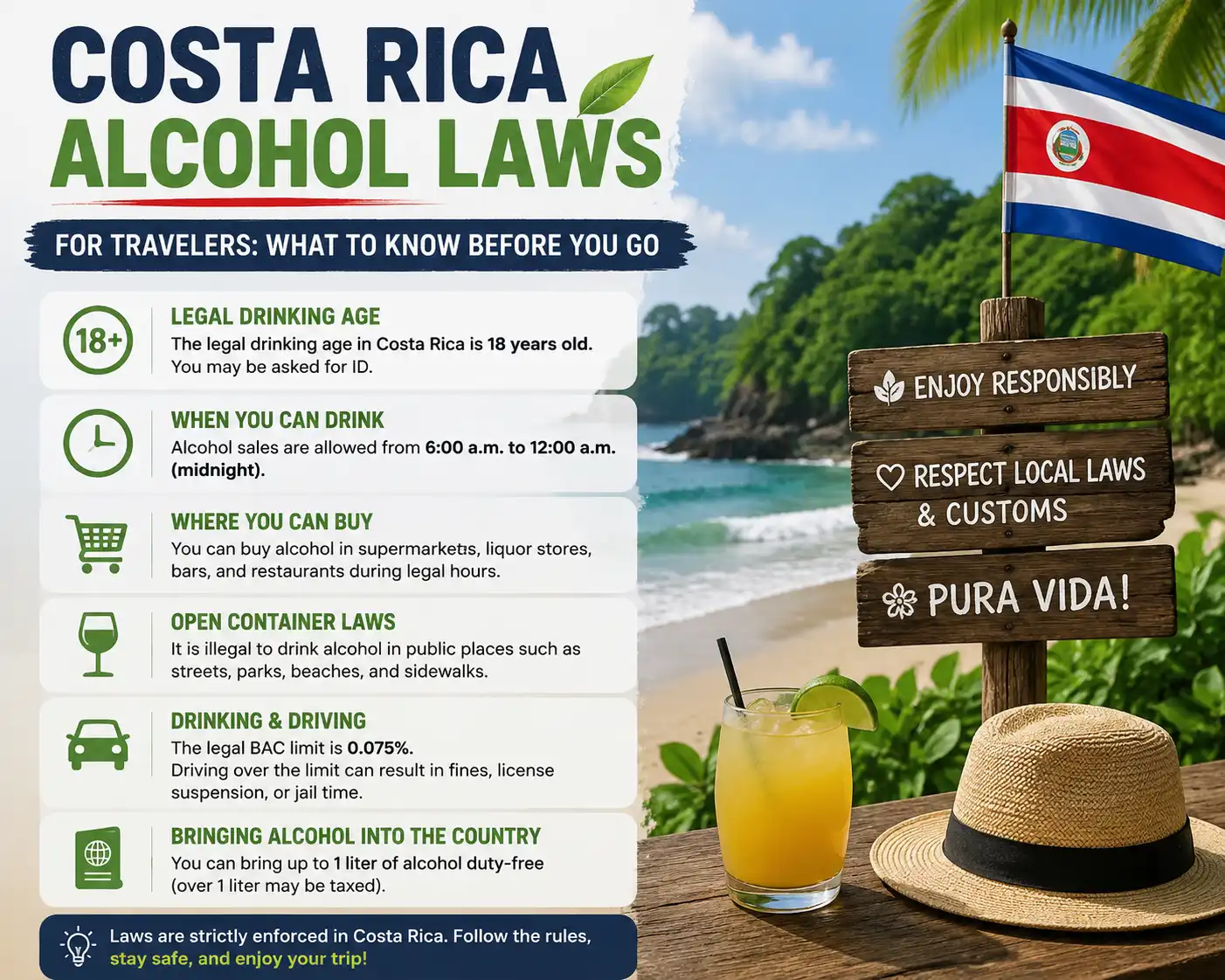
Know the legal drinking age, public drinking restrictions, national park rules, and essential alcohol laws before your Costa Rica trip.
Travelers researching Costa Rica alcohol laws usually want one thing first: a clear explanation of the rules that apply during a visit. The most important point is that 18 is the legal age of adulthood in Costa Rica, and the country’s tourism authority identifies 18 as the minimum age for consuming alcoholic beverages.
The rules go beyond age. Costa Rica also regulates public consumption, alcohol in protected areas, sales to minors, and activities where alcohol could create safety concerns. Understanding those rules can help visitors avoid misunderstandings and respect local laws.
Costa Rica’s legal drinking age is 18. Adults 18 and older may consume alcohol responsibly in authorized establishments, while public drinking is generally prohibited. Additional restrictions can apply in national parks, protected areas, and certain events or venues.
- Legal drinking age: 18
- Under 18: Alcohol cannot legally be sold or provided to minors.
- Public drinking: Generally prohibited and may result in fines or confiscation.
- National parks: Alcohol may be prohibited, with protected areas having stricter rules.
- Driving: Never drink and drive; use legal transportation instead.
- Venues & events: Individual establishments and authorized events may have additional rules.
Costa Rica Drinking Age at a Glance
The basic rule is simple: Costa Rica’s legal drinking age is 18. The official Costa Rica Tourism Board states that tourists over 18 may consume alcoholic beverages responsibly in authorized establishments such as hotels, restaurants, and bars.
Costa Rica’s tourism guidance also states that 18-year-olds are considered adults under Costa Rican law. That makes the age threshold especially important for families traveling with teenagers.
| Rule | What Travelers Should Know |
|---|---|
| Legal drinking age | 18 |
| Under 18 | Alcohol should not be sold or provided to minors. |
| Public consumption | Generally prohibited in public spaces and may lead to fines or confiscation. |
| Protected areas | Additional restrictions can apply, including alcohol bans in specific parks. |
| Authorized establishments | Hotels, restaurants, bars, and other licensed venues may have their own policies. |
| Local events | Special rules or designated areas may apply. |
Is the Legal Drinking Age 18 in Costa Rica?
Yes. 18 is the relevant legal age cited by Costa Rica’s official tourism information. The Tourism Board specifically says tourists over 18 may consume alcoholic beverages responsibly in authorized establishments.
This is important for visitors who assume that vacation destinations follow the same rules as their home country. They do not. Travelers are expected to follow the laws of the country they are visiting.
For families, the practical takeaway is simple: being on vacation does not change Costa Rica’s minimum legal drinking age.
What Are the Rules for People Under 18?
Costa Rica’s alcohol regulations protect minors from alcohol sales and provision. The legal framework prohibits businesses from selling or providing alcoholic beverages to people under 18.
The rule matters even when alcohol is offered without a direct purchase. An adult accompanying a teenager does not automatically create an exception to the country’s age restrictions.
- Minors cannot legally purchase alcoholic beverages.
- Businesses must comply with age restrictions.
- Adults should not provide alcohol to minors.
- Age verification can be required.
- Venue policies may impose additional restrictions.
Can Businesses Ask for Identification?
Yes. Age verification is an important part of complying with alcohol restrictions. Businesses may request official identification when they need to establish that a customer meets the applicable age requirement.
For international travelers, keeping important documents secure is good general practice. Costa Rica’s tourism guidance recommends protecting passports, cards, money, and other valuables while traveling.
Carry Appropriate ID
Have appropriate identification available when age verification is required.
Protect Your Passport
Keep your passport and other important travel documents secure.
Avoid False ID
Never use altered, fraudulent, or false identification.
Follow Staff Instructions
Authorized venue staff may require proof of age before serving alcohol.
Is Alcohol Allowed in Public Places?
Public alcohol consumption is generally prohibited in Costa Rica. The country’s official tourism information specifically warns visitors that drinking alcohol in public spaces can result in fines and confiscation of the product.
That distinction matters because a traveler might assume that an open public area has the same rules as a licensed private establishment. It does not.
When visiting a beach, street, plaza, park, or other public location, do not assume alcohol is permitted. Follow posted rules and instructions from local authorities.
Are There Special Rules in National Parks?
Yes. Protected areas can have stricter environmental and safety rules than ordinary tourist locations.
Costa Rica’s official tourism guidance says that tobacco, drugs, and alcoholic beverages are regulated in protected areas. The rules are designed partly to protect wildlife, ecosystems, and visitors.
The official information for Manuel Antonio National Park states that alcohol is not allowed inside the park.
- Check protected-area rules before entering.
- Do not assume beach rules apply inside a national park.
- Follow signs and ranger instructions.
- Respect wildlife and conservation requirements.
- Keep public and protected-area regulations separate.
What About La Fortuna and Arenal?
The same national rules apply in popular destinations such as La Fortuna and the Arenal Volcano area.
The official Costa Rica Tourism Board states that visitors over 18 may consume alcoholic beverages responsibly in authorized establishments in the area, while public drinking is prohibited and can lead to fines and confiscation.
This distinction is useful for travelers because the Arenal region includes hotels, restaurants, protected areas, roads, and outdoor attractions. Each setting can have different rules.
Think in terms of where you are drinking, not just whether you are 18 or older. A licensed establishment and a protected natural area can have very different rules.
Do Festivals Have Different Rules?
Some officially authorized public events can operate under specific rules and designated areas. That does not mean alcohol is automatically permitted throughout the surrounding town or public spaces.
The safest approach is to follow the event’s posted instructions and stay within any area officially designated for the event.
- Event rules can differ from ordinary public-space rules.
- Designated areas matter.
- Municipal requirements can apply.
- Posted instructions should be followed.
- An event exception does not create blanket permission everywhere.
Can Rules Differ Between Establishments?
Yes. Costa Rican alcohol regulations distinguish between different types of licensed establishments.
A restaurant, hotel, bar, nightclub, or other venue can operate under different licensing conditions. As a result, travelers should not assume that the rules for one establishment automatically apply to another.
Legal age + venue license + local restrictions = the rules that apply to your situation.
The key point is that venue licensing and age restrictions work together. If a business has its own age policy, visitors should follow it.
What Should Families Traveling With Teenagers Know?
Families should understand that 18 is the key legal threshold. A teenager traveling with parents or other adults does not receive a special exemption simply because the family is on vacation.
Venue access can also vary depending on the establishment. Some locations may have restrictions that go beyond the basic national age rule.
- Check venue policies before entering.
- Remember that parental supervision does not remove legal age requirements.
- Follow posted age restrictions.
- Ask staff when a venue’s policy is unclear.
- Choose family-appropriate locations for younger travelers.
How Does Alcohol Relate to Travel Safety?
Costa Rica’s tourism authority includes alcohol within its broader traveler-safety guidance. It advises visitors to avoid alcohol before swimming and emphasizes caution around beaches, changing weather, and other outdoor conditions.
The same principle applies to adventure activities. Costa Rica’s official safety guidance advises travelers to remain alert and follow professional instructions during activities such as rafting, kayaking, and other excursions.
Alcohol should never be treated as compatible with activities where clear judgment, balance, reaction time, and coordination are essential.
What About Alcohol and Driving?
Driving is a separate legal and safety issue from the country’s minimum drinking age. Being legally old enough to consume alcohol does not mean it is safe or lawful to drive after consuming it.
Costa Rica’s official tourism guidance emphasizes using legal transportation and taking appropriate safety precautions. For travelers, the safest approach is to keep drinking and driving completely separate.
Drink
If you choose to consume alcohol, do so responsibly in an appropriate setting.
Do Not Drive
Do not attempt to drive after consuming alcohol.
Plan Transportation
Arrange an appropriate driver or authorized transportation in advance.
Stay Safe
Avoid combining alcohol with risky outdoor or adventure activities.
What Are the Most Common Misunderstandings?
Many travel-law mistakes happen because visitors assume Costa Rica follows the same rules as their home country.
The biggest misunderstanding is that vacation status changes local law. It doesn’t. Visitors are responsible for following Costa Rican regulations while they are in the country.
- Vacation does not change the legal age.
- Public spaces do not automatically permit alcohol.
- A festival does not necessarily change nearby public-space rules.
- A restaurant and nightclub may have different policies.
- Protected areas can have additional restrictions.
- Local instructions should always be followed.
How Can Travelers Check the Current Rules?
Laws and local policies can change, especially around public events and protected areas. For that reason, travelers should verify current information shortly before a trip.
The Costa Rica Tourism Board maintains official traveler information and tourism information centers. Its official tourism offices provide maps, destination information, and safety guidance.
For a specific legal question, official Costa Rican government publications are preferable to relying only on an old travel blog or social-media post.
A Simple Legal Checklist for Your Trip
You don’t need to memorize every regulation before visiting Costa Rica. A few basic principles cover most situations.
FAQs About Costa Rica Alcohol Laws
What Is the Legal Drinking Age in Costa Rica?
The legal age is 18. The official Costa Rica Tourism Board states that tourists over 18 may consume alcoholic beverages responsibly in authorized establishments.
Can Someone Under 18 Buy Alcohol in Costa Rica?
No. Costa Rican regulations prohibit the sale or provision of alcoholic beverages to minors. Businesses can use identification checks to verify age.
Is Drinking Alcohol in Public Legal in Costa Rica?
Generally, no. The official tourism authority states that alcohol consumption is prohibited in public spaces and can result in fines and confiscation.
Is Alcohol Allowed in Costa Rica’s National Parks?
Rules for protected areas can be stricter than ordinary tourist locations. For example, the official information for Manuel Antonio National Park states that alcohol is not allowed inside the park.
Can Families Travel to Costa Rica With Teenagers?
Yes. Families regularly visit Costa Rica, but parents should understand the country’s age restrictions and venue-specific policies. Being accompanied by an adult does not remove the minimum legal age for alcohol.
Are Alcohol Rules the Same Everywhere in Costa Rica?
Not necessarily. National law provides the main framework, while protected areas, municipalities, licensed establishments, and authorized events can have additional rules.
Where Can Travelers Get Official Information?
The Costa Rica Tourism Board provides official travel information, safety guidance, and tourist assistance. Its tourism information centers can also provide destination-specific information.
What Is the Legal Drinking Age in Costa Rica?
The legal drinking age in Costa Rica is 18. People 18 and older may consume alcohol responsibly in authorized establishments.
Can You Drink Alcohol in Public in Costa Rica?
Generally, no. Public alcohol consumption is prohibited in many circumstances and can lead to fines and confiscation. Travelers should follow local signs and instructions.
Is Alcohol Allowed in Costa Rica’s National Parks?
Not necessarily. Protected areas can have stricter alcohol rules than ordinary tourist locations. For example, alcohol is prohibited inside Manuel Antonio National Park.
Can You Drink and Drive in Costa Rica?
You should never combine alcohol with driving. Being legally old enough to drink does not make driving after drinking safe or lawful. Use a designated driver or authorized transportation instead.
For travelers, the most important Costa Rica alcohol-law fact is straightforward: 18 is the legal age, while public consumption and alcohol use in protected areas can face additional restrictions. Venue, event, and municipal rules may also matter.
The safest approach is to check current official guidance, respect local restrictions, and keep alcohol separate from driving, swimming, and adventure activities. That simple approach helps visitors enjoy Costa Rica while respecting its laws, communities, and protected natural spaces.