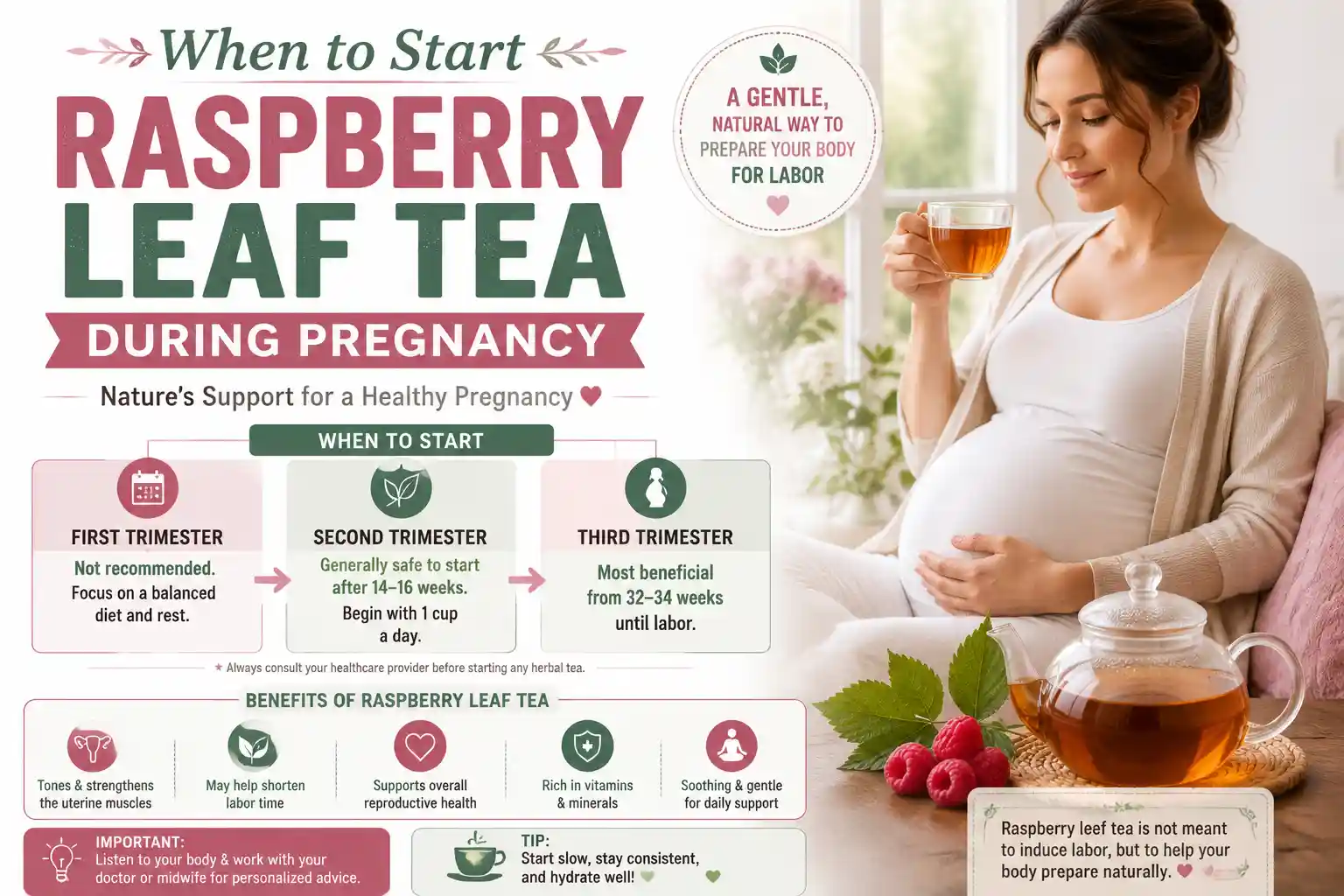
When Should You Start Raspberry Leaf Tea During Pregnancy? 32, 36 & 37 Weeks Explained
A clear, evidence-focused guide to the commonly discussed 32-, 36-, and 37-week starting points—and what research actually says about raspberry leaf tea during pregnancy.
Quick Answer
There is no medically established week when everyone should start raspberry leaf tea. Around 32 weeks is a commonly discussed starting point, but that timing comes largely from traditional use and the main clinical trial, not from proof that 32 weeks is the best time to begin. (ODs)
If you’re considering it during pregnancy, the safest choice is to ask your maternity care provider whether it fits your individual pregnancy before starting.
What Is Raspberry Leaf Tea?
Raspberry leaf tea is made from the dried leaves of the red raspberry plant, Rubus idaeus. It is different from raspberry-flavored tea, which may contain fruit flavoring without raspberry leaf. (GOV.UK)
People have traditionally used raspberry leaf during pregnancy because they believe it may support the uterus and make labor easier. Modern research, however, has not established those benefits clearly. (PubMed Central (PMC))
The important distinction is that traditional use and clinical evidence are not the same thing. A practice can be popular for generations without having a proven effect in controlled research.
Why Is 32 Weeks Often Mentioned?
The 32-week mark is frequently mentioned because the best-known randomized trial began raspberry leaf treatment at 32 weeks of pregnancy.
That study included 192 low-risk, first-time mothers. Participants received raspberry leaf tablets providing 2.4 grams of extract per day from 32 weeks until labor. (PubMed)
However, the study did not prove that 32 weeks is the ideal time to start tea. It studied a particular tablet preparation and dose, not ordinary cups of brewed raspberry leaf tea.
That’s an important difference when interpreting online advice.
Does 32 Weeks Mean You Should Start?
No.
Think of 32 weeks as a research reference point, not a universal medical instruction.
The National Institutes of Health says evidence supporting raspberry leaf during pregnancy is very limited, while its safety during pregnancy has not been well studied. (ODs)
What About Starting at 36 Weeks?
36 weeks is another commonly discussed starting point.
A 2024 prospective observational study found that 36 weeks was the most common time women in its raspberry-leaf group began using it. Among the 44 women exposed to raspberry leaf, 37 used tea, four used tablets, and three used both. Tea consumption averaged about two cups per day, but actual intake ranged from one to six cups. (PubMed Central (PMC))
That study does not establish two cups as a recommended pregnancy dose. It simply describes what participants reported using.
For that reason, don’t turn observational usage patterns into a personal dosing schedule.
Is Starting at 37 Weeks Better?
Starting at 37 weeks is sometimes discussed because pregnancy has reached term.
That does not mean raspberry leaf tea has been shown to start labor or make birth easier at 37 weeks. There is still insufficient evidence to establish a reliable benefit. (ODs)
If you’re already 37 weeks pregnant and considering raspberry leaf tea, ask your maternity provider about it rather than assuming that reaching term makes every herbal product appropriate.
What Does the Research Actually Show?
The research is much less convincing than many pregnancy websites suggest.
A 2021 systematic review identified 13 studies, including six human studies. Only one was a randomized controlled trial. The review concluded that evidence supporting raspberry leaf use during pregnancy was weak. (PubMed Central (PMC))
The randomized trial found no shortening of the first stage of labor. It did find a mean reduction of about 9.6 minutes in the second stage and a lower rate of forceps delivery, but the researchers did not find significant differences across the broader birth outcomes they examined. (PubMed)
A newer 2024 observational study found associations with less labor augmentation and more vaginal births. But only 91 records met the study criteria, and the researchers explicitly said the findings could not be generalized to the wider pregnant population. (PubMed Central (PMC))
Evidence at a Glance
| Evidence | What it found | What it means |
|---|---|---|
| Randomized trial | No first-stage labor reduction | Benefit remains unproven |
| 2021 systematic review | Evidence base was weak | More research is needed |
| 2024 observational study | Several favorable associations | Cannot establish cause and effect |
| Traditional use | Long history of use | Does not prove effectiveness |
| Safety reviews | No clear safety signal in limited human data | Uncertainty remains high |
The overall picture is mixed: there are some potentially interesting findings, but not enough evidence to say raspberry leaf tea reliably improves labor or birth.
Raspberry Leaf Tea vs. Tablets and Capsules
This distinction is easy to miss.
The main randomized trial used raspberry leaf tablets, not ordinary brewed tea. The tablets provided 2.4 grams of raspberry leaf extract per day starting at 32 weeks. (PubMed)
A cup of tea can vary substantially depending on:
- how much dried leaf is used
- the product’s preparation
- steeping time
- serving size
- the concentration of the finished drink
Therefore, you cannot assume that one cup of tea equals the tablet dose used in the trial.
The 2024 observational study also found wide variation in reported tea intake, from one to six cups per day. That was an observation, not a validated dosing recommendation. (PubMed Central (PMC))
Is There a Standard Dose?
No universally established pregnancy dose exists.
This is one of the most important points to understand before following online cup-by-cup schedules.
The Committee on Toxicity found substantial uncertainty around exposure and noted that estimated consumption from tea and other raspberry-leaf products could be several times higher than the dose tested in the randomized trial. It concluded that the risk appeared low but with high uncertainty. (GOV.UK)
So claims such as “start with one cup and increase to four cups” should not be treated as medical instructions.
If your provider approves raspberry leaf tea, ask specifically about the product, preparation, amount, and frequency they consider appropriate for you.
Is Raspberry Leaf Tea Safe During Pregnancy?
The best answer is we don’t know enough to call it completely safe.
The NIH says pregnancy safety has not been well studied. It also notes that doses up to 2.4 grams per day from 32 weeks until delivery have not been reported to cause adverse effects in the available evidence. (ODs)
The UK’s Committee on Toxicity reached a similar nuanced conclusion. It considered the risk associated with raspberry leaf use to be low but highly uncertain, based on limited human evidence. (GOV.UK)
That is different from saying the product has been proven safe for every pregnant person.
Who Should Be Especially Cautious?
Talk with your maternity provider before using raspberry leaf if you have:
- a high-risk pregnancy
- a history of preterm labor
- current bleeding
- pregnancy complications
- gestational diabetes
- hypertension or preeclampsia
- a planned cesarean birth
- a scheduled induction
- medication or supplement interactions
- concerns about contractions
Your individual pregnancy matters more than a generic week-by-week schedule.
Can Raspberry Leaf Tea Start Labor?
It has not been proven to reliably induce labor.
Raspberry leaf is traditionally promoted for stimulating or facilitating labor, but the evidence does not establish it as a dependable labor-induction method. (ODs)
The proposed effects on uterine muscle are also unclear. Laboratory and animal findings have been inconsistent, with different preparations producing different effects. (GOV.UK)
That makes it especially important not to treat raspberry leaf tea as an alternative to a medically indicated induction.
Can It Make Labor Shorter?
The evidence does not provide a reliable yes.
The 2001 randomized trial found no significant shortening of the first stage of labor. It did report a mean difference of about 9.59 minutes in the second stage, along with fewer forceps deliveries. (PubMed)
Those findings are interesting, but they are not enough to establish that raspberry leaf tea shortens labor.
The 2021 systematic review reached the broader conclusion that the evidence supporting raspberry leaf in pregnancy remains weak. (PubMed Central (PMC))
What Did the Newer 2024 Study Find?
The 2024 prospective observational study adds useful but limited evidence.
Researchers analyzed 91 completed records: 44 women had used raspberry leaf and 47 had not. The raspberry-leaf group had lower observed rates of labor augmentation, epidural use, instrumental birth, cesarean birth, and postpartum hemorrhage. (PubMed Central (PMC))
But there is a major limitation.
The study was observational, not randomized. The researchers also noted selection bias, a small sample, and differences between the groups. They specifically stated that the findings could not be relied upon or generalized to the wider population. (PubMed Central (PMC))
So the study is worth knowing about, but it should not be used as proof that raspberry leaf causes easier labor.
What If You Started Raspberry Leaf Tea Too Early?
If you started raspberry leaf tea earlier than planned, don’t panic based on internet advice alone.
Stop and contact your maternity care provider if you’re unsure whether you should continue. Tell them when you started, how much you used, what product you used, and how often you drank it.
The available evidence does not establish a specific “too early” cutoff that applies to every pregnancy. However, safety data are especially limited, which is why earlier pregnancy use deserves individualized medical advice. (ODs)
What If You Have Gestational Diabetes?
Don’t assume raspberry leaf tea is automatically appropriate if you have gestational diabetes.
The evidence around raspberry leaf and pregnancy is limited, and herbal products can have uncertain effects or interactions. The 2024 observational study excluded women who developed gestational diabetes, so its findings cannot be used to answer whether raspberry leaf is appropriate for that group. (PubMed Central (PMC))
Ask your OB-GYN, midwife, or diabetes care team before adding it to your routine.
How to Choose Raspberry Leaf Tea
If your maternity provider says raspberry leaf tea is appropriate, choose the product carefully.
Look for:
- Raspberry leaf listed clearly as an ingredient
- A short, understandable ingredient list
- A reputable manufacturer
- Clear serving information
- Batch or lot information
- Proper packaging and storage instructions
- No unnecessary stimulant or proprietary herbal blend
Be careful with products that combine raspberry leaf with several other herbs.
A raspberry-flavored tea is not necessarily raspberry leaf tea, so check the ingredient panel rather than relying on the front label.
How to Prepare Raspberry Leaf Tea
Preparation should follow the specific product directions and your provider’s advice.
For loose leaf or tea bags, avoid assuming that stronger tea is better. Steeping longer or using more leaf can change the concentration without giving you a proven additional benefit.
If you’re using a product during pregnancy, keep the original packaging so your healthcare professional can review the exact ingredients.
Raspberry Leaf Tea Myths vs. Facts
Myth: 32 weeks is the medically required starting point.
Fact: There is no universal medical starting week. Thirty-two weeks is mainly notable because the randomized trial began treatment then. (ODs)
Myth: Raspberry leaf tea naturally induces labor.
Fact: Its ability to induce labor has not been established in good human evidence. (PubMed Central (PMC))
Myth: Four cups a day is the proven dose.
Fact: There is no standardized pregnancy dose. Research and real-world use involve different preparations and amounts. (GOV.UK)
Myth: Tea and capsules are interchangeable.
Fact: The main randomized trial used tablets containing extract, not ordinary brewed tea. (PubMed)
Myth: No reported harm means it’s proven safe.
Fact: Limited human data are reassuring in some respects, but safety uncertainty remains high. (GOV.UK)
Myth: Raspberry leaf tea is the same as raspberry tea.
Fact: Raspberry leaf comes from the plant’s leaves. Raspberry-flavored tea may contain fruit flavoring instead.
Questions to Ask Your OB-GYN or Midwife
A short conversation can give you much better guidance than a generic online schedule.
Consider asking:
- Is raspberry leaf tea appropriate for my pregnancy?
- When, if ever, would you recommend starting it?
- Do you have concerns based on my pregnancy history?
- Should I use tea, tablets, or neither?
- What amount would you consider reasonable?
- Could it interact with any medicines or supplements I take?
- Should I stop it before labor or delivery?
These questions are especially important if your pregnancy involves complications or planned interventions.
Frequently Asked Questions
When should you start drinking raspberry leaf tea during pregnancy?
There is no medically established starting week. Around 32 weeks is commonly discussed because the main randomized trial began raspberry leaf tablets at that point, but this does not prove that 32 weeks is the best time to start tea. (PubMed)
Can I start raspberry leaf tea at 30 weeks?
There is not enough evidence to recommend a universal 30-week starting point. Because pregnancy safety data are limited, discuss earlier use with your maternity care provider.
Can I start raspberry leaf tea at 36 weeks?
Some pregnant women begin around 36 weeks, and a 2024 observational study found that 36 weeks was the most common starting point among its raspberry-leaf users. That finding describes actual use rather than proving that 36 weeks is medically preferable. (PubMed Central (PMC))
Is raspberry leaf tea safe at 37 weeks?
Available human data have not identified a clear safety signal, but researchers still describe the evidence as limited and uncertain. Your provider can assess whether it makes sense for your specific pregnancy. (GOV.UK)
Does raspberry leaf tea help induce labor?
It has not been proven to reliably induce labor. Its traditional reputation comes from proposed effects on uterine muscle, but human evidence has not established a dependable labor-inducing effect. (GOV.UK)
Is raspberry leaf tea better than capsules?
Neither form has been established as the best choice during pregnancy. The key issue is that the main randomized trial used 2.4 grams per day of raspberry leaf extract in tablets, so its findings cannot simply be transferred to a particular tea preparation. (PubMed)
Can I drink raspberry leaf tea every day?
There is no universally established daily pregnancy dose. If your healthcare professional approves it, follow the product-specific and individualized advice they provide rather than copying a cup schedule from another pregnancy website.
Conclusion
If you’re wondering when to start raspberry leaf tea during pregnancy, the most accurate answer is that there is no proven universal starting week. Thirty-two weeks is often mentioned because of traditional practice and the timing used in the main randomized trial, but the evidence does not show that starting at 32, 36, or 37 weeks reliably improves labor. (ODs)
The current evidence is limited, and safety remains uncertain. If you’re considering raspberry leaf tea, take the product information to your OB-GYN or certified nurse-midwife and ask about the timing, preparation, amount, and whether it fits your pregnancy.
Sources and Evidence
- National Institutes of Health, Office of Dietary Supplements: pregnancy fact sheet and red raspberry leaf evidence summary. (ODs)
- Committee on Toxicity: 2024 assessment of raspberry leaf tea and pregnancy exposure. (GOV.UK)
- PubMed: randomized trial involving 192 low-risk, first-time mothers. (PubMed)
- 2021 systematic review: 13 studies assessing raspberry leaf’s safety and effectiveness. (PubMed Central (PMC))
- 2024 prospective observational study: 91 pregnancy records examining raspberry leaf use and birth outcomes. (PubMed Central (PMC))
This article is for general educational purposes and does not replace individualized prenatal medical advice.
Related Posts