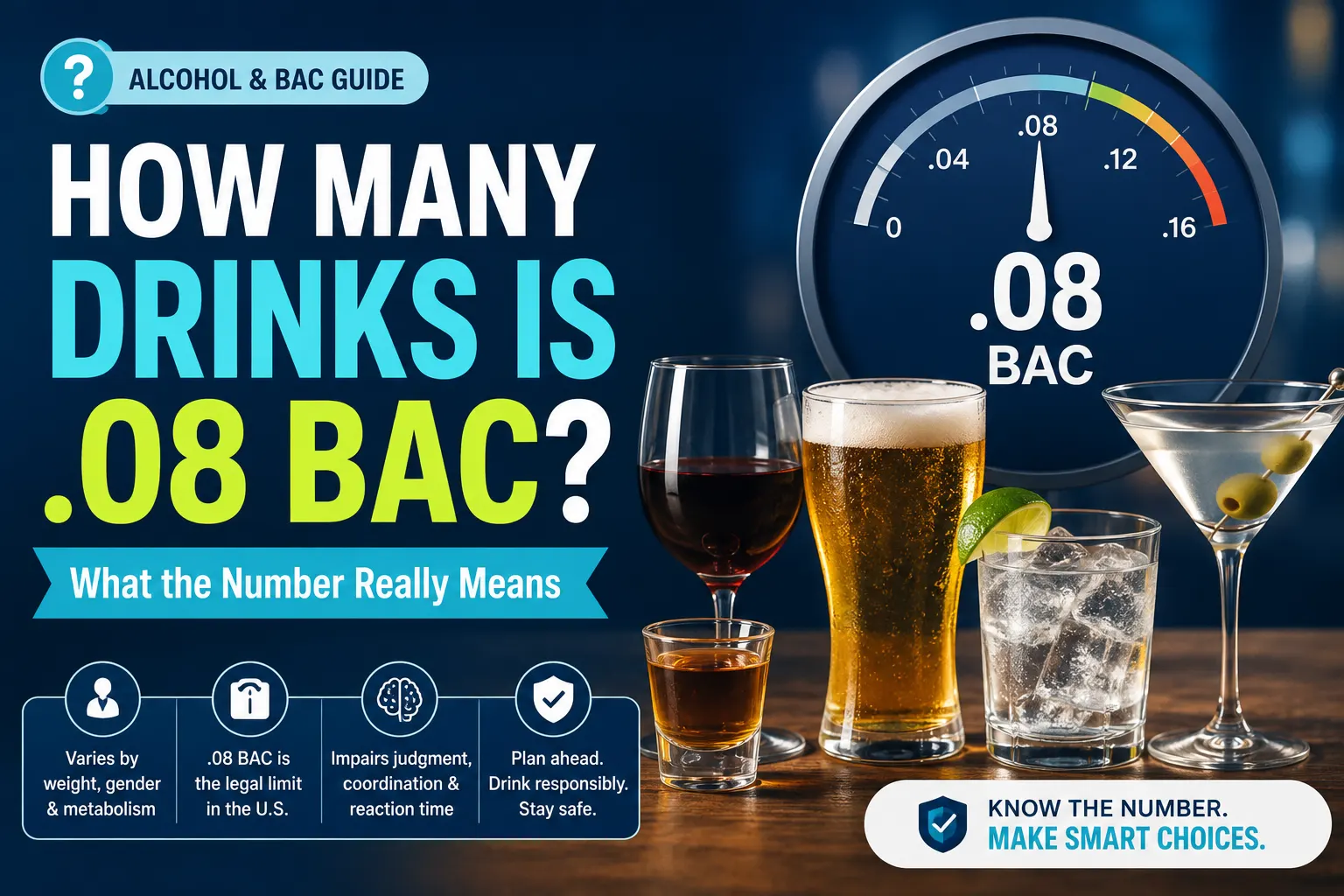
If you’re wondering how many drinks is .08 BAC, the short answer is that there is no exact number that works for everyone.
For a typical adult, the National Institute on Alcohol Abuse and Alcoholism (NIAAA) says reaching 0.08% BAC commonly corresponds to about 4 standard drinks for females or 5 for males within roughly two hours. Individual results can vary significantly.
That estimate is useful for understanding alcohol exposure, but it is not a safe-driving formula. Drink strength, serving size, drinking speed, food, body size, body composition, and metabolism can all change BAC. More importantly, driving ability can decline well before BAC reaches .08.
Quick Answer: How Many Drinks Typically Reach .08 BAC?
For a typical adult, NIAAA uses this population-level pattern when describing drinking that commonly raises BAC to 0.08% or higher:
| Typical Adult | Approximate Pattern |
|---|---|
| Female | 4 or more standard drinks in about 2 hours |
| Male | 5 or more standard drinks in about 2 hours |
These are general population estimates, not predictions for one individual. A person may reach .08 with fewer drinks, while another may reach a different BAC after the same amount because alcohol absorption and metabolism vary.
A bigger issue is what you mean by “one drink.” A strong IPA, oversized glass of wine, or double cocktail may contain two or more standard drinks even though it arrives as one beverage.
What Does .08 BAC Mean?
BAC stands for blood alcohol concentration. A BAC of 0.08% means there are 0.08 grams of alcohol per deciliter of blood. BAC reflects the concentration of ethanol in the bloodstream.
The number is important because alcohol affects brain function, judgment, coordination, vision, reaction time, and other skills needed for driving.
At .08 BAC, NHTSA says typical effects include poorer balance, speech, vision, reaction time, reasoning, memory, and danger detection. Driving effects include reduced concentration, weaker speed control, poorer perception, and slower information processing.
NHTSA also reports that a driver at .08 BAC is about four times more likely to crash than a driver with zero BAC.
What Counts as One Standard Drink?
A U.S. standard drink contains about 14 grams, or 0.6 fluid ounces, of pure alcohol. The beverage itself can be much larger because beer, wine, and spirits contain different percentages of alcohol.
| Beverage | Typical Serving | Alcohol Strength | Standard Drinks |
|---|---|---|---|
| Regular beer | 12 fl oz | 5% ABV | About 1 |
| Table wine | 5 fl oz | 12% ABV | About 1 |
| Distilled spirits | 1.5 fl oz | 40% ABV / 80 proof | About 1 |
Why One Beer or Cocktail May Count as Multiple Drinks
Counting glasses is one of the easiest ways to underestimate alcohol intake. Container size and ABV matter more than the number of glasses in front of you.
NIAAA’s standard-drink examples show how quickly serving sizes can add up.
| Actual Beverage | Approximate Standard Drinks |
|---|---|
| 12 oz regular beer at 5% ABV | 1 |
| 16 oz regular beer at 5% ABV | 1⅓ |
| 22 oz regular beer at 5% ABV | About 2 |
| 12 oz beer at 10% ABV | About 2 |
| 750 mL bottle of 12% wine | About 5 |
| 1.5 oz 80-proof spirit | 1 |
| Mixed drink or cocktail | 1 or more |
A Practical Example
Two Regular Beers
Two 12-ounce beers at 5% ABV contain approximately two standard drinks.
Two Strong Beers
Two 12-ounce beers at 10% ABV contain approximately four standard drinks.
Both people counted “two beers,” but the amount of alcohol consumed was very different. NIAAA specifically notes that a 12-ounce 10% beer contains about twice the alcohol of a 12-ounce 5% beer.
How to Estimate Standard Drinks From ABV
For a 16-ounce beer at 8% ABV:
16 × 0.08 ÷ 0.6 ≈ 2.1 standard drinks
So a 16-ounce beer at 8% ABV contains a little more than two U.S. standard drinks.
Why BAC Varies From Person to Person
Two adults can consume the same amount of alcohol and reach different BAC levels. That is one reason a weight chart or online calculator should never be treated as an exact personal result.
According to NIAAA and NHTSA, several major factors influence BAC.
Amount of Alcohol
The more ethanol you consume, the more alcohol enters your bloodstream. The important measurement is standard drinks, not simply bottles, shots, or glasses.
Drinking Speed
Drinking several servings quickly can make BAC rise faster because alcohol enters the blood faster than the body can metabolize it.
Spacing drinks farther apart changes the pattern, but there is no guaranteed drinks-per-hour rule that makes driving safe.
Body Weight and Body Water
Alcohol distributes through the water in the body. Differences in body size and body water can therefore change the concentration that results from the same dose.
Weight alone still cannot predict an individual BAC accurately.
Sex and Body Composition
NIAAA notes that women, on average, tend to have less body water per pound than men. As a result, a woman and man of the same weight can reach different BAC levels after consuming equal amounts of alcohol.
These are population averages. Individual physiology varies, so sex-based estimates should not be treated as personal guarantees.
Food
Alcohol enters the bloodstream faster when consumed on an empty stomach. Eating before or while drinking can slow absorption and may reduce the speed of the BAC rise.
Food does not remove alcohol once it has entered the bloodstream.
Metabolism
Alcohol metabolism varies among individuals because of factors including body mass, liver size, and genetics. NIAAA notes that the rate may be relatively steady for one individual while still differing substantially between people.
That variation makes exact “time until sober” predictions unreliable.
BAC Levels: What Happens at .02, .05, and .08?
NHTSA documents measurable changes in driving-related abilities at BAC levels considerably lower than .08.
| BAC | Typical Effects | Possible Driving Impact |
|---|---|---|
| .02 | Some judgment changes and relaxation | Reduced visual tracking and divided attention |
| .05 | Lower alertness, weaker judgment and coordination | Harder steering, tracking, and emergency response |
| .08 | Poorer coordination, reaction time, memory and reasoning | Weaker perception, concentration, speed control and information processing |
The difference matters because .08 is a legal threshold in most states, not the point where impairment suddenly begins.
NHTSA reported 2,028 deaths in 2024 crashes involving a driver with a BAC between .01 and .07, below the standard .08 per-se threshold.
The practical lesson is clear: below .08 does not automatically mean safe to drive.
Can BAC Keep Rising After Your Last Drink?
Yes. BAC can continue rising after a person stops drinking.
Alcohol remaining in the stomach and intestines may continue entering the bloodstream after the last sip. NIAAA warns that this can occur even when someone has stopped drinking or has become unconscious.
That assumption can be wrong. Depending on absorption and timing, a person’s BAC may still be increasing.
This is especially important after drinking several beverages quickly. The final drink does not instantly mark the beginning of sobriety.
How Long Does .08 BAC Last?
There is no universal answer for how long a BAC of .08 will last.
Alcohol must be metabolized, mainly by the liver. The process takes time, and NIAAA notes that metabolism rates can vary considerably among individuals.
Someone’s BAC may also continue increasing after drinking stops because unabsorbed alcohol remains in the digestive system.
- “One hour per drink means I’m safe.”
- “I’ve waited two hours, so I can drive.”
- “I feel normal now, so my BAC must be zero.”
- “A calculator says I’m under .08.”
MedlinePlus also notes that the timing of testing affects blood alcohol results and that alcohol can remain detectable in blood for hours after drinking.
Do Coffee, Water, Food, or Cold Showers Lower BAC?
Coffee may make you feel more alert. Water may help with hydration. A shower may make you feel awake. None of these makes the liver suddenly process alcohol faster.
☕ Coffee
Coffee does not make an intoxicated person sober. Caffeine can reduce sleepiness without restoring normal reaction time, judgment, or coordination.
💧 Water
Water does not remove alcohol from your bloodstream. Staying hydrated may be sensible, but hydration should not be confused with sobriety.
🍽️ Food
Eating before or during drinking may slow alcohol absorption. Eating afterward does not instantly eliminate alcohol already circulating in the blood.
🚿 Cold Showers
A cold shower can make someone feel temporarily more alert. It does not lower BAC or restore impaired driving skills.
How Is BAC Measured?
BAC can be measured in more than one way. NHTSA states that law enforcement may determine alcohol concentration using a breath test or blood test.
Breath Testing
A breathalyzer measures alcohol in exhaled breath and uses that information to assess alcohol concentration.
Breath testing is commonly associated with roadside impaired-driving investigations.
Blood Testing
A blood alcohol test measures ethanol directly in a blood sample.
MedlinePlus notes that blood alcohol testing can show the amount of alcohol present in a person’s blood and that timing affects the result.
What About BAC Calculators?
Online BAC calculators use assumptions about variables such as:
- Body weight
- Biological sex
- Drink quantity
- Drinking time
- Alcohol strength
Can You Be Too Impaired to Drive Below .08?
Yes.
The clearest evidence comes directly from NHTSA. At .02 BAC, changes in divided attention and visual functions can already occur. At .05, coordination, steering, object tracking, and responses to emergencies may decline.
This explains why asking only whether you are “under the limit” misses the larger safety issue.
Below .08
You may still have reduced attention, coordination, reaction time, or judgment.
Feeling Fine
Confidence and alertness do not prove that driving ability has returned to normal.
Alcohol itself can also make people worse at recognizing their own impairment. NHTSA warns that people may believe they are “fine” even when their ability to drive has already declined.
What Is the Legal BAC Limit in the United States?
For most adult drivers in the United States, .08 BAC is the per-se legal threshold. Utah is the major exception, with a .05 BAC limit for ordinary drivers.
A per-se limit means the BAC reading itself can establish the offense at or above that threshold without separate proof of unsafe driving.
However, this does not mean every BAC below the threshold is legally or practically safe. State impaired-driving laws and individual circumstances vary.
Drivers Under 21
All states have zero-tolerance rules for drivers under 21.
NHTSA reports that these limits are .02 BAC or lower, with the exact rule varying by state.
Commercial Drivers
Federal Motor Carrier Safety Administration rules establish .04 BAC as the threshold at which a CDL holder operating a commercial motor vehicle is considered under the influence and subject to federal disqualification rules.
| Driver Category | General BAC Threshold |
|---|---|
| Most ordinary adult drivers | .08 |
| Utah ordinary adult drivers | .05 |
| Drivers under 21 | .02 or lower, depending on state |
| CDL driver operating a commercial motor vehicle | .04 |
Can You Get a DUI With a BAC Below .08?
Yes, depending on the circumstances and state law.
The .08 figure is generally a per-se threshold, not a guarantee that driving below .08 cannot result in an impaired-driving charge.
NHTSA emphasizes that alcohol-related driving impairment begins below .08 and recommends laws addressing driving while impaired by alcohol or other drugs separately from the per-se BAC offense.
Alcohol Strength Matters More Than the Drink Name
Beer is not automatically weaker than wine. Wine is not automatically weaker than liquor.
What matters is the amount of pure ethanol consumed.
| Drink Example | Approximate Standard Drinks |
|---|---|
| 12 oz of 5% beer | ≈ 1 |
| 12 oz of 10% beer | ≈ 2 |
| 5 oz of 12% wine | ≈ 1 |
| 750 mL of 12% wine | ≈ 5 |
| 1.5 oz of 40% liquor | ≈ 1 |
| One cocktail | 1, 2, or more |
This distinction is particularly useful with IPAs, craft beer, strong hard seltzers, large restaurant pours, martinis, margaritas, and mixed drinks.
BAC Does Not Tell the Whole Story About Alcohol Risk
BAC is useful, but it does not capture every factor that can make drinking risky.
Certain prescription medicines, over-the-counter drugs, and other substances can interact with alcohol and increase impairment or other harmful effects. NIAAA warns that alcohol-medication interactions can be serious.
Tolerance can also be misleading. Someone who drinks frequently may feel fewer obvious effects at a given alcohol level, but feeling less intoxicated does not make driving safer.
Safer Choices If You Have Been Drinking
Make the transportation decision before drinking.
If driving is part of your evening, the simplest strategy is to make the transportation decision before the first alcoholic drink.
- Choose a sober designated driver before drinking begins.
- Use a taxi or rideshare instead of driving yourself.
- Take public transportation when practical and safe.
- Stay overnight rather than estimating when you are sober.
- Choose non-alcoholic beer, mocktails, soda, or sparkling water when you are the driver.
- Do not let a visibly impaired friend drive.
- Never rely only on how “normal” or alert you feel.
- Treat zero alcohol as the safest driving target, not .08.
Frequently Asked Questions
There is no exact number of beers that equals .08 BAC for every person. NIAAA’s typical-adult benchmark associates .08 with about four standard drinks for females or five for males in roughly two hours, but beer size and ABV can change the amount of alcohol dramatically.
A 12-ounce 10% beer contains about two standard drinks, while a 12-ounce 5% beer contains about one. Never use a beer count to decide whether you can drive.
There is no reliable personal number. A 1.5-ounce shot of 80-proof spirits contains approximately one U.S. standard drink, but larger pours and higher-proof spirits contain more alcohol.
Your BAC also depends on drinking speed, body characteristics, food, and metabolism.
It varies. A standard wine serving is 5 ounces at about 12% ABV, but many real pours are larger.
A standard 750 mL bottle of 12% wine contains about five standard drinks, while a 14% bottle contains nearly six.
For a typical adult, one true standard drink would not usually correspond to .08 BAC by itself. However, what looks like “one drink” can contain multiple standard drinks, and individual responses vary.
Do not use that generalization to judge driving safety. Impairment can begin at BAC levels far below .08.
For ordinary adult drivers, .08 is the per-se limit in most U.S. states. Utah uses .05.
From a safety standpoint, however, alcohol-related impairment begins earlier. NHTSA documents measurable driving effects at .02 and .05 BAC.
Eating before or during drinking can slow alcohol absorption, particularly compared with drinking on an empty stomach.
Food does not rapidly remove alcohol already in your blood and should not be used as a way to “sober up” before driving.
Yes. Alcohol remaining in the stomach and intestines can continue entering the bloodstream after drinking stops, so BAC may continue rising for a period afterward.
This is one reason the time of the final drink cannot reliably tell you when you will be safe to drive.
Sources and Editorial Standards
This guide was checked against current information available on August 20, 2026 from major U.S. public-health and transportation authorities.
Key references include the National Institute on Alcohol Abuse and Alcoholism (NIAAA) for standard-drink definitions, alcohol absorption, metabolism, and binge-drinking benchmarks; the National Highway Traffic Safety Administration (NHTSA) for driving impairment, crash statistics, and BAC laws; the Federal Motor Carrier Safety Administration (FMCSA) for commercial-driver requirements; and MedlinePlus for blood alcohol testing information.
Because alcohol-related health and impaired-driving questions can have serious consequences, this information should be treated as general education rather than personal medical or legal advice. State laws can change, and individual medical factors require professional guidance.
Conclusion
So, how many drinks is .08 BAC? For a typical adult, the widely used NIAAA benchmark is roughly four standard drinks for females or five for males within about two hours.
But that number is an average, not a personal prediction, and one beer, wine, or cocktail may contain more than one standard drink.
The most important point is that .08 is not a safe-driving target. Driving skills can decline at much lower BAC levels, and NHTSA data show serious crashes occur below .08.
If driving is part of your plans, arrange a sober ride or choose an alcohol-free drink rather than trying to calculate how close you are to the limit.