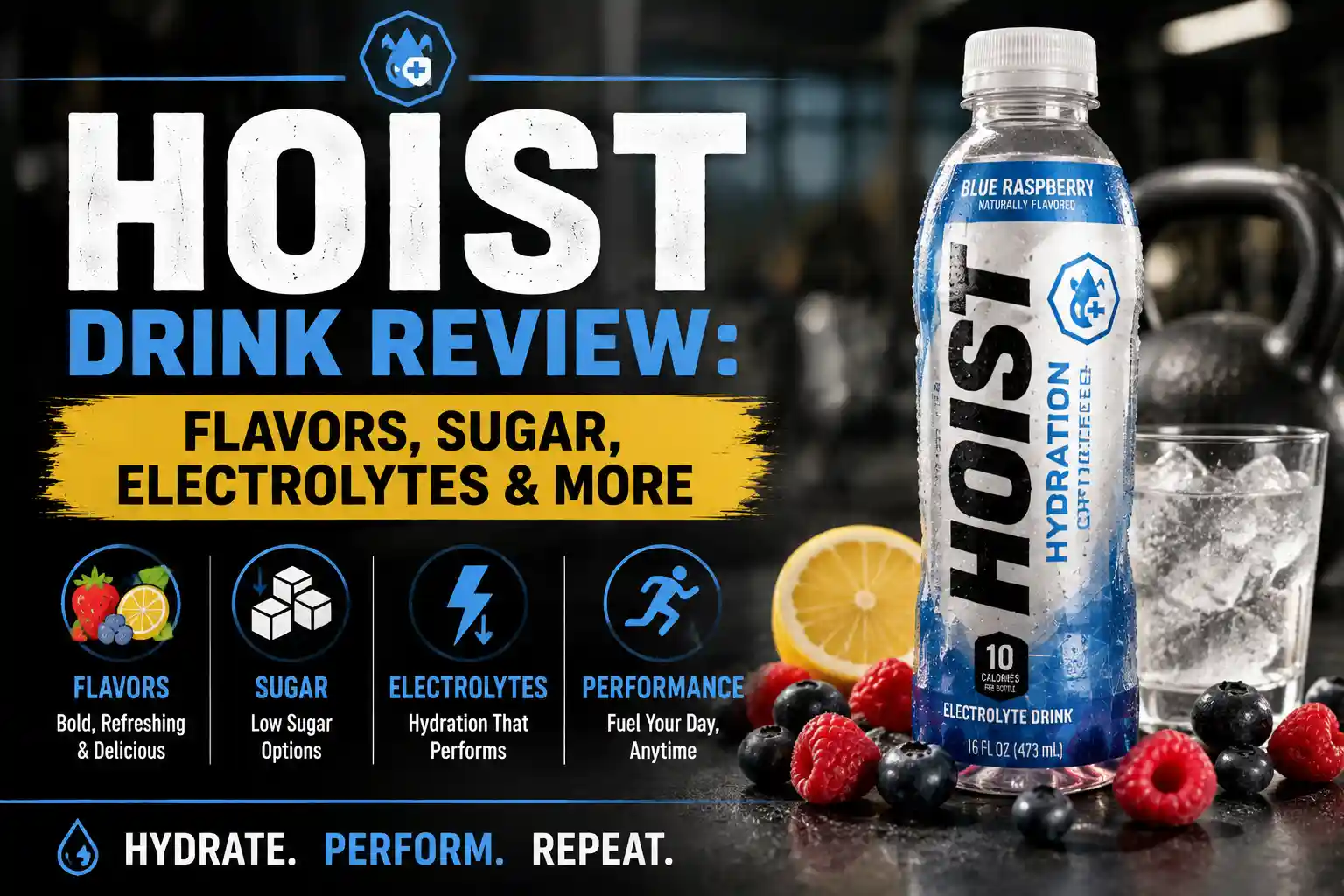
Everything you need to know about HOIST hydration drinks, including sugar, sodium, electrolytes, ingredients, flavors, price, military connection, comparisons and the best times to drink it.
Quick Answer: What Is a HOIST Drink?
HOIST is a non-caffeinated electrolyte hydration drink containing water, carbohydrates, sodium, potassium, magnesium and calcium. A current 16-ounce bottle provides 70 calories, 13g added sugar and 430mg sodium.
That makes HOIST most useful for exercise, hot weather, outdoor activities and periods of heavy sweating rather than ordinary everyday hydration.
HOIST Drink: TL;DR
- Type: Electrolyte hydration drink
- Caffeine: None listed in the current bottle formula
- Calories: 70 per 16-ounce bottle
- Added sugar: 13g
- Sodium: 430mg
- Other electrolytes: Potassium, magnesium and calcium
- Best use: Exercise, heat and heavy sweating
- Formats: Bottles, powder sticks and liquid pouches
- Popular flavors: Strawberry Lemonade, Peach Mango, Watermelon and more
What Is a HOIST Drink?
HOIST is a non-caffeinated electrolyte hydration beverage made by QCK, LLC. Its formula combines purified water, carbohydrates and several electrolytes, including sodium, potassium, magnesium and calcium.
The brand positions HOIST for situations where people may sweat heavily, including exercise, heat, outdoor work, travel and other demanding activities.
The important distinction is that HOIST is not simply flavored water. Its regular bottle contains both electrolytes and added sugar, so it is better viewed as a purposeful hydration drink than an everyday replacement for plain water.
HOIST Nutrition Facts: Calories, Sugar and Sodium
A current 16-ounce HOIST bottle contains about 70 calories, 14 grams of carbohydrate, 13 grams of total and added sugar, and 430mg of sodium. It also provides potassium, calcium and magnesium.
| Nutrient | Per 16 fl oz Bottle |
|---|---|
| Calories | 70 |
| Total carbohydrate | 14g |
| Total sugar | 13g |
| Added sugar | 13g |
| Sodium | 430mg |
| Potassium | 260mg |
| Calcium | 130mg |
| Magnesium | 20mg |
| Fat | 0g |
| Protein | 0g |
What’s in HOIST? Ingredients Explained
The current ingredient list starts with water and cane sugar, followed by citric acid, trisodium citrate, calcium lactate gluconate, potassium phosphate, natural flavors, dextrose, magnesium lactate, salt and stevia extract.
Purified Water
The primary fluid component of the drink.
Cane Sugar & Dextrose
Provide carbohydrate and sweetness.
Sodium Sources
Trisodium citrate and salt contribute sodium.
Mineral Sources
Potassium phosphate, magnesium lactate and calcium lactate gluconate supply electrolytes.
Citric Acid
Adds acidity and helps create the fruit-drink flavor.
Stevia Extract
Provides additional sweetness.
HOIST says its formula contains no high-fructose corn syrup, artificial sweeteners or artificial dyes. These are manufacturer statements, so they should be distinguished from broader claims about whether a beverage is “healthy.”
What Do the Electrolytes in HOIST Do?
The main electrolytes in HOIST are sodium, potassium, magnesium and calcium. These minerals have different roles in normal body function, including fluid balance, nerve signaling and muscle function.
- Sodium: Helps regulate fluid balance and supports normal nerve and muscle function.
- Potassium: Supports normal muscle and nerve function and fluid balance.
- Magnesium: Contributes to normal muscle and nerve function.
- Calcium: Supports normal muscle contraction and nerve signaling.
How HOIST’s Isotonic Formula Works
HOIST describes its beverage as an isotonic formula, meaning the formulation is designed around a balance of fluids, carbohydrates and electrolytes.
The brand also promotes claims such as “3x the electrolytes” and “half the sugar” compared with leading sports drinks. Those are HOIST’s product comparisons, not universal conclusions about every sports drink.
A practical way to view the formula is simple: HOIST gives you water plus electrolytes plus carbohydrate. Whether that combination is useful depends on what you’re doing.
HOIST Flavors: Which Ones Are Available?
The current HOIST collection lists seven ready-to-drink flavors, including Blaze Orange, Five Star Punch, Black Cherry, Blue Raspberry, Peach Mango, Strawberry Lemonade and Watermelon.
| Flavor | Flavor Profile |
|---|---|
| Peach Mango | Tropical fruit combination |
| Strawberry Lemonade | Sweet strawberry with tart lemonade |
| Watermelon | Classic watermelon profile |
| Black Cherry | Dark cherry-style fruit flavor |
| Blue Raspberry | Sweet berry profile |
| Five Star Punch | Classic fruit-punch style |
| Blaze Orange | Bright orange-citrus flavor |
Which HOIST Flavor Should You Try First?
Your safest first choice is the flavor profile you already know you enjoy.
| If You Prefer… | Try… |
|---|---|
| Tropical fruit | Peach Mango |
| Sweet and tart | Strawberry Lemonade |
| Watermelon | Watermelon |
| Dark berry | Black Cherry |
| Sweet berry | Blue Raspberry |
| Fruit punch | Five Star Punch |
| Citrus | Blaze Orange |
Is HOIST Worth Buying?
HOIST can be worth buying if you specifically want a flavored electrolyte drink with meaningful sodium and moderate carbohydrate. It makes less sense if you’re simply looking for an inexpensive everyday beverage.
HOIST Makes More Sense When You…
- Sweat heavily during exercise.
- Spend long periods outdoors in heat.
- Want substantial sodium.
- Prefer ready-to-drink bottles.
- Want carbohydrate with electrolytes.
- Need portable hydration.
HOIST Makes Less Sense When You…
- Mostly need routine hydration.
- Want minimal added sugar.
- Want the lowest cost per serving.
- Prefer zero-calorie electrolyte drinks.
- Don’t need additional sodium.
Practical Verdict
HOIST is more compelling as a purpose-driven hydration drink than as an everyday beverage. Its formula makes the most sense when you actually need fluids, electrolytes and some carbohydrate.
HOIST Bottles vs Powder Sticks
| Format | Best For | Main Advantage | Main Drawback |
|---|---|---|---|
| 16 oz bottle | Immediate hydration | No mixing | More space and weight |
| Powder stick | Travel and outdoor use | Lightweight | Requires water and mixing |
| Liquid pouch | Portable hydration | Compact | Availability varies |
When Should You Drink HOIST?
The strongest use cases are situations involving sweating, heat, prolonged activity or increased fluid needs.
Long Workouts
Especially useful when sweating is substantial.
Outdoor Sports
Useful when heat and activity combine.
Hiking
Convenient during longer routes.
Cycling
Portable during extended rides.
Yard Work
May be useful during prolonged hot-weather work.
Travel
Convenient when you’re moving around in heat.
For everyday desk work, light activity or a normal day at home, water remains the simplest hydration choice.
Is HOIST Good for Running and Sports?
For runners and athletes, the important variables are duration, intensity, temperature and sweat rate.
- Short, easy workout: Water may be enough.
- Longer training session: Electrolytes become more relevant.
- Hot-weather running: Pay closer attention to fluids and sodium.
- Long cycling sessions: Portable electrolyte drinks can be convenient.
- Team sports: Easy access to fluids matters.
- Heavy sweaters: Sodium replacement may deserve more attention.
Is HOIST Good for Hot Weather?
Hot weather can increase sweating and make hydration harder to manage during prolonged outdoor activity. That’s one situation where an electrolyte drink can have a clearer purpose.
- Start outdoor activities well hydrated.
- Carry enough fluid for the planned activity.
- Drink regularly during prolonged exertion.
- Use electrolytes when sweating heavily.
- Take breaks from direct heat.
- Wear appropriate clothing and sun protection.
- Keep bottles cool when possible.
Is HOIST Healthy?
Calling any drink simply “healthy” misses the important details.
HOIST provides electrolytes, water and carbohydrate, which can be useful in certain situations. But a regular 16-ounce bottle also contains 13g of added sugar and 70 calories.
HOIST’s Advantages
- 430mg sodium per 16-ounce bottle.
- Four key electrolytes.
- Carbohydrate during prolonged activity.
- No caffeine listed on current bottle nutrition information.
- No high-fructose corn syrup according to the brand.
- Convenient ready-to-drink format.
Things to Consider
- 13g added sugar per bottle.
- 70 calories per bottle.
- Sodium may be unnecessary for sedentary days.
- Bottles can cost more than ordinary water.
- Powder and bottle nutrition are not necessarily identical.
Is HOIST Good for Kids?
For most routine hydration, water remains the simplest choice for children. An electrolyte drink may make more sense during prolonged sports, significant sweating or hot outdoor activity.
Parents should pay attention to the product’s 13g of added sugar per 16-ounce bottle and consider the child’s overall diet.
Is HOIST Good for a Low-Sugar Diet?
Regular HOIST is not sugar-free. A 16-ounce bottle currently contains 13g of added sugar.
| Your Goal | How HOIST Fits |
|---|---|
| Need carbohydrate + electrolytes | Can fit |
| Want zero sugar | Consider a sugar-free alternative |
| Counting calories | Include 70 calories |
| Watching sodium | Remember 430mg per bottle |
| Long endurance activity | Carbohydrate may be useful |
| Casual drinking | Water may be simpler |
HOIST vs Gatorade, Liquid I.V. and LMNT
The best comparison is based on serving size, sodium, sugar, carbohydrates, calories, format and intended use.
| What Matters | HOIST | Alternatives |
|---|---|---|
| Sodium | 430mg / 16 oz | Varies by formula |
| Sugar | 13g added | Zero to high |
| Calories | 70 | Varies |
| Format | Bottle, powder, pouch | Bottle, powder, tablet or stick |
| Carbohydrate | 14g | Varies widely |
| Best fit | Active hydration with carbs | Depends on product |
HOIST vs Gatorade
HOIST is worth considering if sodium and lower sugar than a traditional full-sugar sports drink are priorities. However, the exact comparison depends on which Gatorade product you choose.
HOIST vs Liquid I.V.
Liquid I.V. is primarily known for powdered hydration sticks, while HOIST offers a strong ready-to-drink bottle option. The better choice often comes down to portability versus immediate convenience.
HOIST vs LMNT
LMNT is designed around a much higher-sodium formulation than most mainstream sports drinks. HOIST is better viewed as a moderate-sodium, carbohydrate-containing hydration option.
HOIST Military Connection: What Does It Mean?
Military positioning is a major part of the HOIST brand story. The company says its hydration product was selected as an electrolyte hydration solution by the U.S. Military and authorized by the Department of Defense.
That is relevant brand information, but it should not be treated as proof that HOIST is automatically superior for every consumer.
The official site also identifies William M. Adams, PhD, ATC, an assistant professor and director of the Hydration, Environment, and Thermal Stress Lab at the University of North Carolina at Greensboro, in connection with clinical research prepared for HOIST.
HOIST and Everyday Hydration
HOIST doesn’t need to replace water to be useful. The easiest way to use it sensibly is to treat it as a special-purpose beverage rather than your default drink.
If you’re working at a desk, eating lunch or running a few errands, water is usually the straightforward choice. If you’re sweating heavily during a long workout or working outside in summer heat, an electrolyte beverage may make more sense.
HOIST Powder Sticks: A Different Nutrition Profile
One important mistake is assuming every HOIST product has the same nutrition.
Current independent product information for HOIST IV-Level Hydration Powder Sticks lists approximately 100 calories, 24g sugar and 300mg sodium per stick, with a suggested mixing range of 16–20 ounces of water.
Choose Bottles If You Want
- No preparation
- Immediate drinking
- Consistent 16-ounce serving
- Easy refrigeration
- Grab-and-go convenience
Choose Powder If You Want
- Less bulk
- Easier travel
- Long-term portability
- Mix-when-needed convenience
How to Choose the Right HOIST Product
Start with the situation, not the flavor.
- Long outdoor activity: Consider a bottle or powder.
- Hot-weather exercise: Look for fluids plus electrolytes.
- Short workout: Water may be enough.
- Travel: Powder is easier to pack.
- Immediate convenience: Choose a ready-to-drink bottle.
- Lower sugar: Compare with zero-sugar alternatives.
- High sodium: Compare with products such as LMNT.
- Trying flavors: Start with a variety pack.
Final HOIST Drink Verdict
HOIST is a legitimate electrolyte beverage with a clear use case, especially for people who want sodium, carbohydrates and fluids in one ready-to-drink product.
Its current 16-ounce bottle provides 70 calories, 13g added sugar and 430mg sodium, plus potassium, magnesium and calcium.
The biggest reason to buy it isn’t the military branding or the word “hydration” on the bottle. It’s the formula and whether that formula matches what you’re doing.
Frequently Asked Questions About HOIST Drink
Is HOIST an energy drink?
No. HOIST is positioned as a hydration drink rather than a caffeinated energy drink. Its current formula centers on water, carbohydrates, electrolytes and flavoring.
How much sugar is in a HOIST drink?
A current 16-ounce bottle contains 13g of total and added sugar and 14g of total carbohydrate. It provides 70 calories per bottle.
Does HOIST have electrolytes?
Yes. HOIST contains sodium, potassium, magnesium and calcium. A current 16-ounce bottle provides 430mg sodium, 260mg potassium, 130mg calcium and 20mg magnesium.
Is HOIST better than water?
Not for every situation. Water is usually the simpler choice for routine hydration. HOIST becomes more relevant when you want electrolytes and carbohydrate during or after prolonged sweating.
Is HOIST good for running?
It can be useful for longer runs, hot-weather training or sessions involving substantial sweating. For a short, easy run, many people won’t need the additional sugar and electrolytes.
Which HOIST flavor is best?
There is no objective winner because flavor preference is personal. Strawberry Lemonade suits sweet-tart preferences, while Peach Mango works for tropical-fruit fans and Five Star Punch fits classic fruit-punch preferences.
Does HOIST contain artificial sweeteners?
The brand says its formula contains no artificial sweeteners and lists Rebaudioside A, or stevia extract, as the sweetener in the current ingredient list. Check the package for the exact product you purchase.
Is HOIST safe for kids?
Water should remain a normal everyday beverage for most children. For prolonged sports, heavy sweating, medical conditions or special dietary needs, parents should consider the child’s individual situation and speak with a pediatrician when appropriate.
Is HOIST good for a low-sugar diet?
Regular HOIST contains 13g of added sugar per 16-ounce bottle, so it isn’t a zero-sugar option. Compare it with a sugar-free electrolyte drink if minimizing added sugar is your priority.
How much does HOIST cost?
The official HOIST store currently lists many 12-bottle cases at $39.99, or about $3.33 per bottle before shipping or discounts. Its current Fruit Punch powder-stick pack is listed at $23.99. Prices can change.
The Bottom Line
HOIST is best used as an electrolyte hydration drink for active situations—not as a mandatory replacement for water. Its combination of sodium, other electrolytes, carbohydrate and flavor gives it a clear purpose when sweating is substantial.
For the best fit, choose your format, flavor, sugar level, sodium level and price based on how you’ll actually use the drink. That approach is more useful than choosing a beverage simply because its marketing sounds impressive.
Read More:
What Can I Drink After a Tooth Extraction
100 Fruit Drink Recipes: Juices, Smoothies & Mocktails
16 Best Non-Alcoholic After Dinner Drinks for Any Evening
Best Places for Non-Alcoholic Drinks in Las Vegas: 2026 Guide
Bob Marley Mocktail: Easy Non-Alcoholic Layered Drink
Liquid Maria Juana Drink: Easy Tropical Cocktail Recipe
Gasolina Drink: Flavors, ABV, Ingredients & More