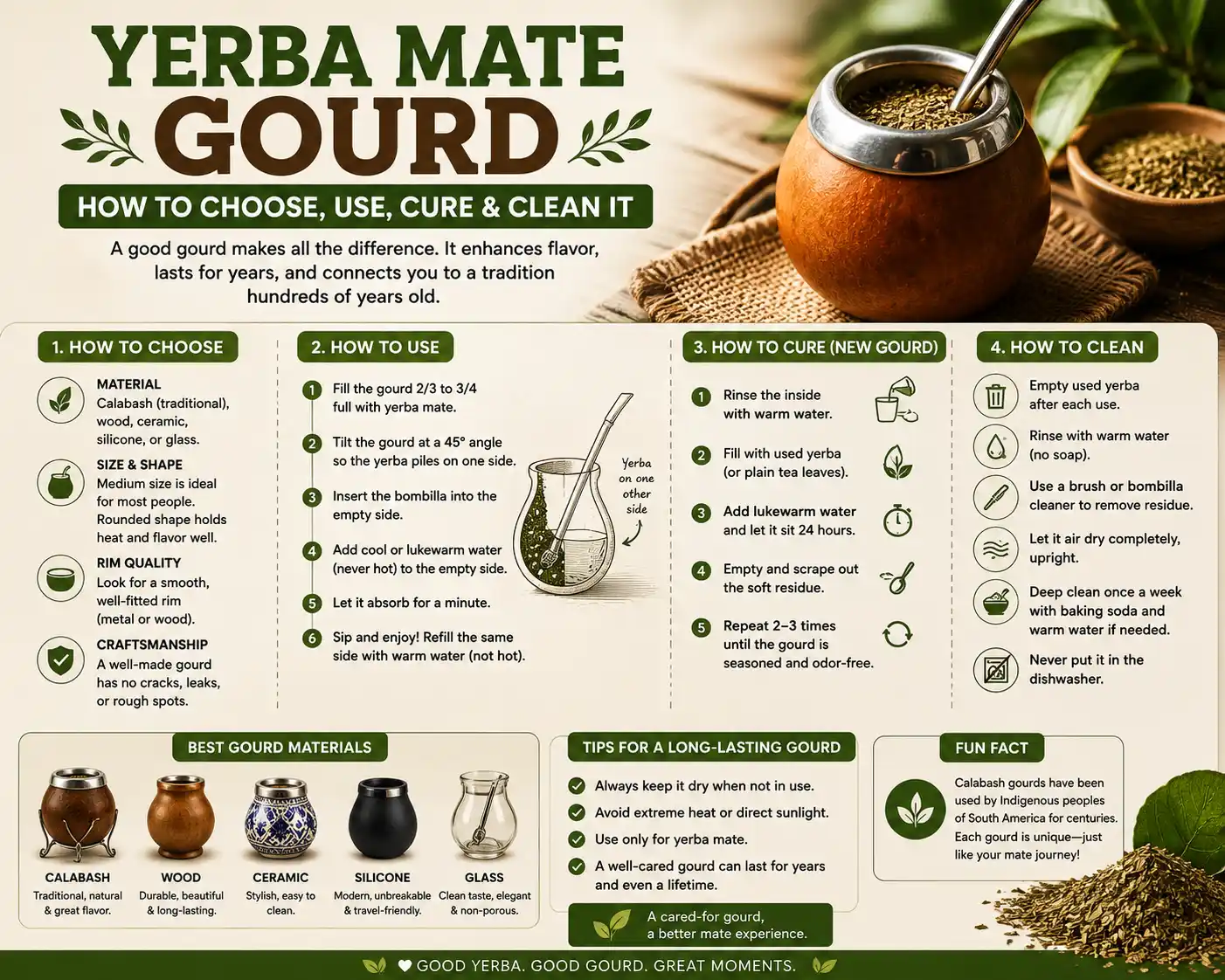
Mate Drinking Gourd Guide: Best Gourds, Sizes, Types, Care & Brewing
Discover which mate drinking gourd is right for you—from traditional calabash and Argentine styles to stainless steel, ceramic, Brazilian cuia and Paraguayan guampa. Learn how to choose, cure, clean and use your gourd with confidence.
A mate drinking gourd, more commonly called a yerba mate gourd or simply a mate, is the cup used for traditional yerba mate. You fill it with loose yerba, add water, and sip through a filtered straw called a bombilla.
Choosing a gourd seems simple until you see calabash, stainless steel, ceramic, wood, camionero, torpedo, cuia, and guampa options. Some need curing. Others need almost no maintenance. The right choice also changes with your yerba, bombilla, drinking style, and whether you prefer hot mate or cold tereré.
This guide explains those differences without making you memorize every tradition before your first drink.
Quick Answer: What Mate Gourd Should You Choose?
For most first-time drinkers, a medium stainless steel yerba mate gourd is the easiest starting point. It doesn’t need curing, handles regular washing well, and removes much of the moisture-management work that comes with natural calabash.
Choose calabash if you want a more traditional experience and don’t mind extra care. Choose ceramic or glass for neutral flavor and easy home use. Choose a guampa-style vessel for cold tereré, while a Brazilian cuia and bomba are better suited to finely ground chimarrão.
| If You Want… | Good Starting Choice | Why |
|---|---|---|
| Easiest first gourd | Stainless steel | No curing and simple cleanup |
| Traditional experience | Calabash | Classic natural mate vessel |
| Neutral flavor | Ceramic or glass | Nonporous interior |
| Work or travel | Double-wall stainless steel | Durable and low-maintenance |
| Cold tereré | Guampa or durable mate cup | Works well with cold refills |
| Brazilian chimarrão | Cuia with a bomba | Shape suits finely ground erva |
| Decorative traditional style | Camionero, torpedo, or imperial | Wide opening and classic design |
What Is a Mate Drinking Gourd?
A yerba mate gourd is the vessel that holds the loose yerba while you drink. Traditionally, many gourds were made from dried calabash. Today, the same general shape is made from steel, ceramic, glass, wood, silicone, and other materials.
The word can be confusing because mate may describe both the beverage and the cup. The drink is prepared from Ilex paraguariensis, a plant native to South America.
The Four Parts of a Basic Mate Setup
- Yerba mate: The dried leaves and stems placed inside the gourd.
- Mate gourd: The cup that holds the yerba and water.
- Bombilla: A metal straw with a filter at its lower end.
- Hot water: Added in small pours throughout the session.
A thermos is also useful because mate is normally refilled repeatedly rather than prepared as one large cup.
Technically, you can drink yerba mate from an ordinary mug. The special gourd becomes useful because its shape supports the traditional preparation method.
A suitable gourd gives you enough room to form a yerba mountain, place the bombilla along one side, and add repeated small pours without soaking all the leaves at once.
Which Yerba Mate Gourd Material Is Best?
Material has more effect on daily use than decoration. A beautiful natural gourd can be rewarding, but it also demands more care than a stainless steel cup.
The best choice depends on whether you value tradition, easy cleaning, durability, neutral flavor, or portability.
| Material | Best For | Curing Needed? | Care Level | Main Trade-Off |
|---|---|---|---|---|
| Calabash | Traditional mate | Usually | High | Must dry thoroughly |
| Stainless steel | Beginners and travel | No | Very low | Less traditional feel |
| Ceramic | Home use | No | Low | Can break |
| Glass | Neutral flavor | No | Low | Fragile |
| Wood | Natural feel | Often varies | Medium-high | Can absorb moisture |
| Silicone | Travel and casual use | No | Low | Less traditional |
| Horn | Certain traditional styles | Material-specific | High | Requires careful care |
Calabash Mate Gourd
A calabash gourd offers the classic natural experience. Over time, the inside can darken and develop its own seasoned appearance.
The disadvantage is moisture. Natural calabash must be emptied, rinsed, and dried carefully after use.
Stainless Steel Mate Gourd
Stainless steel is the simplest option for many beginners. It doesn’t need curing, doesn’t absorb flavors easily, and tolerates everyday cleaning.
A double-wall version can also make the exterior more comfortable to hold.
Ceramic and Glass Mate Cups
Ceramic and glass are good choices when you want the yerba itself to drive the flavor. Neither develops the same seasoned interior as calabash.
Their main weakness is breakage.
Wooden Mate Gourds
Wood can feel warmer and more traditional than metal. However, care varies by wood species, finish, and construction.
Check the maker’s instructions before curing or washing a wooden mate.
What Size Mate Gourd Should a Beginner Buy?
Gourd capacity affects strength, leaf use, session length, and caffeine exposure. There is no official universal “small, medium, large” standard, so look at the actual capacity in ounces or milliliters.
| Approximate Capacity | Best Use |
|---|---|
| 4–6 oz / 120–180 mL | Short sessions and lower yerba use |
| 6–10 oz / 180–300 mL | Good general beginner range |
| 10 oz+ / 300 mL+ | Longer sessions and experienced drinkers |
For many beginners, a gourd near 8 ounces / 240 mL gives enough working space without demanding a huge amount of yerba.
Don’t Judge Size by Capacity Alone
- Opening width: Wider openings make shaping the yerba easier.
- Bombilla length: The straw should reach the bottom comfortably.
- Base stability: Important if you drink while working.
- Wall thickness: Thick natural walls reduce internal space.
- Grip: The gourd should sit comfortably in one hand.
Common Mate Gourds and Regional Styles
Mate is not one identical drinking tradition across South America. Argentina, Uruguay, Paraguay, and southern Brazil have overlapping customs but also distinct vessels, yerba cuts, and preparation styles.
Argentina: Calabash and Porongo
Natural calabash remains strongly associated with traditional Argentine mate. The term porongo may also be used for certain larger gourd forms.
Uruguay: Camionero, Torpedo, and Imperial
Uruguayan yerba tends to be finer and more powder-heavy than many Argentine blends. Wide-opening gourds make forming a stable mountain easier.
Camionero
A camionero typically has a generous opening and practical shape, giving the drinker plenty of room to form the mound.
Torpedo
The torpedo style narrows toward its lower portion and has a broad upper opening. It is popular with drinkers who enjoy a pronounced yerba mountain.
Imperial
An imperial mate usually refers to a more elaborate style, often with decorative leather and metal details.
Brazilian Cuia
In southern Brazil, chimarrão uses very finely ground erva-mate. The traditional vessel is a cuia, while the filtered straw is called a bomba.
Paraguayan Guampa
In Paraguay, guampa is strongly associated with tereré. Modern guampas can be made from metal and other materials, not only traditional horn.
Tereré has deep cultural importance in Paraguay. UNESCO inscribed the practices and traditional knowledge of tereré in the culture of Pohã Ñana on the Representative List of the Intangible Cultural Heritage of Humanity in 2020.
What You Need to Drink Yerba Mate From a Gourd
You don’t need an expensive starter kit. A basic setup should solve practical problems rather than add decorative accessories.
Essential Gear
- A gourd: Steel, calabash, ceramic, glass, or another suitable material.
- A bombilla: Long enough to reach the bottom.
- Yerba mate: Choose a cut appropriate for your experience.
- A kettle: Temperature control is helpful.
- A thermos: Useful for keeping refill water ready.
Helpful Extras
- Bombilla cleaning brush
- Small spoon for emptying wet yerba
- Drying rack for natural gourds
- Travel container for dry yerba
- Thermometer if your kettle lacks temperature control
How to Prepare Yerba Mate in a Gourd
Traditional mate works differently from ordinary steeped tea. You don’t fill a tea infuser, wait several minutes, and remove the leaves. Instead, the yerba stays inside while you drink and refill it repeatedly.
Traditional Yerba Mate Gourd Preparation
A beginner-friendly approach to building the yerba mountain and controlling each refill.
- Fill the gourd: Fill roughly one-half to two-thirds of the usable space with dry yerba.
- Settle and tilt: Cover the opening and gently shake. Tilt the gourd so the yerba collects along one wall.
- Moisten the low side: Add a small amount of cool or lukewarm water into the empty lower area.
- Insert the bombilla: Slide it into the wet side until its filter sits near the bottom. Leave it there.
- Add hot water: Pour a small amount beside the bombilla instead of flooding the whole surface.
- Sip and refill: Sip until most liquid is gone, then add another small pour to the same wet area.
- Use the dry side later: As flavor weakens, let water reach more of the dry mound.
- Replace the yerba: When it becomes lavado, empty the gourd and start fresh.
How Much Yerba Should You Use?
- About half full: Easier and lighter first session.
- Around two-thirds full: Fuller traditional setup.
- Less yerba: Useful for unusually large gourds or caffeine-sensitive drinkers.
Don’t feel obligated to use a traditional two-thirds fill immediately. Starting with less yerba gives you more control while learning water placement and refill technique.
How to Choose the Right Bombilla
A beautiful gourd can still give a frustrating experience if the bombilla filter doesn’t suit the yerba. Filter design matters more as the yerba becomes finer and dustier.
Coarser Argentine-Style Yerba
Coarser blends with visible stems are relatively forgiving. A spoon, spring, or slotted bombilla will often work well.
Fine Uruguayan-Style Yerba
Fine leaf and dust can pass through weak filters or clog small ones. Look for fine filtration across a larger surface area.
Brazilian Chimarrão
Chimarrão is extremely fine and powdery. Brazilian preparation commonly uses a larger spoon-shaped bomba, sometimes with an extra filter sleeve called a camisinha.
The wet yerba around the filter acts as another filtration layer. Moving the bombilla can break that structure and send fine particles toward the filter holes.
If your bombilla clogs repeatedly, check the yerba cut, filter design, and preparation technique before assuming the straw is defective.
Best Water Temperature for Yerba Mate
A common preparation range is roughly 150–175°F (65–80°C). Lower temperatures usually create a softer infusion, while hotter water can bring bitterness out faster.
The temperature of water entering the gourd is not a target temperature for swallowing the drink.
The International Agency for Research on Cancer defines beverages consumed above 65°C / 149°F as “very hot.” The concern is very hot beverage consumption, not yerba mate uniquely.
Practical rule: prepare mate with hot water, but let each pour cool enough to sip comfortably. Avoid making a habit of swallowing scalding liquid.
Avoid Boiling Water
Boiling water tends to extract bitterness aggressively and can make the first pours unpleasant. If your kettle reaches a full boil, allow the water to cool before pouring.
Yerba Mate Caffeine: What Gourd Drinkers Should Know
Yerba mate naturally contains caffeine. Because a traditional gourd is repeatedly refilled, total intake depends on much more than the cup’s physical capacity.
A 2025 scientific review reported substantial variation in mate caffeine content and cited roughly 78–196 mg per 500 mL, depending on preparation and other factors.
Factors include:
- Amount of dry yerba
- Brand and cultivar
- Leaf and stem ratio
- Gourd size
- Number of refills
- Water temperature
- Total water consumed
If you’re caffeine-sensitive, start with less yerba and a shorter session. Caffeine sensitivity varies considerably between individuals.
How to Cure a Natural Mate Gourd
Curing prepares a new porous gourd before repeated use. It is mainly relevant to natural calabash and certain wooden or horn vessels.
Stainless steel, glass, ceramic, and silicone generally do not require traditional curing.
Simple Calabash Curing Method
Use maker-specific instructions first when they are available.
- Rinse gently: Remove loose dust or plant material.
- Add yerba: Used damp yerba or fresh yerba can be used.
- Moisten: Use warm water and avoid boiling water.
- Let it sit: Follow the maker’s suggested curing time when available.
- Empty the yerba: Remove the used material.
- Scrape gently: Remove loose soft fibers with a spoon rather than a sharp tool.
- Rinse: Give the interior another gentle rinse.
- Dry completely: Place the gourd somewhere with strong airflow.
Curing does not make a natural gourd maintenance-free. You still need to empty, rinse, dry, and ventilate it after use.
How to Clean, Dry, and Store a Mate Gourd
The biggest cleaning mistake is treating every gourd material the same way. A porous calabash has different needs from a stainless steel cup.
| Gourd Material | Basic Cleaning | Soap? | Drying |
|---|---|---|---|
| Calabash | Empty and rinse | Usually avoid scented soap inside | Thorough airflow |
| Wood | Follow maker guidance | Depends on finish | Thorough drying |
| Stainless steel | Wash normally | Usually yes | Easy to dry |
| Ceramic | Wash normally | Yes | Normal drying |
| Glass | Wash normally | Yes | Normal drying |
| Silicone | Follow maker guidance | Usually yes | Normal drying |
Cleaning a Natural Calabash
- Scoop out the wet yerba.
- Rinse the interior.
- Remove loose residue gently.
- Shake out excess water.
- Place the gourd where air can move through it.
- Leave it open until completely dry.
Avoid sealing a damp calabash inside a cabinet, travel case, or plastic bag. Moisture trapped inside can create conditions for unwanted growth and unpleasant odors.
Cleaning a Bombilla
- Rinse it with warm water after drinking.
- Flush water through the tube.
- Use a narrow bombilla brush regularly.
- Check removable filters for trapped particles.
- Allow it to dry before storage.
Mate Gourd Mold vs. Normal Dark Staining
Natural calabash changes color with use. Green, brown, gray, or dark patches can be normal staining from yerba.
Normal Seasoning May Look Like
- Flat dark patches
- Greenish staining
- Uneven brown areas
- Smooth discoloration
- Darkening that remains after drying
More Concerning Signs
- Fuzzy or raised growth
- Persistent musty odor
- Unusual soft decay
- Growth that returns after cleaning
- A gourd that never dries properly
If there is obvious active mold or serious deterioration and you cannot confidently restore the vessel, replace the gourd rather than drinking from it.
Common Mate Gourd Problems and Quick Fixes
| Problem | Likely Cause | Practical Fix |
|---|---|---|
| Bombilla keeps clogging | Fine yerba or disturbed filter bed | Use better filtration and stop stirring |
| Leaves enter the straw | Filter holes too large | Match bombilla to finer yerba |
| Mate tastes extremely bitter | Water too hot or overly strong setup | Lower temperature or use less yerba |
| Flavor dies quickly | Whole mound soaked at once | Pour into one controlled area |
| Mountain collapses | Too much water or weak initial slope | Use smaller pours and compact the slope gently |
| Gourd smells musty | Slow drying | Improve airflow and inspect for mold |
| Natural gourd cracks | Drying stress, impact, or aging | Stop using it if it leaks or is structurally damaged |
| Water sits on top | Fine yerba packed too tightly | Create a better water pocket before inserting bombilla |
| Mate splashes over rim | Too much yerba or water | Reduce fill level |
| Bombilla gets hot | Very hot water and metal conduction | Allow the drink to cool before sipping |
If Your Mate Is Too Strong
- Use a smaller amount of yerba.
- Use cooler water.
- Reduce the number of refills.
- Choose a smaller session.
- Try a blend with more stems.
If Your Mate Is Too Weak
Check whether you flooded the entire mound early. A properly managed dry side gives you more fresh leaf to introduce later in the session.
Tereré: Using a Gourd for Cold Yerba Mate
Tereré is not simply hot mate with ice dropped into the cup. It is a distinct cold preparation with deep roots in Paraguay and Guaraní culture.
Tereré traditionally involves cold water and Pohã Ñana, with the drink served through a bombilla from a vessel containing yerba mate. UNESCO recognizes the cultural practices and traditional knowledge surrounding Paraguayan tereré.
Simple Cold Yerba Mate for Home
A straightforward cold preparation using a gourd or guampa.
- Add yerba to a gourd or guampa.
- Form a slight slope.
- Place the bombilla in the lower side.
- Prepare very cold water with ice in a separate thermos or pitcher.
- Pour small amounts over the same area.
- Sip and refill.
Best Gourd for Tereré
- Stainless steel guampa
- Traditional guampa
- Stainless mate cup
- Glass
- Durable plastic or silicone travel vessel
How to Share Yerba Mate Properly
Sharing mate is part of the drink’s cultural identity. The person managing the gourd is commonly called the cebador.
Basic Sharing Etiquette
- The cebador prepares and manages refills.
- Drink the liquid in your turn.
- Return the gourd to the cebador.
- Avoid stirring or repositioning the bombilla.
- Let the cebador manage the next pour.
Modern Hygiene Preferences
Ask before adding sugar, herbs, or citrus to a shared gourd. Traditional sharing is important, but modern hygiene preferences are valid. Separate gourds or bombillas can be used when a group prefers them.
Mate Gourd Buying Checklist
Ignore decoration for a moment. A useful first gourd needs to work with your actual drinking habits.
- Material: Traditional character or easy maintenance?
- Capacity: Will it use more yerba than you want?
- Opening width: Is there room to shape a mound?
- Base: Will it stand securely on your desk?
- Bombilla fit: Does the straw reach the bottom?
- Yerba style: Coarse mate, fine Uruguayan yerba, or chimarrão?
- Cleaning: Are there seams or narrow areas that complicate washing?
- Travel needs: Could it crack or leak in a bag?
Best First Setup for Most Beginners
A low-maintenance combination for learning the basics.
- Medium stainless steel gourd
- Stainless spoon-style bombilla
- Coarse or medium-cut yerba with stems
- Kettle or thermos
- Bombilla brush
It removes curing and natural-gourd moisture concerns while you learn water placement, bombilla positioning, and refill technique.
Frequently Asked Questions About Mate Gourds
Is a mate gourd the same as a calabash?
No. Calabash is a traditional material used to make a mate gourd. Modern gourds can also be stainless steel, ceramic, glass, wood, silicone, and other materials.
Can I drink yerba mate from a normal mug?
Yes. You do not need a traditional calabash. However, a mate-shaped vessel makes it easier to form the leaf mound, position the bombilla, and manage repeated pours.
What size mate gourd is best for beginners?
A practical starting point is roughly 6–10 ounces (180–300 mL), with around 8 ounces / 240 mL being an easy reference size.
Does every yerba mate gourd need curing?
No. Natural calabash and some wood or horn vessels may require curing. Stainless steel, glass, ceramic and silicone generally do not.
Can you use soap on a mate gourd?
It depends on the material. Soap is normally fine for steel, glass and ceramic when the maker allows it. Strong scented soap is commonly avoided inside porous natural calabash.
Why does my bombilla keep clogging?
Common reasons include fine yerba, poor filtration, stirring the bombilla, or collapsing the leaf mound. Match the bombilla to your yerba cut and leave it in place.
How many times can I refill a mate gourd?
There is no fixed number. Keep refilling while the yerba produces flavor you enjoy. Stop when it becomes watery or lavado.
Can a yerba mate gourd go in the dishwasher?
It depends on material and construction. Plain dishwasher-safe glass, ceramic or steel may tolerate machine washing, but natural calabash, wood, leather-wrapped vessels and decorative metalwork should not be assumed dishwasher-safe.
How do I know when a calabash gourd is dry?
The interior should feel dry, have no obvious wet patches, and lack a damp or musty smell. Keep it exposed to airflow before storage.
Is dark coloring inside a mate gourd mold?
Not necessarily. Yerba naturally stains porous calabash. Flat discoloration can be normal, while fuzzy growth, persistent musty odors or soft deterioration are more concerning.
What is the difference between mate and tereré?
Mate is usually prepared with hot water, while tereré uses cold water and is especially associated with Paraguay.
Is yerba mate caffeinated?
Yes. Yerba mate naturally contains caffeine. The amount in a session varies because traditional preparation uses different quantities of dry yerba and repeated refills.
Final Verdict: Which Mate Drinking Gourd Is Best?
A good mate drinking gourd should make yerba mate easier to enjoy, not turn your first session into an equipment problem. For most beginners, stainless steel offers the simplest route because it skips curing and complicated drying.
Natural calabash becomes more appealing when you want the traditional feel and are ready for extra care.
The gourd is only one part of a good setup. Match your bombilla to the yerba, leave enough room to build a mountain, use controlled water pours, and keep brewing temperature separate from safe sipping temperature.
Once those basics are comfortable, you can explore calabash, camionero, torpedo, imperial, cuia, chimarrão, guampa, and tereré with a much clearer sense of what each style changes.