Legal Drinking Age in Japan: Is It 18, 20 or 21? Complete 2026 Guide
Learn Japan’s legal drinking age, rules for American tourists, ID requirements, Shibuya street-drinking restrictions, train etiquette, driving laws, bicycle rules, and practical tips for drinking responsibly while traveling.
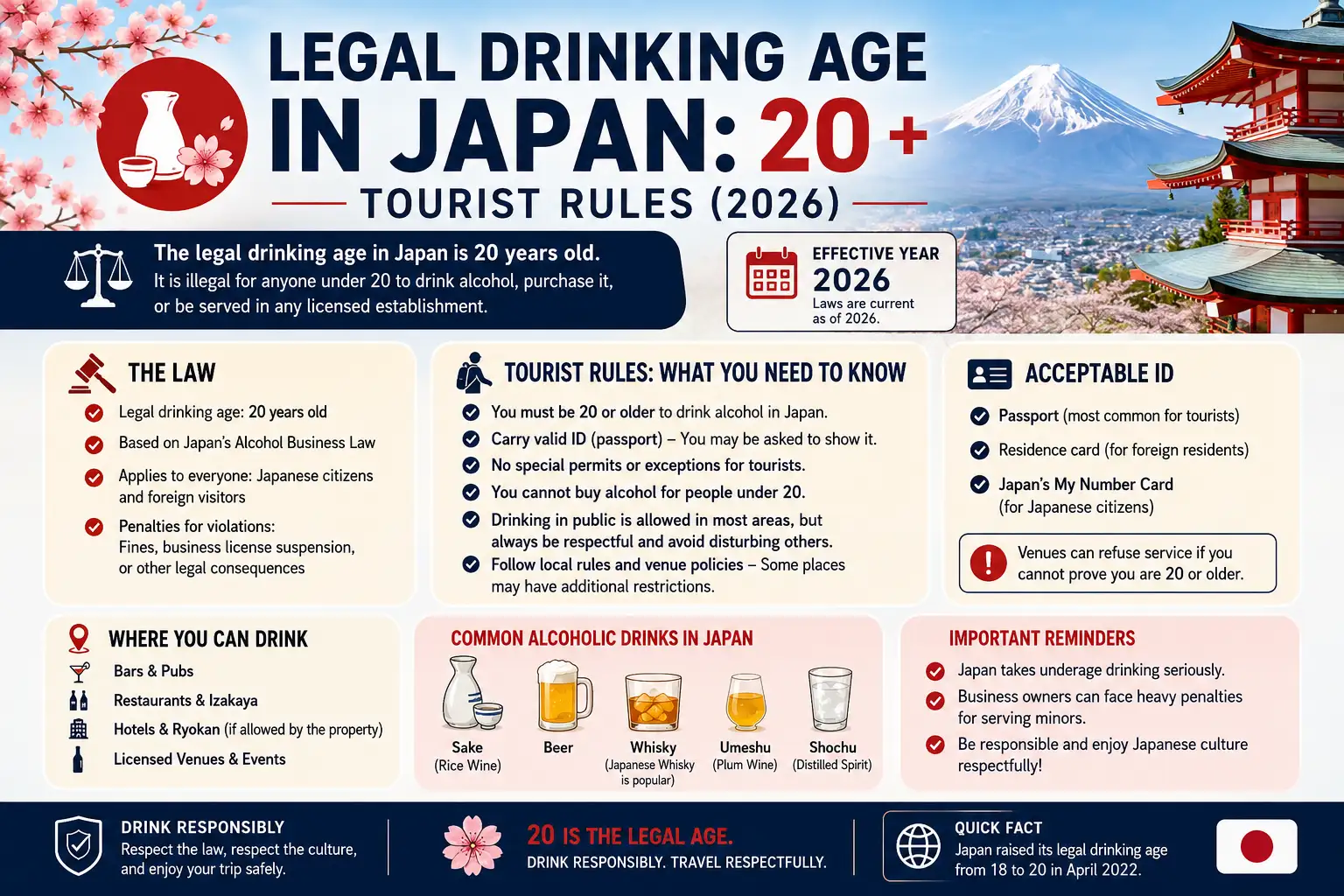
The legal drinking age in Japan is 20, including for American and other foreign visitors. Japan lowered its general age of adulthood to 18 in 2022, but it did not lower the age for alcohol.
That simple answer covers only part of what travelers need to know. Buying alcohol, proving your age, drinking outdoors, visiting Shibuya, riding trains, cycling, and driving all involve different rules or customs.
Quick Answer: What Is the Legal Drinking Age in Japan?
You must be 20 years old or older to legally drink alcohol in Japan. The rule applies nationwide to residents and visitors, regardless of the drinking age in your home country.
For an American traveler, that creates an unusual situation: a 20-year-old can legally drink in Japan, even though the U.S. minimum legal drinking age is 21.
| Question | Answer |
|---|---|
| Legal drinking age in Japan | 20 |
| Can an 18-year-old drink? | No |
| Can a 19-year-old drink? | No |
| Can an American age 20 drink? | Yes, under Japanese age law |
| Does the rule apply to tourists? | Yes |
| Can stores check your age? | Yes |
| Is public drinking always legal? | No; local and property restrictions apply |
| Shibuya street drinking | Restricted daily in designated areas, 6 p.m.–5 a.m. |
| Driving after alcohol | Do not drive |
| Cycling after alcohol | Prohibited |
Why Is Japan’s Drinking Age 20 When Adulthood Starts at 18?
Japan changed its general age of adulthood from 20 to 18 on April 1, 2022. An 18-year-old can now enter many contracts without parental consent and perform other adult legal acts.
However, the Japanese government specifically kept the minimum age for drinking alcohol and smoking at 20.
- At 18, you are generally considered an adult in Japan.
- At 18 or 19, you still cannot legally drink alcohol.
- At 20, you meet Japan’s legal drinking age.
The rule covers ordinary alcoholic drinks such as beer, sake, shochu, wine, whisky, cocktails, highballs, and canned alcoholic beverages.
Japan Drinking Age for American and Other Foreign Tourists
Japanese alcohol law does not change based on your passport. If you are in Japan, Japan’s age-20 rule applies to you.
Your home country’s rules do not give you an exception.
U.S. Traveler Examples
| Traveler | Legal to Drink in Japan? | Why? |
|---|---|---|
| American, age 18 | No | Under Japan’s age-20 limit |
| American, age 19 | No | Under Japan’s age-20 limit |
| American, age 20 | Yes | Meets Japan’s minimum age |
| American, age 21+ | Yes | Meets Japan’s minimum age |
| British traveler, age 19 | No | Home-country rules do not override Japanese law |
Example: 20-Year-Old American Traveler
A 20-year-old American visiting Tokyo has reached Japan’s legal drinking age. They may legally drink in Japan if the bar, restaurant, or retailer is satisfied with their age verification.
Example: 19-Year-Old Foreign Visitor
A 19-year-old visitor from a country where drinking is legal at 18 must still wait until age 20 while in Japan.
What Law Sets the Drinking Age in Japan?
Japan’s age rule comes from the law titled 二十歳未満ノ者ノ飲酒ノ禁止ニ関スル法律, which concerns the prohibition of drinking by people under 20.
Article 1 states that a person under 20 may not drink alcohol. The law also addresses parents, guardians, and businesses that sell or provide alcohol.
What the Law Requires
- People under 20 may not drink alcohol.
- Parents or guardians who know about under-20 drinking have a duty to stop it.
- Businesses may not knowingly sell or provide alcohol for consumption by someone under 20.
- Businesses must take appropriate measures to confirm age.
- Alcohol held for an under-20 person’s drinking may be confiscated or disposed of through administrative action.
What Happens If Someone Under 20 Drinks in Japan?
A person who is 18 or 19 should not assume that being a legal adult makes drinking acceptable. Alcohol consumption remains prohibited until age 20.
The specific under-20 drinking statute does not list a standalone monetary fine for the young drinker in the same way it lists penalties for prohibited supply. However, that does not make under-20 drinking legal or consequence-free.
Penalties for Selling or Giving Alcohol to Someone Under 20
Japan places substantial responsibility on adults and businesses supplying alcohol.
A business operator who knowingly sells or provides alcohol for someone under 20 to drink can face a fine of up to ¥500,000 under the statute.
Japan’s National Tax Agency also states that a retailer convicted of prohibited alcohol sales to an under-20 person can, under applicable licensing rules, potentially have its liquor retail license revoked.
Buying Alcohol at Convenience Stores, Supermarkets, and Liquor Shops
Alcohol is widely available in Japan. Convenience stores commonly sell beer, sake, whisky highballs, wine, chuhai, and other alcoholic drinks.
Availability does not remove the age requirement. Retailers are expected to prevent sales to people under 20.
You may encounter:
- An age-confirmation screen at a convenience-store checkout
- A verbal age question from an employee
- A request to show identification
- Additional checks at bars or clubs
- Alcohol-sale notices displaying the 20+ requirement
What ID Should Tourists Use to Prove Their Age?
For short-term foreign visitors, a passport is the strongest practical form of age identification because it clearly shows your name, nationality, photograph, and birth date.
Japan’s Immigration Services Agency also has rules concerning foreign nationals’ documentation and identification. Long-term residents may have different obligations involving residence cards.
Best Practice for Visitors
- Carry the identification required for your immigration status.
- Make sure your birth date is clearly visible.
- Expect stricter checks at some clubs and nightlife venues.
- Do not argue if a business refuses alcohol without acceptable age proof.
- Keep your passport secure while carrying it.
Can You Drink Alcohol in Public in Japan?
Japan does not have a simple nationwide rule saying that every outdoor drink is illegal. Outdoor drinking can occur in some settings, including certain traditional events such as hanami.
However, travelers should not interpret that as permission to drink anywhere they want. Local ordinances, park rules, event policies, and property regulations can prohibit alcohol.
For example, alcohol is prohibited at Shinjuku Gyoen National Garden.
Shibuya Street Drinking Rules in 2026
Anyone visiting Tokyo nightlife should know about Shibuya’s street-drinking restriction.
Since October 1, 2024, Shibuya has prohibited alcohol consumption in designated public spaces around Shibuya Station every day from 6 p.m. until 5 a.m.
The regulated area includes parts of:
- Shibuya
- Dogenzaka
- Maruyamacho
- Udagawacho
- Jinnan
- Jingumae
Instead, drink inside a bar, restaurant, izakaya, or another location where alcohol consumption is permitted.
What About Parks, Hanami, Festivals, and Outdoor Events?
Alcohol is associated with some traditional social occasions in Japan, especially hanami picnics beneath cherry blossoms. That does not mean every park allows alcohol.
- Check signs at the entrance.
- Look for temporary event notices.
- Follow instructions from park or festival staff.
- Stay inside designated drinking areas when provided.
- Keep noise under control.
- Take cans, bottles, and other trash with you when required.
- Never assume last year’s rules are still current.
Can You Drink Alcohol on Trains in Japan?
The answer depends heavily on the train.
| Train Situation | Practical Guidance |
|---|---|
| Shinkansen | Generally acceptable |
| Long-distance train with suitable seating | Often acceptable, subject to operator rules |
| Packed Tokyo subway or commuter train | Skip the alcohol |
On a Shinkansen, eating and drinking at your seat is generally accepted. Keep your drink controlled, avoid strong odors or spills, speak quietly, and dispose of containers properly.
Drinking at Bars, Izakaya, and Clubs
For most visitors, a licensed restaurant, bar, or izakaya is the simplest place to enjoy alcohol legally after turning 20.
Common choices include:
- Beer — widely available and easy to order
- Sake — Japanese rice-based alcoholic beverage
- Shochu — distilled spirit commonly mixed with water, soda, or tea
- Highball — whisky and soda over ice
- Chuhai — spirit-based drink often flavored with citrus or fruit
- Umeshu — sweet plum liqueur
- Wine and cocktails — common in larger bars and restaurants
A Few Useful Izakaya Customs
- Kanpai means “cheers.”
- Otoshi may be served as a small starter or table charge.
- People sometimes pour drinks for one another in group settings.
- You can decline another refill.
- You do not need to drink alcohol to participate in a social gathering.
Japan’s Drunk-Driving Laws Are Extremely Strict
Japan’s National Police Agency makes clear that driving while affected by alcohol is prohibited. Do not treat a particular breath-alcohol number as permission to drive.
Current Alcohol-Driving Categories
| Category | Key Criterion | Maximum Criminal Penalty |
|---|---|---|
| Shuki-obi unten | Breath alcohol 0.15 mg/L or more | Up to 3 years imprisonment or ¥500,000 fine |
| Sake-yoi unten | Breath alcohol 0.5 mg/L or more, or impaired ability to drive normally | Up to 5 years imprisonment or ¥1 million fine |
The more serious 0.5 mg/L criterion took effect on July 21, 2026. A driver can still fall into the more serious category below 0.5 mg/L when alcohol has impaired normal driving ability.
Other People Can Also Face Penalties
Depending on the circumstances, consequences may apply to someone who:
- Provides a vehicle to a drunk driver
- Provides alcohol to a person who will drive
- Rides as a passenger with a drunk driver
Why Japan Takes Drinking and Driving So Seriously
Official 2025 figures show why visitors should take the rule seriously.
| 2025 Alcohol-Related Driving Data | Figure |
|---|---|
| Traffic accidents involving drinking and driving | 2,283 |
| Fatal accidents | 125 |
| Fatal-accident rate compared with non-alcohol driving | About 6.9× higher |
Can You Ride a Bicycle After Drinking in Japan?
Japan treats bicycles as vehicles under its road rules, and alcohol-impaired cycling is prohibited. Japan strengthened its rules concerning alcohol-impaired bicycle riding from November 1, 2024.
Instead:
- Walk when you can do so safely.
- Take a train while service is running.
- Use a taxi.
- Leave the bicycle and retrieve it later.
- Plan your return trip before drinking.
Legal Drinking in Japan: Four Traveler Scenarios
Scenario 1: American Traveler, Age 20
You are 20 and visiting Osaka from the United States. Can you order sake with dinner? Yes. You have reached Japan’s age-20 drinking threshold.
Scenario 2: European Traveler, Age 19
You normally drink legally at home and are visiting Kyoto. Can you drink in Japan? No. Japan’s age requirement applies while you are in Japan.
Scenario 3: Adult Buying Beer in Shibuya
You are 30 and buy beer from a convenience store near Shibuya Station at 9 p.m. Buying it is generally fine, but drinking it in a restricted public area is not.
Scenario 4: One Beer Before Driving
You plan to rent a car and think one beer should leave you under a numerical threshold. Do not drive.
Quick Checklist for Drinking Legally and Responsibly in Japan
- You must be 20 or older to drink.
- Foreign visitors follow the same age rule.
- Carry the identification required for your immigration status.
- Expect stores or venues to verify your age.
- Check signs before drinking in parks or other public spaces.
- Do not street-drink in Shibuya’s restricted area from 6 p.m.–5 a.m.
- Avoid alcohol on crowded commuter trains.
- Drinking is generally acceptable on a Shinkansen when done considerately.
- Never drive after drinking.
- Never cycle after drinking.
- Do not provide alcohol to someone under 20.
- Alternate alcohol with water and eat during longer evenings.
- Know how you will return to your hotel before you start drinking.
Frequently Asked Questions
Is the Legal Drinking Age in Japan 18, 20, or 21?
The legal drinking age in Japan is 20. Japan lowered general adulthood to 18 in 2022, but alcohol remained restricted until 20.
Can You Drink at 18 in Japan With Your Parents?
No. Parental permission does not lower Japan’s age requirement.
Can You Drink at 19 If It Is Legal at Home?
No. Japanese law applies while you are in Japan.
Can a 20-Year-Old American Drink in Japan?
Yes. A 20-year-old has reached Japan’s legal drinking age.
Do Japanese Convenience Stores Ask for ID?
They can. Retailers are expected to use measures that help prevent alcohol sales to people under 20.
Should Tourists Carry Their Passport?
Short-term foreign visitors should generally carry the documentation required for their immigration status. A passport also provides clear proof of age.
Is Street Drinking Legal in Tokyo?
There is no single nationwide rule banning every instance of outdoor drinking, but local restrictions matter. Shibuya has specific nighttime restrictions.
Can You Drink on the Shinkansen?
Generally, yes. JNTO confirms that eating and drinking are allowed on Shinkansen trains.
What Happens If a Store Sells Alcohol to Someone Under 20?
A business operator who knowingly violates the prohibition can face a fine of up to ¥500,000, with additional licensing consequences possible under applicable law.
Is It Safe to Drive the Morning After Drinking?
Do not assume it is safe. Alcohol can remain in the body the following morning. If you may still have alcohol in your system, do not drive.
Popular Japanese Drinks You May Encounter After Turning 20
Knowing the law is the priority, but visitors often wonder what they will actually see on menus.
- Sake: Japan’s best-known traditional alcoholic drink.
- Shochu: A distilled spirit commonly made from barley, sweet potato, or rice.
- Japanese whisky highballs: Whisky combined with carbonated water.
- Chuhai and sours: Popular mixed drinks often flavored with citrus or fruit.
- Japanese beer: Widely available throughout the country.
- Wine and cocktails: Common in larger cities and modern bars.
How to Drink More Responsibly While Traveling
Being legally old enough to drink does not mean you need to drink heavily. Travel can make alcohol feel less predictable because of jet lag, long walking days, unfamiliar serving sizes, heat, and changes in eating habits.
- Eat before and while drinking.
- Drink water during the evening.
- Pace alcoholic drinks rather than consuming them quickly.
- Check the alcohol percentage on unfamiliar canned drinks.
- Stop when you feel impaired.
- Do not participate in rapid-drinking challenges.
- Never pressure someone else to drink.
- Keep control of your drink in busy nightlife areas.
- Arrange safe transportation before the evening begins.
Alcohol-free beer, tea, sparkling water, juice, soft drinks, and zero-alcohol options can make it easy to participate in a group without drinking alcohol.
Official Sources and Fact-Check References
This article was checked against primary and official Japanese sources current as of August 20, 2026.
- Japan e-Gov Law Search: Current text of Japan’s law prohibiting alcohol consumption by people under 20, including age verification and supplier penalties.
- Government Public Relations Online: Confirms that Japan lowered adulthood to 18 in 2022 while keeping the drinking age at 20.
- National Tax Agency: Provides official guidance on alcohol retailer age verification, sales notices, and under-20 alcohol prevention.
- National Police Agency: Provides current drunk-driving requirements, penalties, the July 21, 2026 legal change, and 2025 accident statistics.
- Immigration Services Agency of Japan: Explains foreign nationals’ documentation requirements.
- Shibuya City: Confirms the year-round public-drinking restriction around Shibuya Station from 6 p.m. to 5 a.m. since October 1, 2024.
- Japan National Tourism Organization: Provides guidance about public behavior, Shinkansen eating and drinking, nightlife, and travel etiquette.
Conclusion
The most important rule is easy to remember: Japan’s legal drinking age is 20, not 18 and not 21. The same minimum applies to American tourists, other foreign visitors, and Japanese residents.
The details matter once you leave the bar. Carry proper identification, respect local public-drinking restrictions, follow Shibuya’s nighttime rules, and never drive or cycle after drinking.
If you keep those rules in mind, you can explore Japan’s bars, izakaya, sake culture, and nightlife without turning a fun trip into a legal problem.



9 Comments on “Legal Drinking Age in Japan: 20 + Tourist Rules (2026)”