9 Healthiest Energy Drinks in 2026: Low-Sugar Picks That Don’t Overdo Caffeine
A practical label-by-label comparison of caffeine, sugar, serving size, sweeteners, and stimulant ingredients—so “zero sugar” is not mistaken for “healthiest.”
Finding the healthiest energy drinks is harder than looking for a zero-sugar label. Some sugar-free cans contain 80 mg of caffeine, while others deliver 200 mg or more in one serving. Ingredients, can size, sweeteners, and your total daily caffeine intake also matter.
For most adults, a better energy drink is one that provides enough caffeine for the desired effect without an unnecessarily large dose, while keeping added sugar low and clearly listing what is in the can.
That is the approach used in this guide. Instead of rewarding products for words such as “clean,” “natural,” or “performance,” we compare measurable details such as caffeine per container, sugar, serving size, sweeteners, and major stimulant ingredients.
Updated: August 16, 2026 Product formulas can change, so check the current can before buying.
Quick Answer: What Are the Healthiest Energy Drinks?
The healthiest energy drinks tend to have moderate caffeine, little or no added sugar, a reasonable serving size, and a transparent ingredient list.
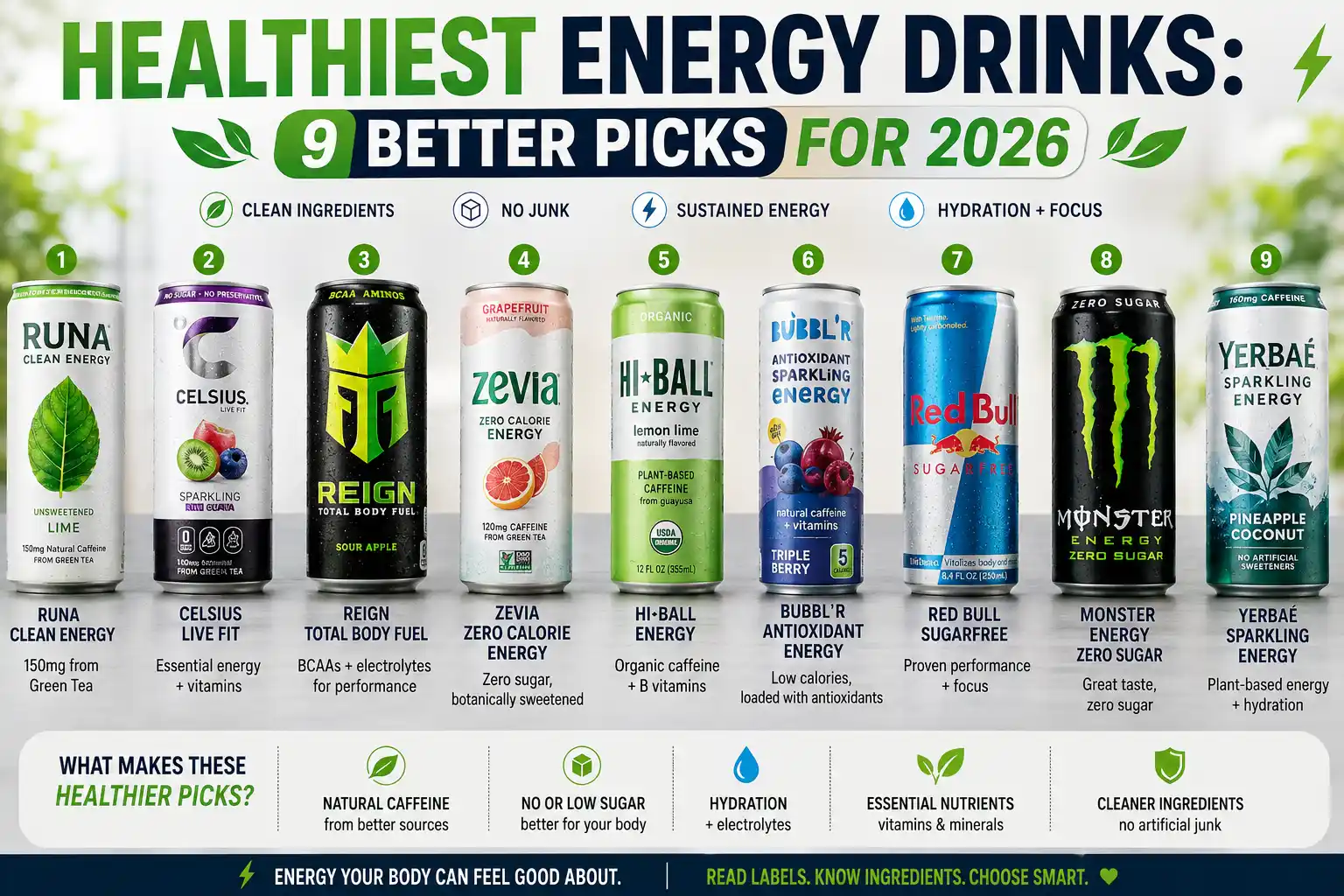
Strong choices for different needs include V8 +Energy, Jocko GO, Zevia Energy, Red Bull Sugarfree in the 8.4-ounce can, Monster Zero Ultra, GORGIE, Yerba Madre Bravo Mango, ZOA Zero Sugar, and CLEAN Cause Zero Calorie Yerba Mate. Current manufacturer information confirms meaningful differences in caffeine and sugar between these products.
Zero sugar does not automatically mean low caffeine or “healthiest.”
What Makes an Energy Drink a Healthier Choice?
There is no official medical definition of a “healthy energy drink.” The term is relative.
For this guide, a better choice generally has:
- Moderate caffeine per container
- Little or no added sugar
- A serving size that makes caffeine easy to track
- Clearly disclosed caffeine
- A sweetener profile that fits your preferences
- No needlessly large stimulant dose
- Ingredients that do not distract from the caffeine total
For most healthy adults, the FDA cites 400 mg of caffeine per day as an amount not generally associated with negative effects. Sensitivity varies widely. Pregnancy, medications, health conditions, sleep habits, and individual tolerance can change what is appropriate.
That 400 mg figure is not a target.
Added sugar matters too. The American Heart Association recommends limiting added sugars to about 36 grams per day for men and 25 grams per day for women.
Choose the smallest caffeine dose that does what you need, then compare sugar and ingredients.
That produces better decisions than choosing the strongest sugar-free drink on the shelf.
How We Chose These Energy Drinks
These recommendations are based on current U.S. manufacturer information and established public-health guidance.
- Caffeine per container — Lower or moderate amounts received an advantage when products were otherwise similar.
- Added sugar — Products with little or no added sugar were generally favored.
- Serving size — Smaller, clearly defined servings make total caffeine easier to control.
- Sweeteners and ingredient profile — We looked at stevia, monk fruit, allulose, sucralose, acesulfame potassium, and other commonly used ingredients.
- Stimulant transparency — Ingredients such as guarana were considered because they can add caffeine.
- Practical usefulness — Different picks were included for lower caffeine, zero sugar, yerba mate, mainstream availability, and other common preferences.
This is a label-based comparison, not a laboratory test or blind taste test. Flavor and personal tolerance were not scored because those factors are subjective.
We also do not give a product extra credit simply because its caffeine comes from tea, coffee, green coffee beans, or yerba mate. Caffeine source may affect the rest of the ingredient profile, but the total caffeine dose still matters. The FDA notes that naturally occurring and added caffeine have the same basic chemical effect.
Healthiest Energy Drinks at a Glance
| Energy Drink | Caffeine | Sugar | Why It Stands Out |
|---|---|---|---|
| V8 +Energy | 80 mg | No added sugar | Lower caffeine and no artificial sweeteners |
| Jocko GO | 95 mg | 0 g | Under 100 mg and zero sugar |
| Zevia Energy | 120 mg | 0 g | Zero sugar with a short ingredient list |
| Red Bull Sugarfree, 8.4 oz | 80 mg | 0 g | Small mainstream serving |
| Monster Zero Ultra, 16 oz | 150 mg | 0 g | Lower caffeine than many 200 mg competitors |
| GORGIE | 150 mg | 0 g | Green tea caffeine and zero sugar |
| Yerba Madre Bravo Mango | 150 mg | 2 g | Low-sugar yerba mate |
| ZOA Zero Sugar, 12 oz | 160 mg | 0 g | Zero sugar with 160 mg caffeine |
| CLEAN Cause Zero Calorie | 160 mg | 0 g | Yerba mate with zero sugar |
The values above are based on current manufacturer information. V8 lists 80 mg per 8-ounce serving, Jocko GO lists 95 mg, Zevia lists 120 mg, Monster Zero Ultra lists 150 mg per 16 ounces, and ZOA lists 160 mg in its 12-ounce product.
The 9 Healthiest Energy Drinks to Consider
V8 +Energy
V8 +Energy is one of the better starting points for people who want an energy drink without immediately reaching 150 or 200 mg of caffeine.
An 8-ounce can provides 80 mg of caffeine from black and green tea. It contains no added sugar and no artificial sweeteners, although juice contributes naturally occurring sugar.
No added sugar does not mean sugar-free.
Best for Adults who prioritize lower caffeine and no artificial sweeteners.
Jocko GO
Jocko GO currently contains 95 mg of caffeine from green coffee beans and zero sugar. Current formulas use sweeteners that include monk fruit, Reb-M, and allulose.
The key advantage is the dose. Many modern energy drinks deliver 150 to 200 mg in one can. Staying below 100 mg makes Jocko GO easier to fit into a day that may also include coffee or tea.
The formula also includes functional ingredients such as Alpha-GPC and electrolytes. Those additions should not be the main reason to choose it, however. Caffeine and sugar remain the more useful comparison points.
Best for Someone seeking a sugar-free drink with restrained caffeine.
Zevia Energy
Zevia Energy sits in a useful middle ground. It provides more caffeine than an 80 mg drink without reaching the 150 to 200 mg range.
Current flavors contain 120 mg of caffeine, zero sugar, and zero calories. Zevia’s ingredient list can be quite short: carbonated water, natural flavors, citric acid, stevia extract, and caffeine.
Zevia removes the sugar, not the stimulant. A 120 mg can still matters if you drink coffee, tea, or another caffeinated beverage the same day.
Best for Adults looking for a straightforward zero-sugar energy drink without 200 mg caffeine.
Red Bull Sugarfree — 8.4 oz
The smallest Red Bull Sugarfree can is one of the easiest mainstream energy drinks to portion.
An 8.4-ounce can contains 80 mg of caffeine. Larger cans contain more: current U.S. information lists 114 mg for 12 ounces, 151 mg for 16 ounces, and 198 mg for 20 ounces.
That range demonstrates why can size matters as much as brand name.
Red Bull Sugarfree uses sucralose and acesulfame potassium instead of sugar.
Best for Someone who wants a small, predictable mainstream energy drink.
Monster Zero Ultra
Monster Zero Ultra deserves inclusion because it is a practical comparison point for people shopping major U.S. brands.
The current 16-ounce Zero Ultra contains 150 mg of caffeine, zero sugar, and about 10 calories.
That is more caffeine than V8, Jocko GO, or Zevia, but less than many popular 200 mg products.
Its larger 16-ounce can also means the drink is consumed over more volume than a compact 12-ounce product with 200 mg.
Best for Adults who want a mainstream sugar-free option without jumping to 200 mg.
GORGIE
GORGIE provides 150 mg of caffeine sourced from green tea, with zero sugar and about 5 calories in current products.
The formula also includes ingredients such as L-theanine, B vitamins, and biotin.
Those extras may be appealing, but the main nutritional decision remains straightforward: this is a 150 mg caffeinated beverage.
Green tea sourcing does not mean you should ignore the dose.
Best for Adults who prefer green tea caffeine and stevia-based sweetness.
Yerba Madre Bravo Mango
Yerba Madre Bravo Mango is useful for people who do not require a completely sugar-free beverage.
The current lower-sugar Bravo Mango contains 150 mg of caffeine, 2 grams of sugar, and 15 calories.
Yerba mate naturally contains caffeine and other plant compounds. That does not make the caffeine “free” from normal caffeine considerations.
Unlike some intensely sweet zero-sugar energy drinks, this product takes a low-sugar rather than zero-sugar approach.
Best for Yerba mate drinkers who want very little sugar without demanding zero sugar.
ZOA Zero Sugar
ZOA’s 12-ounce energy drink currently provides 160 mg of caffeine and zero sugar. The company says its caffeine comes from green tea and green coffee beans.
ZOA also contains electrolytes, B vitamins, vitamin C, amino acids, and camu camu.
Those ingredients make the label busy, but they should not obscure the main point: 160 mg is twice the caffeine in an 80 mg drink.
ZOA also sells a 16-ounce format containing 210 mg, so the package size must be checked.
Best for Adults who intentionally want more caffeine than the lower-dose picks.
CLEAN Cause Zero Calorie
CLEAN Cause’s zero-calorie sparkling yerba mate line provides 160 mg of caffeine with zero sugar and zero calories. Current flavors include options such as Orange Ginger, Cherry Lime, and Strawberry Lemonade.
Stevia is used in at least some current zero-calorie formulas.
This is a stronger product than the 80 to 120 mg drinks above, so it makes more sense for someone who already knows that 160 mg fits their caffeine tolerance.
Best for People who want yerba mate without added sugar.
How Popular Energy Drinks Compare
Popular brands deserve comparison even when they do not make the main recommendation list.
| Product | Typical Current Caffeine | Sugar | Key Consideration |
|---|---|---|---|
| Red Bull Sugarfree, 8.4 oz | 80 mg | 0 g | Lower caffeine in the small can |
| Monster Zero Ultra, 16 oz | 150 mg | 0 g | Midrange caffeine |
| Celsius | 200 mg | 0 g | High caffeine per can |
| Alani Nu Energy | 200 mg | 0 g | High caffeine in a compact serving |
| Ghost Energy, 16 oz | 200 mg | 0 g | Zero sugar but higher caffeine |
| Rockstar | Varies by line | Varies | Check the exact product |
| Bang Energy, 16 oz | 300 mg in current listings | 0 g | Very high caffeine |
Standard CELSIUS and CELSIUS Vibe currently contain 200 mg per can, while CELSIUS Essentials contains 270 mg.
Current Alani Nu energy drinks commonly provide 200 mg of caffeine and zero sugar per serving.
GHOST’s current energy line is zero sugar, and major U.S. listings show 200 mg in the 16-ounce can.
Current Bang Energy listings continue to show 300 mg of caffeine in a 16-ounce sugar-free can.
That does not mean a healthy adult can never choose a 200 mg product. It means higher caffeine should not earn a health advantage simply because the drink has zero sugar.
120 mg caffeine · zero sugar
200 mg caffeine · zero sugar
Both solve the added-sugar issue. Only one leaves substantially more room for other caffeine that day.
Caffeine Per Ounce: The Comparison Most Labels Do Not Emphasize
Total caffeine matters most, but caffeine concentration can reveal how strong a drink actually is.
| Drink | Size | Caffeine | Approx. Caffeine Per Ounce |
|---|---|---|---|
| Red Bull Sugarfree | 8.4 oz | 80 mg | 9.5 mg/oz |
| V8 +Energy | 8 oz | 80 mg | 10 mg/oz |
| Monster Zero Ultra | 16 oz | 150 mg | 9.4 mg/oz |
| Ghost Energy | 16 oz | 200 mg | 12.5 mg/oz |
| Bang Energy | 16 oz | 300 mg | 18.8 mg/oz |
Product amounts are based on current manufacturer or major retail listings.
Monster Zero Ultra has almost twice the liquid volume of a small Red Bull, yet the caffeine concentration is very similar. Bang, by contrast, packs far more caffeine into each ounce.
For everyday buying, still prioritize total caffeine per container because most people finish the entire can.
Sugar-Free vs. Low-Sugar Energy Drinks
Zero sugar is useful, but it is only one part of the label.
A traditional sugared energy drink can contain a large amount of added sugar. For example, an 8.4-ounce regular Red Bull currently contains 27 grams of sugar.
That single small can is already close to the AHA’s suggested daily added-sugar limit for many adults.
Sugar-free alternatives remove that problem, but they often use non-sugar sweeteners instead.
Stevia · Monk fruit · Allulose · Erythritol
Sucralose · Acesulfame potassium
There is no need to treat every sweetener as identical.
If you dislike sucralose, a stevia-sweetened drink may suit you better. If stevia’s aftertaste bothers you, a small amount of real sugar may be more enjoyable.
The practical goal is not to find a magically perfect sweetener. It is to choose a beverage that fits your overall diet, tolerance, and preferences.
Energy Drink Ingredients Worth Checking
Energy drink labels often contain ingredients that sound more impressive than the caffeine number. Understanding their role makes comparison easier.
Caffeine Sources
Guarana
Guarana contains caffeine. Adding it to a formula increases the drink’s total caffeine exposure. NCCIH specifically notes this point.
Do not mentally separate “caffeine” and “guarana” as unrelated stimulants.
Green Tea and Green Coffee
Both can provide caffeine. They may fit a particular ingredient preference, but caffeine from a plant still counts toward your daily total.
Yerba Mate
Yerba mate is a naturally caffeinated South American plant used in both brewed drinks and canned beverages.
Products such as Yerba Madre and CLEAN Cause use it as their main caffeine source.
Other Functional Ingredients
Taurine
Taurine is common in traditional energy drink formulas, including Red Bull. Its presence should not distract from checking caffeine and sugar first.
L-Theanine
L-theanine occurs naturally in tea and is added to products such as GORGIE. A formula containing L-theanine can still be a high-caffeine beverage.
Alpha-GPC
Some performance-oriented beverages, including Jocko GO, include Alpha-GPC as a nootropic ingredient.
Consumers who simply want caffeine do not necessarily need a long list of additional functional compounds.
B Vitamins
B6, B12, niacin, and other B vitamins appear in many energy drinks.
They have genuine nutritional roles, but seeing “200% daily value” on a label does not automatically make one energy drink healthier than another.
Do B Vitamins and Electrolytes Make an Energy Drink Healthier?
Not by themselves.
Many energy drinks prominently advertise B vitamins, vitamin C, electrolytes, amino acids, antioxidants, or plant extracts.
Those nutrients can have legitimate roles in the body. However, their presence should not override the bigger comparison questions:
How much caffeine is in the can?
How much added sugar does it contain?
What else have you consumed today?
Electrolytes are another good example.
ZOA includes electrolytes, but that does not mean it should automatically replace water or a purpose-built sports drink during prolonged exercise.
A beverage can contain useful nutrients and still provide more caffeine than a person wants.
Who Should Be Careful With Energy Drinks?
The CDC notes that the American Academy of Pediatrics says caffeine and other stimulants in energy drinks have no place in the diets of children and adolescents.
Adults should also use extra caution if they:
- Are pregnant or breastfeeding
- Are highly sensitive to caffeine
- Have frequent insomnia or poor sleep
- Experience anxiety or jitters from caffeine
- Have certain cardiovascular conditions
- Take medications that may interact with caffeine
- Already consume several other caffeinated products
Possible signs of excessive caffeine include jitters, anxiety, insomnia, nausea, headache, increased heart rate, or heart palpitations.
NCCIH also notes potential concerns involving large amounts of caffeine and heart rate, blood pressure, anxiety, sleep, and digestive symptoms.
If you have a medical condition or questions about caffeine with medication, personalized guidance from a qualified healthcare professional is more appropriate than relying on a generic product ranking.
Coffee vs. Energy Drinks: Which Is the Better Choice?
For many people, plain coffee is the simpler caffeine source.
Coffee does not naturally contain added sugar. Syrups, sweetened creamers, and specialty preparations are what often add sugar and calories.
- Consistent labeled caffeine
- Portability
- Carbonation
- Sweet flavors
- No brewing required
- Very short ingredient list
- No need for alternative sweeteners
- Wide control over serving size
- Usually no added functional ingredients
Caffeine in coffee still varies by brewing method and serving size, so coffee is not automatically a low-caffeine choice.
If you mainly want caffeine rather than an energy-drink flavor or format, coffee or tea may be the more straightforward option.
Energy Drinks vs. Sports Drinks
Energy drinks and sports drinks solve different problems.
An energy drink usually centers on caffeine and alertness.
A sports drink usually centers on fluid, carbohydrates, and electrolytes for certain exercise situations.
CDC guidance makes the distinction clear: energy drinks can contain substantial caffeine and other stimulants, while sports drinks are formulated around hydration and fuel.
Do not assume a caffeinated energy drink is the best hydration choice simply because it contains electrolytes. For ordinary daily hydration, water is usually the simplest starting point.
Healthier Alternatives to Energy Drinks
You may not need an energy drink at all. Choose the alternative based on why you want one.
- Plain coffee
- Black tea
- Green tea
- Unsweetened iced tea
- Sparkling water
- Flavored seltzer
- Unsweetened sparkling tea
If You Are Actually Hungry
A drink cannot replace food.
A snack that includes carbohydrates plus protein or fat may make more sense if your low energy is connected to hunger.
If You Are Tired From Poor Sleep
Caffeine can improve alertness temporarily, but it does not replace adequate sleep.
Using increasingly strong energy drinks to compensate for chronic sleep loss can create a cycle in which later caffeine makes the next night’s sleep harder.
How to Choose the Best Energy Drink for Your Needs
Start with your reason for buying one.
| Your Priority | Better Starting Point |
|---|---|
| Lowest caffeine among our top picks | V8 +Energy or 8.4-oz Red Bull Sugarfree |
| Zero sugar under 100 mg | Jocko GO |
| Zero sugar around 120 mg | Zevia Energy |
| Mainstream zero-sugar option | Monster Zero Ultra |
| Green tea caffeine | GORGIE |
| Low-sugar yerba mate | Yerba Madre Bravo Mango |
| Zero-sugar yerba mate | CLEAN Cause |
| Stronger zero-sugar choice | ZOA 12 oz |
| Avoid artificial sweeteners | Compare V8, Jocko GO, and stevia-based products |
| Avoid 200 mg caffeine | Choose from the lighter options above |
A simple buying sequence works well:
- Check caffeine for the whole can.
- Check added sugar.
- Look at serving size.
- Read the sweeteners.
- Check for other caffeine-containing ingredients.
- Add caffeine from coffee, tea, soda, and supplements consumed that day.
Do that before worrying about vitamins, antioxidants, metabolism claims, or whether the caffeine is described as natural.
Energy Drinks That Did Not Make Our Main Picks
Some popular products were left outside the top nine because their caffeine levels make them less flexible for everyday use.
Celsius
Standard CELSIUS products contain 200 mg of caffeine per can, while the Essentials line contains 270 mg.
The zero-sugar profile is appealing, but the higher stimulant dose keeps standard Celsius below our lower-caffeine recommendations.
Alani Nu
Alani Nu’s standard energy drinks commonly provide 200 mg of caffeine with zero sugar.
That can suit adults who deliberately want 200 mg, but it is not our first choice when a smaller amount could do the job.
Ghost Energy
GHOST Energy is also zero sugar, but its common 16-ounce format provides about 200 mg of caffeine.
Again, zero sugar solves only one side of the comparison.
Bang Energy
Current U.S. listings show Bang products with 300 mg of caffeine per 16-ounce can.
That is 75% of the FDA’s 400 mg general daily reference for most healthy adults in one can. For that reason, it is difficult to justify Bang as one of the best starting points for someone specifically seeking the healthiest energy drinks.
Rockstar
Rockstar sells several formulas, including sugar-free products, and caffeine varies by line and package.
Some current 16-ounce Rockstar products provide 240 mg of caffeine, illustrating why the exact can must be checked rather than treating “Rockstar” as one uniform beverage.
FAQs
What Is the Healthiest Energy Drink?
There is no single healthiest energy drink for every person. A better choice generally combines moderate caffeine, little or no added sugar, and a serving size that fits your total daily caffeine intake.
For lower caffeine, V8 +Energy and Jocko GO are strong starting points. For zero sugar with moderate caffeine, Zevia Energy offers 120 mg.
What Energy Drink Has the Lowest Caffeine and Sugar?
Among the picks in this guide, the 8.4-ounce Red Bull Sugarfree contains 80 mg caffeine with zero sugar. Jocko GO contains 95 mg with zero sugar.
V8 +Energy also contains 80 mg but has naturally occurring sugar from juice despite having no added sugar.
Is 200 mg of Caffeine a Lot at Once?
200 mg is a substantial single serving, especially if you also consume coffee, tea, soda, chocolate, or other caffeinated products.
The FDA cites 400 mg per day as an amount not generally associated with negative effects for most adults, but individual sensitivity varies.
Are Zero-Sugar Energy Drinks Healthier?
They can be a better choice for reducing added sugar, but zero sugar does not mean low caffeine.
Celsius, Alani Nu, and Ghost all have common zero-sugar products around 200 mg caffeine, while lighter sugar-free options may contain 80 to 120 mg.
Is Monster Zero Ultra Healthier Than Regular Monster?
Monster Zero Ultra removes the sugar found in traditional sugared energy drinks and currently provides 150 mg caffeine and zero sugar per 16-ounce can.
Whether it is the better choice still depends on your caffeine tolerance and what else you consume that day.
Is Natural Caffeine Better Than Synthetic Caffeine?
Not simply because it is natural.
Caffeine may come from coffee, tea, guarana, or yerba mate, or it may be added directly. The total dose remains the key consideration, and Red Bull notes that naturally derived and synthetic caffeine are structurally identical in effect.
Are B Vitamins in Energy Drinks Actually Helpful?
B vitamins are essential nutrients, but their presence does not automatically make an energy drink healthier.
When choosing between products, caffeine, added sugar, serving size, and the overall ingredient list usually provide more useful comparison information.
Conclusion
The healthiest energy drinks are not necessarily the cans with the most vitamins, the most natural-sounding ingredients, or the biggest caffeine number.
For a lighter approach, V8 +Energy, Jocko GO, Zevia Energy, and the 8.4-ounce Red Bull Sugarfree offer roughly 80 to 120 mg of caffeine. Products such as Monster Zero Ultra, GORGIE, Yerba Madre, ZOA, and CLEAN Cause move higher while still keeping sugar low or at zero.
The most useful habit is simple: read the caffeine amount for the entire container first. Then compare added sugar, serving size, sweeteners, and other ingredients.
If 80 or 120 mg gives you the alertness you want, there is no nutritional prize for choosing 200 or 300 mg instead.