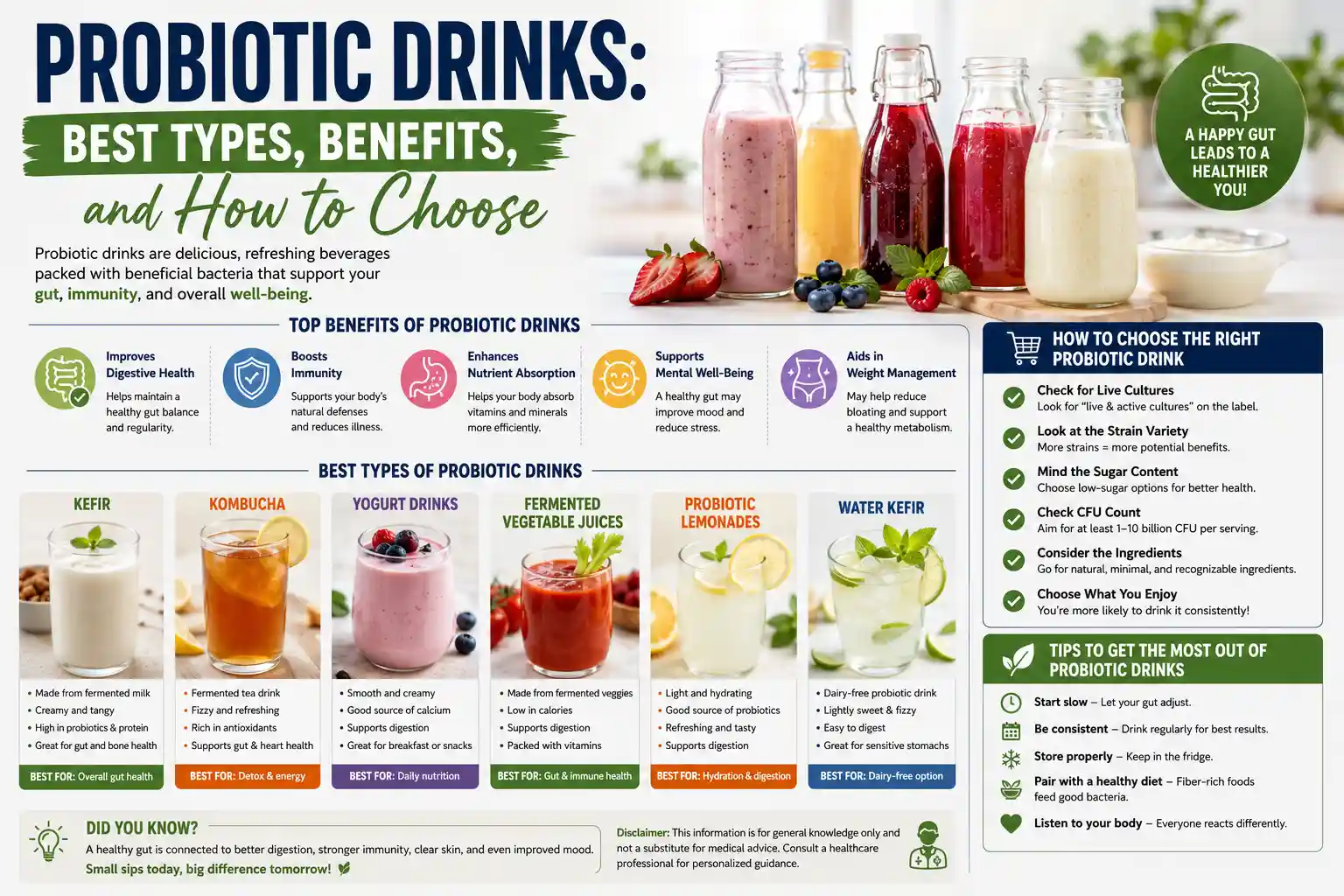
Probiotic drinks include cultured dairy beverages, fermented teas, water kefir, fortified juices, and some newer sparkling sodas. They can be convenient, flavorful ways to consume live microorganisms, but products vary greatly in strains, sugar, nutrition, and supporting evidence.
The hardest part is not finding a bottle labeled “gut friendly.” It is finding a drink that actually identifies its cultures, fits your diet, and provides useful nutrition without excessive sugar. This guide explains what qualifies as probiotic, which beverage types are worth considering, and how to read labels with confidence.
Quick Answer
The most practical probiotic drinks are usually plain kefir, live-culture yogurt drinks, water kefir, and products that name a specific probiotic strain.
Choose a drink that lists live cultures, identifies the strain when possible, provides useful nutrition, and guarantees viable organisms through its expiration date. More cultures or a larger CFU number does not automatically mean a better product.
Key Takeaways
• Not every fermented drink is probiotic.
• Probiotic effects can depend on the exact strain.
• A higher CFU count is not always more effective.
• Plain kefir often offers protein with no added sugar.
• Kombucha may contain caffeine and small amounts of alcohol.
• Compare added sugar, allergens, serving size, and refrigeration needs.
• High-risk individuals should seek medical advice before using live-microbe products.
What Are Probiotic Drinks?
Probiotics are live microorganisms that provide a demonstrated health benefit when consumed in adequate amounts. The term applies to specific organisms, not every bacterium or yeast found in fermented food.
A true probiotic product should ideally provide three things:
• A clearly identified microorganism
• A useful amount of that organism
• Evidence connecting that organism and amount with a health benefit
This definition matters because fermented and probiotic do not mean the same thing. Fermentation uses microorganisms to change food or drink, but the organisms may die during heating, filtering, pasteurization, or storage.
Some fermented drinks contain living cultures at the time you consume them. Others contain unknown organisms, inconsistent amounts, or no live organisms at all. ISAPP notes that relatively few fermented foods meet the full scientific criteria for a probiotic.
Do Probiotic Drinks Actually Work?
Some specific probiotic strains have evidence for specific digestive or health outcomes. However, results from one strain cannot automatically be applied to another strain, product, or beverage.
This means a general claim such as “supports gut health” tells you much less than a full strain name. The benefits, effective amount, and study results may differ even between closely related microorganisms.
A probiotic drink should therefore be viewed as a food choice, not a guaranteed treatment. It may fit into a balanced diet, but it should not replace medical care, prescribed treatment, fiber-rich foods, or basic hydration.
The evidence is strongest when:
• The product names the exact strain
• The strain has human research behind it
• The tested amount matches the product serving
• The organisms remain viable through expiration
• The drink is stored as directed
The evidence is weakest when:
• The label only says “probiotic blend”
• No strain is identified
• The bottle makes broad cure-like claims
• The CFU number only applies at manufacture
• The drink is called probiotic only because it is fermented
Best Probiotic Drinks at a Glance
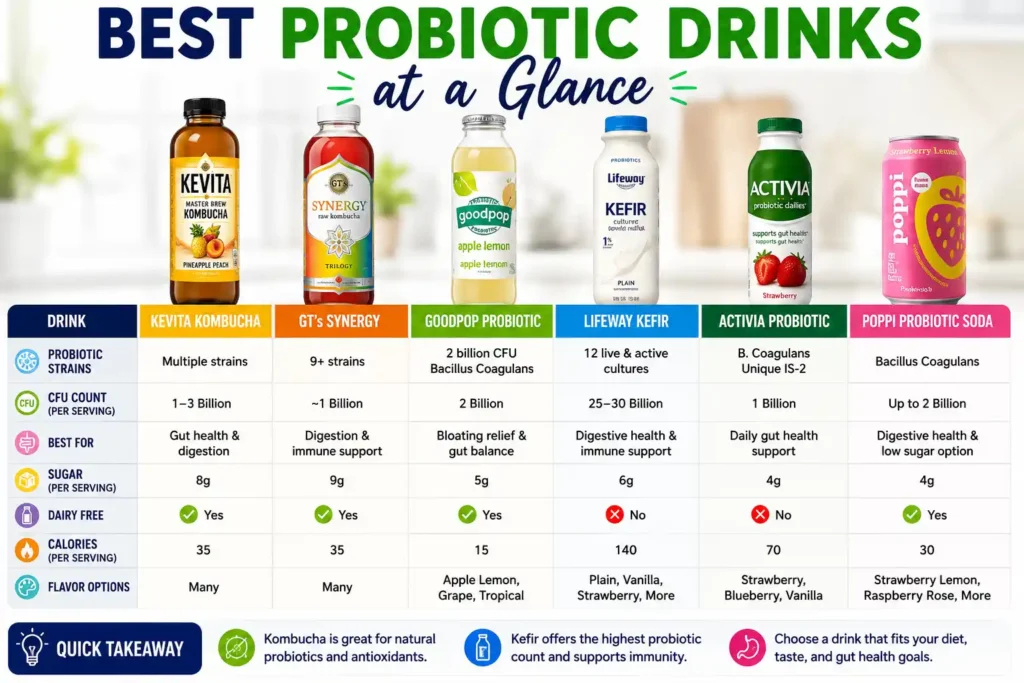
The best beverage depends on your diet, taste, allergies, and reasons for choosing it. No single drink is ideal for everyone.
| Drink Type | Typical Texture | Dairy-Free | Caffeine | Useful Features | Main Considerations |
|---|---|---|---|---|---|
| Milk kefir | Creamy and pourable | No | No | Often provides protein, calcium, and cultures | Contains milk |
| Yogurt drink | Smooth and mild | Usually no | No | Familiar flavor and portable portions | Added sugar varies |
| Water kefir | Light and fizzy | Yes | No | Dairy-free and caffeine-free | Culture details may be limited |
| Kombucha | Tart and sparkling | Yes | Usually yes | Tea-based and widely available | Acidity, caffeine, sugar, trace alcohol |
| Probiotic soda | Carbonated | Usually | Varies | Familiar soda-style format | Confirm strain and evidence |
| Probiotic juice | Fruity | Usually | No | Dairy-free and easy to drink | May contain substantial sugar |
| Cultured shot | Small and concentrated | Varies | Varies | Portable and portion-controlled | Cost per ounce may be high |
For many shoppers, plain kefir or a plain live-culture yogurt drink is the strongest starting point. These products can offer protein and minerals in addition to cultures.
A verified water kefir or probiotic soda may suit people avoiding dairy. Kombucha can also be dairy-free, but it brings extra questions about caffeine, acidity, refrigeration, and alcohol.
Probiotic Strains and CFU Counts Explained
A probiotic name can contain a genus, species, and strain. The strain is especially important because different strains may behave differently.
For example, a product may list:
Lacticaseibacillus paracasei strain Shirota
In that name:
• Lacticaseibacillus is the genus
• paracasei is the species
• Shirota is the strain
Another drink may contain Bifidobacterium animalis subsp. lactis DN-173 010. It should not be treated as identical to every other Bifidobacterium product.
What Does CFU Mean?
CFU means colony-forming units. It estimates the number of viable microorganisms in a product.
A label may list:
• 1 million CFU
• 1 billion CFU
• 10 billion CFU
• 30 billion CFU
A bigger number may look more impressive, but it is not automatically better. NIH states that products with higher CFU counts are not necessarily more effective than lower-count products. The right amount depends on the organism, strain, formulation, and intended use.
Expiration Date vs Time of Manufacture
Live organisms can decline during transportation and storage. A bottle that contained 20 billion CFU when made may contain fewer near its expiration date.
Look for language such as:
• Guaranteed through expiration
• CFU at end of shelf life
• Viable through use-by date
NIH consumer guidance notes that counts guaranteed through expiration are more useful than numbers measured only at manufacture.
How to Read a Probiotic Drink Label
The front of the bottle is designed to attract attention. The ingredient list, nutrition panel, strain information, and storage directions provide more useful facts.
Use this step-by-step check before buying.
Check the Culture Statement
Look for wording such as:
• Contains live and active cultures
• Live probiotic cultures
• Probiotic strain followed by a name
• CFU guaranteed through expiration
Be cautious when the bottle only says “fermented,” “cultured,” or “gut friendly.”
Find the Full Strain Name
A species name is better than no information. A complete strain name is even more useful.
Compare:
• Less useful: Probiotic cultures
• Better: Bacillus subtilis
• More specific: Bacillus subtilis DE111
Specific strain information makes it easier to check whether the organism has relevant research.
Compare Added Sugar
Check the Added Sugars line, not just total sugar. Plain dairy drinks naturally contain lactose, which appears under total sugar even when no sweetener was added.
Compare products using the same serving size. A tiny shot and a 16-ounce kombucha bottle should not be judged as equal servings.
Review the Serving Size
Some bottles contain two servings. Others look large but list nutrition for only eight ounces.
Confirm:
• Fluid ounces per serving
• Servings per container
• Added sugar per full bottle
• Calories per full bottle
• Protein per serving
Check Allergens and Dietary Restrictions
Common ingredients may include:
• Milk
• Soy
• Coconut
• Tree nuts
• Oats
• Citrus
• Herbal extracts
People with milk allergies must avoid dairy kefir and dairy yogurt drinks. Lactose intolerance is different from a milk allergy, and tolerance varies.
Read the Storage Instructions
Some products must remain cold because heat and time can reduce viable organisms. Other products contain hardy, spore-forming strains designed for room-temperature storage.
Follow the exact package instructions. Do not assume every probiotic drink needs refrigeration or that every shelf-stable drink contains viable organisms.
Look for Honest Claims
Avoid using the front label as proof that a product treats bloating, constipation, irritable bowel syndrome, infection, or another condition.
A trustworthy label should not suggest that one drink can transform the entire microbiome or cure digestive illness.
Best Types of Probiotic Drinks
Milk Kefir
Milk kefir is a cultured dairy drink with a tart taste and a texture thinner than yogurt. It is made with communities of bacteria and yeasts known as kefir grains.
Plain kefir is often one of the most practical choices because it may provide protein, calcium, vitamin D, and live cultures in one serving. Sweetened flavors can contain much more added sugar.
Best for:
• Breakfast smoothies
• People who prefer creamy drinks
• Higher-protein snacks
• Savory dressings and dips
• Shoppers wanting no-added-sugar options
Avoid milk kefir if you have a milk allergy. People with lactose intolerance may tolerate some fermented dairy products differently, but individual tolerance is not guaranteed.
Drinkable Yogurt
Drinkable yogurt has a mild flavor and smooth texture. It is often easier for beginners than sharp kefir or acidic kombucha.
FDA rules require yogurt treated after culturing to inactivate viable organisms to carry wording stating that it does not contain live and active cultures. This makes the culture statement especially useful when shopping for yogurt beverages.
Best for:
• Portable breakfasts
• Small serving sizes
• Mild flavors
• People who dislike carbonation
• Families already comfortable with yogurt
Check added sugar carefully. Small bottles can contain significant sugar relative to their size.
Water Kefir
Water kefir is made by fermenting sugar water with water kefir grains. It is naturally dairy-free and usually has mild carbonation.
Unlike kombucha, water kefir does not require tea. That makes it a useful option for people avoiding both dairy and caffeine.
Best for:
• Dairy-free diets
• Caffeine-sensitive drinkers
• Light sparkling drinks
• Fruit-and-herb flavor combinations
• Warm-weather serving
Not every commercial water kefir lists a well-studied strain. Treat “contains live cultures” and “contains a clinically studied probiotic” as different claims.
Kombucha
Kombucha is a fermented tea made with sugar and a mixed culture of bacteria and yeast. It usually tastes tart, slightly sweet, and carbonated.
Kombucha can contain living microorganisms, but its microbial population varies by brand and process. Fermentation alone does not prove that each organism qualifies as a probiotic.
Check kombucha labels for:
• Added sugar
• Serving size
• Caffeine
• Alcohol wording
• Pasteurization
• Refrigeration
• Named cultures
U.S. alcohol regulations apply when kombucha reaches 0.5% alcohol by volume or more, including when continued fermentation raises the level after bottling.
Kombucha may not suit children, pregnant people, anyone avoiding alcohol completely, or people who are highly sensitive to caffeine or acidic drinks.
Probiotic Soda
Probiotic soda is a carbonated drink containing added live microorganisms. It is different from most prebiotic sodas, which contain fermentable fiber rather than live organisms.
Some probiotic sodas use spore-forming bacteria that tolerate room-temperature storage. Others may need refrigeration. Read the strain and storage information rather than relying on the word “probiotic.”
Best for:
• People replacing traditional soda
• Dairy-free diets
• Drinkers who prefer carbonation
• Small cans and portable servings
Do not assume a probiotic soda is low in sugar. Compare total and added sugars just as you would with any soft drink.
Probiotic Juice and Wellness Shots
Ordinary fruit or vegetable juice is not probiotic. It must contain a suitable added organism or a verified live culture.
Juice-based products can work for people avoiding dairy, but sugar and acidity may be higher than in plain cultured dairy drinks.
Look for:
• A named strain
• CFU information
• A small serving size
• No cure-like claims
• Clear refrigeration guidance
• Reasonable added sugar
Fruit, ginger, turmeric, or beet ingredients may add flavor and nutrients. They do not make a juice probiotic by themselves.
Label-Based U.S. Product Examples

These examples show how differently probiotic beverages can be labeled. They are not universal recommendations, and product formulas may change.
Lifeway Plain Lowfat Kefir
The current manufacturer page lists 12 live and active cultures, no added sugar, and a one-cup serving. The company’s FAQ reports about 25 to 30 billion CFU per serving.
Why it stands out:
• Plain, unsweetened format
• Protein and calcium
• Clearly stated culture count
• Suitable for smoothies or savory recipes
Main limitation:
• Contains milk
Yakult and Yakult Light
Yakult identifies L. paracasei strain Shirota on its U.S. product information. The original 2.7-ounce bottle lists 10 grams of sugar, while Yakult Light lists 3 grams.
Why it stands out:
• Named strain
• Small, portable bottle
• Clear sugar difference between versions
Main limitation:
• The small original bottle still contains notable sugar
Activia Probiotic Dailies
Activia’s drinkable yogurt identifies a specific probiotic, B. lactis DN-173 010/CNCM I-2494, alongside traditional yogurt cultures. Its bottles are sold in small single-serving portions.
Why it stands out:
• Specific strain information
• Familiar yogurt flavor
• Portable serving
Main limitation:
• Flavored versions may contain added sugar
GT’s SYNERGY Kombucha
GT’s states that its raw kombucha contains living probiotics and should be stored refrigerated between 33°F and 37°F. The company reports roughly 4 to 8 milligrams of caffeine per eight-ounce serving.
Why it stands out:
• Clear refrigeration instructions
• Published caffeine range
• Dairy-free fermented tea
Main limitation:
• Acidic, caffeinated, and subject to fermentation-related alcohol concerns
Culture Pop Probiotic Soda
Culture Pop states that its sodas contain Bacillus subtilis. This provides more useful information than a label that only says “probiotic,” although shoppers should still check the exact package for strain and nutrition details.
Why it stands out:
• Soda-like format
• Dairy-free
• Identifies the probiotic species
Main limitation:
• Species information alone does not prove every health claim
Probiotic vs Prebiotic, Synbiotic, and Postbiotic Drinks
These terms are often mixed together, but they describe different ingredients.
| Term | What It Contains | Simple Meaning |
|---|---|---|
| Probiotic | Live microorganisms | Adds specific living microbes |
| Prebiotic | Substrates used by certain microbes | Feeds selected existing microbes |
| Synbiotic | Probiotics and prebiotics | Combines live microbes with a supporting substrate |
| Postbiotic | Inactivated microbes or their components | Contains nonliving microbial preparations with a health purpose |
| Fermented drink | Made through controlled microbial activity | May or may not contain live microbes when consumed |
A prebiotic soda may contain inulin, chicory-root fiber, resistant dextrin, or another fermentable ingredient. It does not automatically contain probiotics.
A synbiotic drink contains both. However, simply adding fiber and an unnamed culture does not prove that the combination has been tested together.
Probiotic Drinks vs Probiotic Supplements
Neither form is universally better.
Probiotic drinks can provide flavor, hydration, protein, calcium, or other nutrients. They also fit naturally into meals and snacks.
Supplements can provide a more controlled strain and dose. That may be useful when a clinician recommends a particular organism for a specific reason.
Choose a drink when:
• You want a food-based option
• You enjoy kefir or yogurt
• You want protein or calcium
• You prefer beverages over capsules
• You are not targeting a specific medical condition
Consider professional guidance when:
• You are addressing persistent digestive symptoms
• You are taking antibiotics
• You have a serious health condition
• You need a condition-specific strain
• You are choosing a product for an infant or child
• You have a weakened immune system
The most important factor is not whether the product is a drink or capsule. It is whether the specific strain, dose, safety profile, and intended use are appropriate.
Best Probiotic Drinks by Dietary Need

Best Starting Point for Protein
Choose plain milk kefir or a low-sugar drinkable yogurt. Compare protein per serving because amounts vary widely.
Best Dairy-Free Option
Choose a verified water kefir, probiotic juice, kombucha, or probiotic soda. Confirm that the product contains a named live organism.
Best Caffeine-Free Choice
Milk kefir, yogurt drinks, water kefir, and many probiotic sodas are caffeine-free. Tea-based kombucha may contain caffeine.
Best Lower-Sugar Choice
Start with:
• Plain kefir
• Unsweetened yogurt drinks
• Products with zero added sugar
• Small cultured shots with clearly stated sugar
• Sparkling products without syrups
“Low calorie” does not always mean low sugar. Some drinks use alternative sweeteners that may also affect digestive comfort.
Best Option for Beginners
A mild yogurt drink or plain kefir blended with fruit is usually easier than strongly acidic kombucha.
Begin with a modest serving. This makes it easier to assess taste and digestive tolerance.
Best Choice for Soda Drinkers
A clearly labeled probiotic soda may be easier to adopt than kefir. Compare its sugar and ingredients with both regular soda and prebiotic soda.
How Often Should You Drink Probiotic Beverages?
There is no universal schedule for every product or strain. Follow the serving instructions and choose a routine that suits your diet and tolerance.
Starting slowly is sensible when fermented drinks are new to you. Consuming several new probiotic foods, drinks, and supplements at once makes it difficult to identify which product caused discomfort.
A practical approach is:
- Choose one product.
- Start with the smallest suggested serving.
- Keep the rest of your diet consistent.
- Notice any changes in comfort or bowel habits.
- Stop if symptoms are persistent or worsening.
Do not assume that drinking more will produce faster or greater benefits. The effective amount is strain- and product-specific.
What Is the Best Time to Drink Probiotics?
There is no proven universal “best time” for every probiotic drink.
Drink kefir or yogurt with breakfast if that makes it easy to remember. Serve kombucha with a meal if drinking an acidic beverage alone causes discomfort. Avoid caffeinated kombucha near bedtime when caffeine affects your sleep.
Consistency, correct storage, and following the package directions matter more than choosing a precise minute of the day.
Safety, Side Effects, and Allergy Notes
Healthy adults often tolerate common probiotic foods in normal portions. Temporary gas, bloating, or changes in bowel habits can occur, especially after a sudden increase.
Long-term safety evidence is more limited than many advertisements suggest. NCCIH reports that serious complications are more likely in people with severe illnesses, weakened immune systems, or other underlying risk factors.
Speak with a qualified healthcare professional before using probiotic products when you:
• Have a weakened immune system
• Are seriously ill or hospitalized
• Have a central venous catheter
• Are buying them for a premature infant
• Are pregnant and considering unpasteurized products
• Have ongoing digestive symptoms
• Are taking antibiotics for an infection
• Have severe food allergies
Milk Allergy and Lactose Intolerance
A milk allergy can cause serious reactions and requires strict avoidance of milk-based kefir and yogurt drinks.
Lactose intolerance involves difficulty digesting lactose. Fermentation may reduce lactose in some products, but that does not make every cultured dairy drink suitable for every person.
Kombucha Caffeine and Alcohol
Kombucha made from tea may contain caffeine. Fermentation can also create alcohol.
Products reaching 0.5% alcohol by volume or more fall under U.S. alcohol rules. Continued fermentation after bottling can affect alcohol levels, making proper production and storage important.
Sugar and Dental Concerns
Sweetened and acidic beverages can expose teeth to sugar and acid. Avoid slowly sipping acidic drinks over several hours.
Consider drinking them with a meal, using a normal serving, and rinsing your mouth with plain water afterward. Do not brush immediately after a strongly acidic drink.
Storage and Serving Tips
Live cultures can be affected by temperature, time, and handling. Follow the storage directions for the specific product.
Use these practical rules:
• Keep refrigerated products cold during transport.
• Return opened bottles to the refrigerator promptly.
• Do not leave dairy drinks on a warm table.
• Store carbonated bottles upright.
• Open fizzy fermented drinks slowly.
• Do not shake kombucha before opening.
• Use clean glasses and utensils.
• Check the use-by date.
• Discard leaking, swollen, or damaged packages.
• Do not consume drinks with unexpected mold or foul odors.
Some sediment or natural separation may be normal. Read the label before assuming the product has spoiled.
Easy Probiotic Drink Recipes
These recipes use commercially prepared probiotic bases. They avoid the food-safety challenges of uncontrolled home fermentation.
Berry Kefir Breakfast Smoothie
Yield: One serving
Prep time: Five minutes
Ingredients
• 1 cup plain kefir
• ½ cup frozen mixed berries
• ½ small banana
• 2 tablespoons rolled oats
• Pinch of cinnamon
Method
- Add all ingredients to a blender.
- Blend until smooth.
- Add a small splash of water if needed.
- Serve immediately.
Why It Works
Plain kefir provides a tart base, while banana softens the acidity. Oats add body without requiring syrup or added sugar.
Savory Cucumber-Dill Kefir Cooler
Yield: One serving
Prep time: Five minutes
Ingredients
• 1 cup plain kefir
• ¼ cup chopped cucumber
• 1 tablespoon fresh dill
• 2 tablespoons cold water
• Small pinch of salt
• Pinch of black pepper
Method
- Blend the kefir, cucumber, dill, and water.
- Season lightly with salt and pepper.
- Pour over ice if desired.
- Serve beside a spicy or grilled meal.
Water Kefir Citrus Spritz
Yield: One serving
Prep time: Three minutes
Ingredients
• ¾ cup prepared water kefir
• ¼ cup plain sparkling water
• 1 lime wedge
• 3 mint leaves
• Ice
Method
- Fill a glass with ice.
- Add the prepared water kefir.
- Top with sparkling water.
- Squeeze in the lime.
- Add mint and serve immediately.
Do not seal this mixture in a bottle. Carbonation can build pressure.
Mango Yogurt Drink
Yield: One serving
Prep time: Five minutes
Ingredients
• ¾ cup plain live-culture yogurt
• ½ cup cold water
• ½ cup frozen mango
• Pinch of ground cardamom
Method
- Blend the yogurt, water, mango, and cardamom.
- Add more water for a thinner drink.
- Serve cold.
- Refrigerate leftovers promptly.
Common Mistakes to Avoid
Assuming Every Fermented Drink Is Probiotic
Fermented drinks may contain live microorganisms, dead microorganisms, or unverified mixed cultures. Look for specific strain information.
Choosing Only by CFU Count
More CFU does not guarantee a better result. The strain and supporting evidence matter.
Ignoring the Full Bottle Size
A label may list nutrition for half a bottle. Calculate the sugar and calories for the amount you will actually drink.
Confusing Total Sugar With Added Sugar
Plain milk kefir contains natural milk sugar. That is different from a flavored product with added cane sugar or syrup.
Believing Every Gut-Health Claim
Terms such as “microbiome friendly” and “digestive wellness” can be vague. Use the strain, nutrition panel, and storage directions to judge the product.
Buying Large Multipacks First
Try one bottle or a small pack before committing. Fermented flavors can be sour, yeasty, vinegary, or strongly carbonated.
Starting Several Products Together
Introducing kefir, kombucha, probiotic soda, and a supplement at once makes reactions difficult to interpret.
Ignoring Refrigeration
A well-labeled product may still lose quality if it remains in a hot car or sits unrefrigerated for too long.
Frequently Asked Questions
What Is the Healthiest Probiotic Drink?
There is no single healthiest choice. Plain kefir is a strong general option because it can provide protein, calcium, and live cultures without added sugar.
The best choice still depends on dairy tolerance, strain information, sugar, serving size, and personal preference.
Is It Safe to Drink Probiotic Drinks Every Day?
Many healthy adults consume cultured beverages regularly as foods. However, daily use is not required, and the right amount varies by product.
Start with the label’s serving guidance. Stop and seek advice if you develop persistent pain, diarrhea, vomiting, fever, or worsening symptoms.
Is Kombucha Really Probiotic?
Kombucha may contain living bacteria and yeasts, but its organisms can vary. Not every kombucha culture has been identified and shown to provide a specific health benefit.
A fermented kombucha is therefore not automatically a scientifically verified probiotic product.
Is Pasteurized Kombucha Probiotic?
Pasteurization uses heat that can inactivate living microorganisms. A pasteurized kombucha may still contain fermentation compounds, tea components, and flavor, but it may not provide live cultures.
Check whether probiotics were added after pasteurization and whether the package names them.
Does a Higher CFU Count Mean a Better Drink?
No. Higher counts are not automatically more effective.
A lower amount of a well-studied strain may be more relevant than a huge number of unidentified microorganisms.
Can Probiotic Drinks Cause Gas or Bloating?
Yes. Some people notice temporary gas, bloating, or stool changes after adding probiotic or fermented products.
Begin with a small serving. Persistent or severe symptoms require medical advice rather than continued self-experimentation.
Can Children Drink Probiotic Beverages?
Some children can consume age-appropriate yogurt or kefir as normal foods. Parents should still check sugar, dairy allergens, caffeine, pasteurization, and alcohol concerns.
Ask a pediatrician before giving probiotic products to an infant, premature baby, seriously ill child, or child with reduced immunity.
Can You Drink Probiotics While Taking Antibiotics?
The answer depends on the antibiotic, probiotic strain, health condition, and timing. Do not assume every probiotic is suitable during treatment.
Ask the prescribing clinician or pharmacist for advice. A probiotic drink should never replace an antibiotic or alter the prescribed course.
Do Probiotic Drinks Need Refrigeration?
Many kefirs, yogurt drinks, raw kombuchas, and juices require refrigeration. Some spore-based probiotic beverages may be shelf-stable.
Always follow the package directions because storage needs depend on the organisms and manufacturing process.
How Long Does It Take for a Probiotic Drink to Work?
There is no universal timeline. Effects depend on the strain, dose, reason for use, diet, and individual response.
A product that helps one person may do nothing for another. Persistent symptoms should be evaluated rather than managed indefinitely with probiotic drinks.
Conclusion
The best probiotic drinks are not necessarily the bottles with the loudest claims or highest numbers. Strong choices provide clear culture information, reasonable sugar, appropriate storage guidance, and ingredients that fit your diet.
Start with one simple option, such as plain kefir, a live-culture yogurt drink, or a clearly labeled dairy-free beverage. Compare the strain, serving size, sugar, allergens, and expiration guarantee before making it part of your routine.