White Rabbit Energy Drink: Ingredients, Caffeine, Flavors, Nutrition & Safety
Is White Rabbit really an energy drink? Here’s what its current product information says about caffeine, kratom, mitragynine, nutrition facts, flavors, reviews, pricing, legal considerations, and the safety questions that matter most.
If you’re searching for White Rabbit Energy Drink, you probably want more than a list of flavors. You want to know what is actually in the can, whether it contains caffeine, how much it costs, what it tastes like, and what makes it different from conventional energy drinks.
White Rabbit is unusual because it is not a conventional caffeine-based energy drink. Current product information identifies Mitragyna speciosa (kratom) extract, including mitragynine, as the active botanical ingredient. The brand also lists zero caffeine, zero sugar, and zero calories.
Quick Answer: What Is White Rabbit Energy Drink?
White Rabbit Energy Drink is a 12-ounce carbonated kratom beverage, rather than a typical caffeine-based energy drink. Current product information lists 45 mg of Mitragyna speciosa extract, 30 mg of mitragynine, and less than 0.01 mg of 7-hydroxymitragynine per can.
The brand markets the beverage as zero caffeine, zero sugar, and zero calories, with flavors spanning fruit, soda-inspired, and tea-inspired profiles.
White Rabbit Energy Drink Ingredients
The ingredient list looks more like a flavored carbonated beverage than a conventional energy drink, but the kratom extract is the ingredient that changes the safety discussion.
Current White Rabbit nutrition information lists carbonated water, citric acid, sucralose, gum arabic, potassium sorbate, sodium chloride, Mitragyna speciosa extract, and natural and artificial flavor.
What’s in a 12-Ounce Can?
| Ingredient or Component | Current Listed Amount |
|---|---|
| Calories | 0 |
| Total sugar | 0 g |
| Total carbohydrate | 0 g |
| Fat | 0 g |
| Protein | 0 g |
| Sodium | 50 mg |
| Mitragyna speciosa extract | 45 mg |
| Mitragynine | 30 mg |
| 7-hydroxymitragynine | <0.01 mg |
| Caffeine | 0 mg |
What Does Mitragynine Mean?
Mitragynine is one of the main alkaloids found in kratom, a tropical tree known scientifically as Mitragyna speciosa. Kratom alkaloids interact with opioid receptors, which is why kratom-containing beverages should not be treated like ordinary flavored sparkling water.
The important distinction is that mitragynine is not caffeine. Calling White Rabbit an “energy drink” does not mean it works through the same mechanism as coffee, soda, or conventional caffeinated energy drinks.
Does White Rabbit Energy Drink Have Caffeine?
Short answer: No caffeine is listed.
White Rabbit’s current nutrition information lists 0 mg caffeine, and the brand positions the beverage as an alternative to caffeine-based energy drinks.
However, caffeine-free should not be interpreted as risk-free. White Rabbit contains kratom-derived alkaloids, so it is not equivalent to an ordinary caffeine-free seltzer.
If you’re avoiding caffeine because it causes unwanted effects or interferes with sleep, don’t automatically assume a kratom beverage is an appropriate substitute. Its active ingredient is fundamentally different.
White Rabbit Energy Drink Nutrition Facts
From a conventional nutrition standpoint, White Rabbit is a very low-calorie beverage. Current product information lists 0 calories, 0 grams of sugar, 0 grams of carbohydrates, 0 grams of fat, and 0 grams of protein per 12-ounce can. Sodium is listed at 50 mg.
Per 12-Ounce Can
- Calories: 0
- Total sugar: 0 g
- Added sugar: 0 g
- Carbohydrates: 0 g
- Fat: 0 g
- Protein: 0 g
- Sodium: 50 mg
- Caffeine: 0 mg
The more important question is what sits outside a conventional nutrition panel: kratom extract and its alkaloids.
White Rabbit Energy Drink Flavors
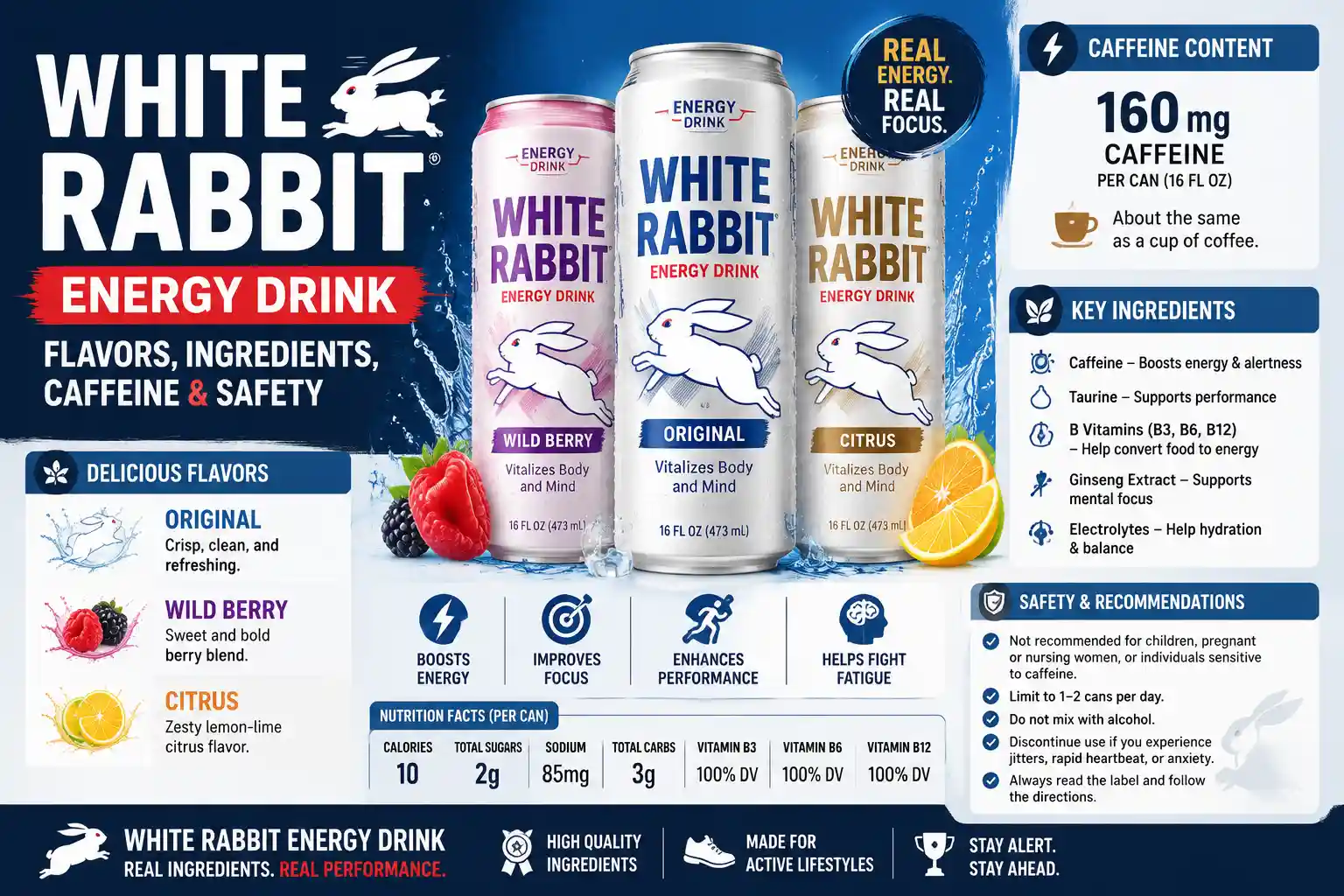
Current listings include MangoBerry, Watermelon Candy, Raspberry Lemonade, Cherry Bomb, Sweet Peach, Passion Fruit, Root Beer, Lemon Iced Tea, and Dr. Rabbit.
| Flavor | General Profile | Preference Match |
|---|---|---|
| MangoBerry | Tropical fruit and berry | Fruit-focused preferences |
| Watermelon Candy | Sweet watermelon | Candy-style flavor fans |
| Raspberry Lemonade | Berry and citrus | Tart-sweet flavor fans |
| Cherry Bomb | Cherry-forward | Cherry soda preferences |
| Sweet Peach | Soft peach | Mellow fruit preferences |
| Passion Fruit | Tropical and tangy | Bold tropical profiles |
| Root Beer | Classic soda profile | Root beer preferences |
| Lemon Iced Tea | Lemon and tea-style profile | Tea-style flavor preferences |
| Dr. Rabbit | Fruity and spiced soda notes | Complex soda profiles |
What Does White Rabbit Taste Like?
Taste depends heavily on the specific flavor. Fruit versions are easier to compare with flavored sparkling beverages, while Root Beer and Dr. Rabbit move closer to familiar soda-style profiles.
Customer feedback is mixed, which is normal for a broad flavor lineup. Anecdotal discussions have praised Root Beer while opinions on other flavors vary. Customer comments are not controlled taste tests.
The safest expectation is carbonated and strongly flavored. If you dislike sparkling beverages, carbonation may be especially noticeable.
White Rabbit Root Beer and Dr. Rabbit Reviews
Root Beer
Root Beer is one of the easiest flavors to understand because it uses a familiar soda profile. Manufacturer-hosted ratings have shown strong customer feedback, but those ratings should be interpreted as anecdotal flavor feedback rather than independent product testing.
Dr. Rabbit
Dr. Rabbit is a more unusual soda-inspired option with fruity and spiced notes. It may appeal to people who enjoy experimenting with complex nostalgic soda profiles. Review history may be smaller than for more established flavors.
White Rabbit Lemon Iced Tea
Lemon Iced Tea gives the lineup a different direction from fruit and soda flavors. It may appeal to people who prefer tea-style flavor profiles.
The name should not be interpreted as proof that the beverage contains brewed tea or caffeine. Current White Rabbit product information lists the beverage as caffeine-free.
How Much Mitragynine Is in White Rabbit?
It is important to distinguish total extract weight from mitragynine content. Current White Rabbit nutrition information states 45 mg of Mitragyna speciosa extract and 30 mg of mitragynine per 12-ounce can, with less than 0.01 mg of 7-hydroxymitragynine.
If your can has different labeling, follow the current package label rather than relying on an older retailer description.
White Rabbit Energy Drink Effects: What Should You Expect?
White Rabbit is marketed as an energy-style beverage, but it should not be described as producing a predictable caffeine-like energy effect.
Its active ingredient is mitragynine from kratom, and kratom’s effects can vary between people. It would therefore be misleading to promise a specific level of energy, focus, mood change, alertness, or other effect.
- Caffeine-free means inactive.
- Plant-based means automatically safe.
- Sugar-free means risk-free.
- A labeled amount guarantees identical effects for every person.
- One person’s experience predicts another person’s response.
White Rabbit Energy Drink Side Effects & Safety
FDA also states that there are no FDA-approved prescription or over-the-counter drugs containing kratom or its known alkaloids.
Recent CDC data provide additional context. U.S. poison centers received thousands of kratom exposure reports over the 2015–2025 period, with substantially more reports in 2025 than in 2015. Multiple-substance exposure reports were also associated with more serious outcomes than single-substance exposure reports.
General Safety Considerations
- Do not combine kratom products with alcohol.
- Avoid combining kratom with other psychoactive substances.
- Be particularly cautious when prescription or over-the-counter medicines are involved.
- Do not drive or operate machinery if you experience impairment.
- Keep kratom-containing beverages away from children and pets.
- Seek appropriate medical care for serious or unusual symptoms.
- Do not use product marketing as a substitute for medical advice.
White Rabbit and 7-OH: Are They the Same Thing?
No. Mitragynine and 7-hydroxymitragynine (7-OH) are different kratom alkaloids.
White Rabbit’s current published information lists 30 mg of mitragynine and less than 0.01 mg of 7-hydroxymitragynine per can.
Don’t assume that every product marketed as “kratom” has the same alkaloid profile. Read the actual label.
Is White Rabbit Energy Drink Legal?
This question requires a two-part answer because federal rules and state/local rules are not the same thing.
Federal considerations
FDA states that kratom is not lawfully marketed as a dietary supplement and cannot lawfully be added to conventional food under applicable federal requirements. FDA continues to issue warnings and take enforcement action involving kratom products.
State and local considerations
State and local laws vary. Some jurisdictions prohibit kratom, while others regulate it through age restrictions, labeling requirements, testing rules, or other consumer-protection measures.
White Rabbit Energy Drink vs. Regular Energy Drinks
The biggest difference is the active ingredient. Conventional energy drinks generally rely on caffeine, while White Rabbit’s current information lists zero caffeine and identifies kratom extract containing mitragynine.
| Feature | White Rabbit | Typical Caffeinated Energy Drink |
|---|---|---|
| Caffeine | 0 mg listed | Usually present |
| Sugar | 0 g listed | Varies |
| Calories | 0 listed | Varies |
| Kratom | Yes | Usually no |
| Mitragynine | Yes | Usually no |
| Alcohol | No | Usually no |
| Primary safety consideration | Kratom exposure | Caffeine and other ingredients |
White Rabbit Energy Drink Pricing & Availability
Retail prices can vary considerably by seller, package size, promotions, shipping costs, availability, and location.
Because kratom products are subject to changing legal and retail restrictions, pricing and availability should be treated as current-market information rather than a permanent product feature.
White Rabbit Energy Drink Reviews: What Customers Say
Customer feedback can help explain flavor preferences, but it is anecdotal evidence. Reviews cannot establish medical safety, effectiveness, or consistent effects.
Manufacturer-hosted ratings have shown strong feedback for several flavors, while independent online discussions are more mixed. Differences between review platforms are normal and may reflect different audiences, serving preferences, or flavor expectations.
How to Interpret Reviews
- Use reviews primarily for subjective flavor impressions.
- Do not treat ratings as proof of safety.
- Do not assume another person’s reported effects will be yours.
- Distinguish manufacturer-hosted reviews from independent discussion.
Pros and Cons of White Rabbit Energy Drink
| Potential Advantages | Important Drawbacks |
|---|---|
| Zero caffeine according to current product information | Contains kratom-derived mitragynine |
| Zero sugar and zero calories listed | FDA warns about serious kratom-related risks |
| Broad flavor lineup | Laws vary across jurisdictions |
| Ready-to-drink carbonated format | Retailer descriptions can contain inconsistent information |
| Current labeling identifies active alkaloid information | Customer reviews are subjective |
Who Should Be Especially Careful?
White Rabbit deserves more caution than a normal flavored seltzer because it contains an active kratom ingredient.
Anyone experiencing severe or unexpected symptoms should seek appropriate medical care rather than attempting to counteract the reaction with another substance.
White Rabbit Flavor Profiles
| If You Usually Prefer… | Flavor Profile to Explore |
|---|---|
| Root beer | Root Beer |
| Cherry soda | Cherry Bomb |
| Berry lemonade | Raspberry Lemonade |
| Watermelon candy | Watermelon Candy |
| Peach drinks | Sweet Peach |
| Tropical fruit | MangoBerry |
| Passion fruit | Passion Fruit |
| Lemon iced tea | Lemon Iced Tea |
| Complex soda profiles | Dr. Rabbit |
Frequently Asked Questions
Is White Rabbit Energy Drink actually an energy drink?
It is marketed as an energy drink, but it is not a conventional caffeine-based energy drink. Current product information lists zero caffeine and identifies kratom extract containing mitragynine as its active botanical ingredient.
Can you drink White Rabbit every day?
There is no universal daily-use recommendation that makes kratom beverages appropriate for everyone. FDA warns consumers about serious kratom-related risks, so zero sugar and zero caffeine should not be interpreted as evidence that daily use is automatically safe.
Can you mix White Rabbit with alcohol?
It is best not to combine kratom with alcohol. Combining psychoactive substances can increase safety concerns, and CDC data indicate that multiple-substance kratom exposure reports have been associated with more serious outcomes.
Does White Rabbit contain 7-OH?
Current published White Rabbit information lists less than 0.01 mg of 7-hydroxymitragynine per can while listing 30 mg of mitragynine. Concentrated 7-OH products are a separate category that has received specific FDA warnings.
Is White Rabbit sugar-free?
Current product information lists 0 grams of total sugar and 0 grams of added sugar per 12-ounce can, along with zero calories and zero carbohydrates.
What is the best White Rabbit flavor?
There is no objective winner. Taste preferences vary, and customer ratings are subjective. Flavor reviews should not be confused with independent safety or effectiveness testing.
Is White Rabbit legal in every state?
No. Kratom laws vary by state and local jurisdiction, and the legal landscape can change. Check current official rules where you live before purchasing or possessing a kratom-containing product.
Final Verdict on White Rabbit Energy Drink
White Rabbit Energy Drink is best understood as a kratom-containing carbonated beverage, not a conventional caffeine-based energy drink.
Current product information lists zero caffeine, zero sugar, zero calories, 45 mg of Mitragyna speciosa extract, and 30 mg of mitragynine per 12-ounce can.
The flavor lineup includes fruit, soda-inspired, and tea-style profiles, but flavor popularity should not be confused with evidence of safety or effectiveness.
The more important issue is the kratom ingredient. FDA warns about serious risks, CDC surveillance has documented substantial kratom-related poison-center activity, and U.S. regulations vary by jurisdiction.