Delta-9 Drinks: What They Are, Effects, Safety, Types & 2026 Legal Guide
Learn what Delta-9 drinks are, how THC beverages work, how to read labels, understand serving sizes and COAs, compare beverage types, recognize safety concerns, and navigate the changing U.S. legal landscape in 2026.
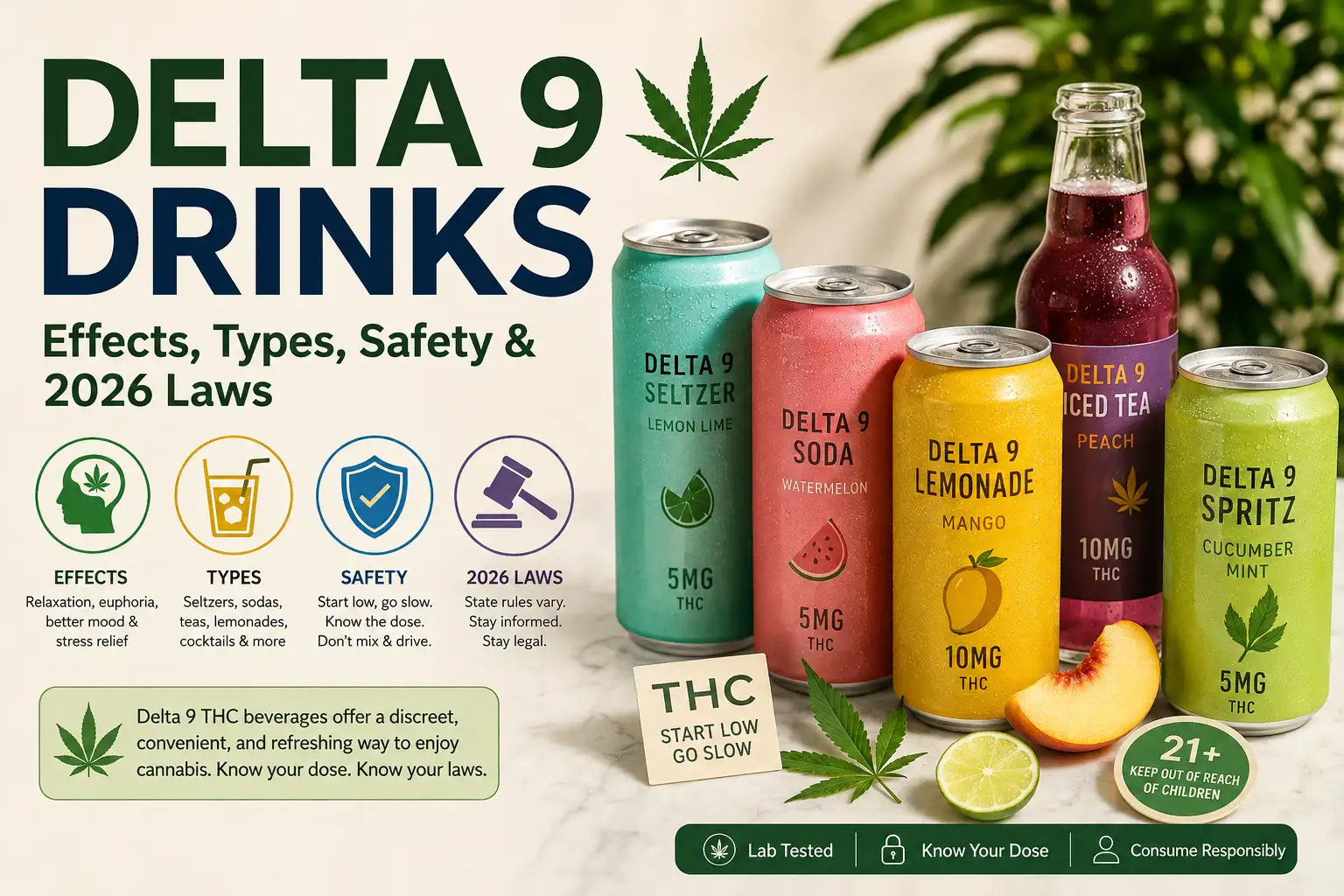
Delta-9 drinks are beverages containing delta-9 tetrahydrocannabinol (THC), the intoxicating cannabinoid most associated with cannabis. They can cause impairment and may be sold as hemp-derived or state-regulated cannabis products, depending on the product and location.
Common styles include THC seltzers, sodas, lemonades, teas, mocktail-style drinks, and non-alcoholic spirits. They should not be confused with ordinary non-alcoholic beverages simply because they contain no alcohol.
Delta-9 Drinks at a Glance
| Drink Type | Typical Flavor Style | What to Check First |
|---|---|---|
| THC seltzer | Citrus, berry, tropical | THC per container |
| THC soda | Cola, orange, fruit | Sugar and THC |
| THC lemonade | Sweet and tart | Serving count |
| THC tea | Peach, lemon, herbal | THC and caffeine |
| THC spritz | Citrus, botanical, bitter | Other cannabinoids |
| THC mocktail | Margarita, mule, paloma-inspired | THC and ingredients |
| THC spirit alternative | Neutral or botanical | Serving size |
| THC + CBD drink | Varies | Amount of each cannabinoid |
What Are Delta-9 Drinks Made From?
A Delta-9 beverage combines a drink base with delta-9 THC. Depending on the product, that THC may come from hemp or cannabis sold through a state-regulated marijuana market.
The rest of the formula can look much like an ordinary beverage. It may contain carbonated water, fruit juice, flavors, acids, sweeteners, tea, herbs, or other cannabinoids such as CBD.
THC Seltzers
Lightly carbonated drinks commonly featuring citrus, berry, tropical, or herbal flavors.
THC Sodas
Fuller-flavored options that may resemble cola, orange soda, cherry drinks, or fruit punch.
THC Lemonades
Sweet-and-tart beverages that use lemon and other acidic fruit flavors.
THC Teas
Tea-based drinks that may contain fruit, herbal ingredients, and sometimes caffeine.
THC Mocktails
Drinks inspired by margaritas, mules, spritzes, palomas, and other cocktails.
THC + CBD Drinks
Products containing both THC and cannabidiol, with each cannabinoid listed separately.
Why Delta-9 Drinks Are Growing So Quickly
THC beverages have become a significant adult beverage category, with products appearing in familiar formats such as seltzers, sodas, spritzes, teas, and mocktails.
Several forces are driving attention:
- Consumers already understand cans, seltzers, sodas, and mocktails.
- THC beverages fit naturally into adult social occasions.
- Many products are positioned beside alcohol alternatives.
- Low-to-mid THC products have become a major part of the category.
- Fruit, citrus, and botanical flavors make the format familiar.
- Retail distribution has expanded in states that permit these products.
- Major food and drink publications are increasingly evaluating the category.
Current Delta-9 Drinks That Show Where the Market Is in 2026
There is no credible way to name one universal “best Delta-9 drink.” Taste preferences vary, formulas change, and psychoactive effects are highly individual.
SOUL Out of Office
A cucumber, melon, and lime THC beverage illustrating the category’s move toward subtle flavor profiles and lower THC options.
Wynk
A THC/CBD seltzer example showing why shoppers should check the cannabinoid amounts on the specific can.
Cann Yuzu Elderflower
An example of a beverage combining THC and CBD rather than relying exclusively on THC.
Tupléy Blackberry Bergamot Social Tonic
A beverage example showing how THC drinks are increasingly being evaluated for aroma, sweetness, acidity, and finish.
Cantrip Orange Soda
An example of the category extending beyond sparkling water into familiar soda-style flavor profiles.
How Delta-9 Drinks Work and What “Fast-Acting” Means
THC does not naturally mix well with water. Beverage manufacturers may therefore use emulsion or nanoemulsion technology to disperse cannabinoid-containing droplets throughout a water-based drink.
Research reviews suggest that some formulations may allow cannabis beverages to be absorbed faster than conventional solid edibles. However, formulations vary and “fast-acting” should never be interpreted as an exact promise about when effects will begin.
Questions worth asking
- How much THC is in the entire container?
- Does the manufacturer explain its formulation?
- Is the product independently tested?
- Does the label clearly separate serving and container amounts?
Hemp-Derived vs. Marijuana-Derived Delta-9 Drinks
Chemically, delta-9 THC is delta-9 THC. The important distinction is where it came from and which regulatory framework applies.
Under the familiar 2018 federal framework, hemp was defined using a 0.3% delta-9 THC dry-weight threshold. That framework contributed to the growth of hemp-derived intoxicating beverage products.
Hemp-Derived
A product made using THC sourced from qualifying hemp, subject to federal and state requirements.
State-Regulated Cannabis
A beverage produced and sold within a state-regulated adult-use or medical cannabis system.
Understanding THC Per Serving vs. THC Per Container
One of the most important details on any THC beverage is the difference between THC per serving and THC in the full container.
Label Checklist
- Total THC in the complete container
- THC listed for one serving
- Number of servings in the container
- Amounts of CBD or other cannabinoids
- Whether the package can be resealed
A number such as 2 mg, 5 mg, or 10 mg does not predict exactly how one person will feel. Milligrams describe the stated quantity of THC, not a guaranteed level of impairment.
How Fast Do Delta-9 Drinks Take Effect?
There is no universal onset time for Delta-9 drinks. Formulation, food intake, individual metabolism, previous cannabis exposure, and other factors can influence how quickly effects are noticed.
This matters because taking additional THC before the first amount has taken effect can lead to unexpectedly strong intoxication.
How Long Do Delta-9 Drink Effects Last?
Duration can vary considerably. There is no universal number of hours that guarantees someone is no longer impaired.
Cannabis can affect coordination, judgment, reaction time, memory, and perception.
Delta-9 Drinks vs. Gummies
Both Delta-9 drinks and gummies deliver THC orally, but their formulations and physical formats are different.
| Feature | Delta-9 Drinks | THC Gummies |
|---|---|---|
| Format | Liquid | Solid edible |
| Serving visibility | Can be easy to sip gradually | Usually individual pieces |
| Onset | May be faster with some formulations | Often slower |
| Portion risk | Easy to keep sipping | Easy to take another piece |
| Storage risk | Can resemble ordinary beverages | Can resemble candy |
| Best label check | THC per whole container | THC per piece and package |
Delta-9 Drinks vs. Alcohol
A Delta-9 beverage may look like a beer, hard seltzer, or canned cocktail, but THC and alcohol are different intoxicants.
| Question | Delta-9 Drink | Alcoholic Drink |
|---|---|---|
| Intoxicating? | Yes | Yes |
| Can impair driving? | Yes | Yes |
| Same active substance? | No | No |
| Can they be assumed equivalent? | No | No |
| Should they be combined casually? | No | No |
How to Read a Delta-9 Drink Label
Packaging is one of the best places to judge whether a product communicates responsibly.
- Total THC per container
- THC per serving
- Servings per package
- CBD and other cannabinoid amounts
- Full ingredient list
- Nutrition information when applicable
- Caffeine content when relevant
- Allergen information
- Manufacturer or responsible company
- Batch or lot number
- Laboratory or testing information
- Required age and impairment warnings
- Storage instructions
What Is a COA and Why Does It Matter?
COA stands for Certificate of Analysis. It is a laboratory report associated with a tested product or batch.
A useful COA should connect clearly to the product in your hand.
Product Identity
Look for a matching product name, batch number, lot number, or other identifying information.
Laboratory
Check the testing laboratory name and the date on which the analysis was performed.
Cannabinoid Results
Review Delta-9 THC and other cannabinoid results rather than relying only on front-label marketing.
Contaminants
Where required, review available testing for contaminants and relevant pass/fail information.
Possible Side Effects and Signs You’ve Had Too Much
Delta-9 THC is psychoactive. It can affect judgment, coordination, reaction time, memory, and perception.
If THC effects become unexpectedly strong:
- Do not consume more THC.
- Do not drive.
- Stay somewhere safe.
- Avoid adding alcohol or other intoxicating substances.
- Stay with a responsible sober adult when possible.
- Seek medical help for severe or concerning symptoms.
Who Should Avoid Delta-9 Drinks?
People who are pregnant, planning pregnancy, or breastfeeding should avoid cannabis use and discuss any exposure with a healthcare professional.
Extra caution is also appropriate for people who:
- Need to drive or operate machinery.
- Work in safety-sensitive occupations.
- Are subject to drug testing.
- Take medicines that may interact with intoxicating substances.
- Have concerns about cardiovascular effects.
- Have previously had unwanted reactions to cannabis.
- Cannot securely store THC products away from children or pets.
Delta-9 Drinks and Drug Testing
A hemp-derived Delta-9 drink is not invisible to a drug test.
Federal workplace programs can test for marijuana-related markers. Therefore, the source printed on the can—“hemp-derived” versus another source—does not guarantee a negative test.
Detection can vary with:
- Type of test
- Frequency of cannabis use
- Amount used
- Individual physiology
- Time since exposure
Are Delta-9 Drinks Legal in the United States in 2026?
This is one of the most complicated parts of the category.
The Federal Hemp Definition
Under the familiar 2018 framework, hemp was defined using a 0.3% delta-9 THC dry-weight threshold. That framework helped create the market for hemp-derived intoxicating beverages.
The FDA Issue Is Separate
The Farm Bill did not eliminate FDA authority over food. Federal food law and controlled-substance law are separate parts of the legal picture.
State Rules Still Matter
States have adopted very different approaches to intoxicating hemp beverages. Some regulate them through cannabis agencies, while others impose THC limits, testing requirements, licensing systems, age restrictions, or outright prohibitions.
Always check the current law in the state where the beverage is being purchased, possessed, or used.
How to Choose a Delta-9 Drink Responsibly
The strongest product is not automatically the best product. A better comparison starts with clarity, testing, ingredients, and legal availability.
- Read the total THC amount for the entire container.
- Compare it with the stated amount per serving.
- Check how many servings are in the package.
- Identify CBD and other cannabinoids separately.
- Check caffeine in tea or energy-style products.
- Review sugar and added sugar if those matter to you.
- Look for a batch-specific COA when available.
- Verify that testing information matches the actual product.
- Avoid products making medical or disease-treatment claims.
- Check state law before buying or transporting the beverage.
- Keep THC drinks separate from ordinary beverages.
- Store them securely away from children and pets.
- Never drive while impaired.
- Avoid casually combining THC with alcohol.
Biggest Red Flag
The biggest warning sign is not an unusual flavor. It is a product that makes THC amount, serving size, ingredients, manufacturer identity, or testing information unnecessarily difficult to understand.
FAQs About Delta-9 Drinks
Do Delta-9 drinks get you high?
Yes, they can. Delta-9 THC is intoxicating and can alter judgment, reaction time, coordination, and perception. The amount printed on the label does not guarantee how strongly one individual will respond.
What does 5 mg of THC on a drink mean?
It means the product claims to contain 5 milligrams of THC in the specified serving or container. Always determine whether the 5 mg applies to one serving or the entire package.
What does “fast-acting THC drink” mean?
Usually, it refers to a formulation such as an emulsion or nanoemulsion intended to disperse THC effectively in liquid. Some research suggests cannabis beverages may be perceived faster than traditional solid edibles, but individual onset still varies.
How long do Delta-9 drinks take to kick in?
There is no guaranteed onset time. Formulation, food intake, individual physiology, and previous cannabis exposure can all influence when effects are noticed.
Will Delta-9 drinks show up on a drug test?
They can. Federal workplace testing programs can test for marijuana-related markers, so “hemp-derived” THC should not be assumed safe for drug-testing purposes.
Are Delta-9 drinks legal in every state?
No. State laws vary, and the federal hemp framework is also scheduled for major changes in November 2026 unless subsequent legislation changes the applicable rules.
Do Delta-9 drinks expire?
Like other packaged beverages, THC drinks have manufacturer-specific shelf lives and storage directions. Check the best-by date and package instructions and follow the manufacturer’s storage guidance.