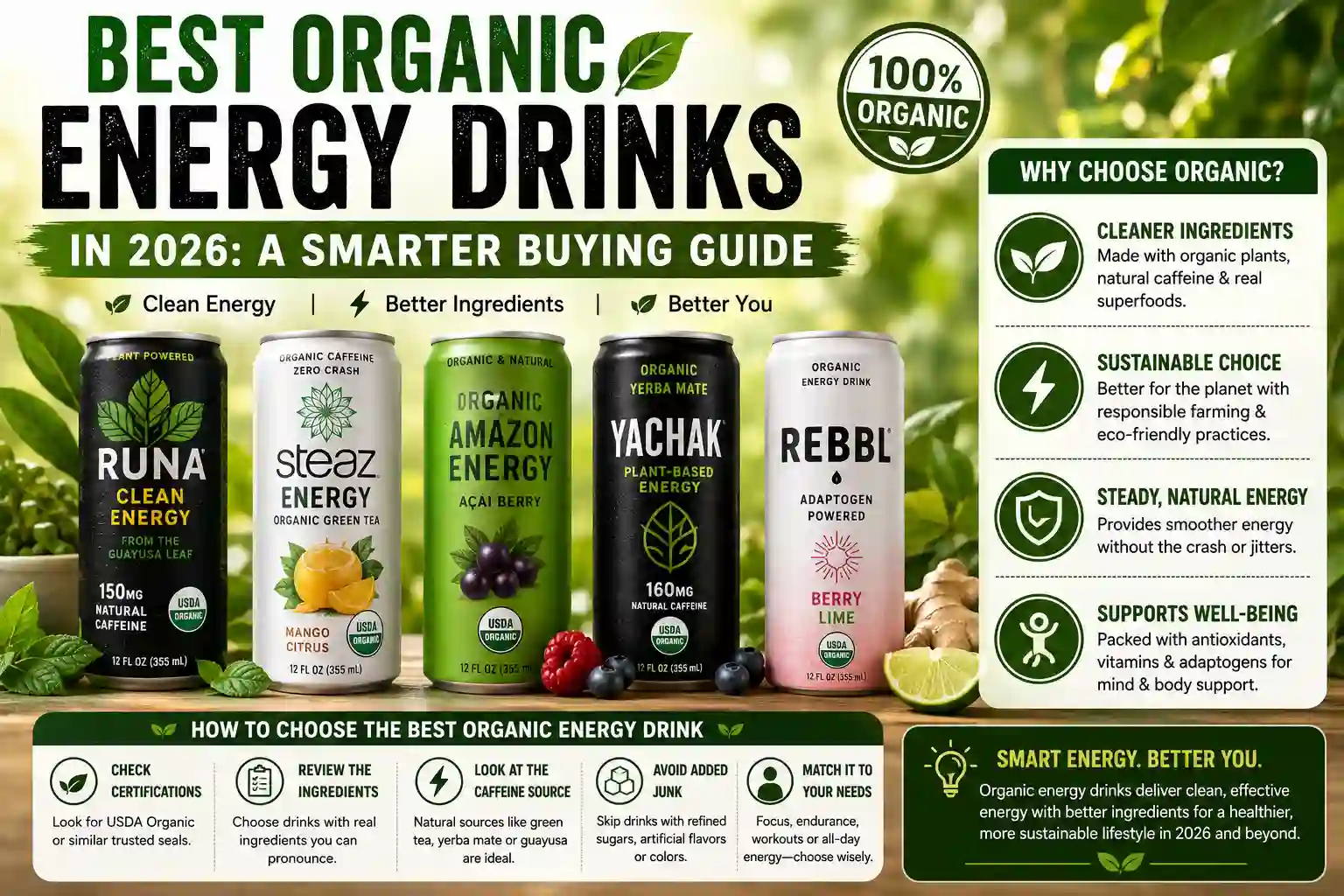
Best energy drinks have moved far beyond sweet, herbal cans with vague “natural energy” claims. In 2026, U.S. shoppers can choose USDA-certified options made with yerba mate, green tea, guarana, green coffee, cane sugar, stevia, and other plant-based ingredients.
But organic does not mean low-caffeine, low-sugar, or automatically healthier. Some cans contain around 115–140 mg of caffeine. Others reach 180–200 mg, which is a substantial single serving for many adults.
This guide compares the strongest current choices by organic certification, caffeine, sugar, sweetener, serving style, availability, and intended use. It also explains what the USDA Organic label actually means and how to avoid misleading “clean energy” marketing.
Last updated: August 12, 2026
Editorial note: Product labels, brand websites, certification claims, caffeine amounts, and current availability were checked for this guide. Products were not personally taste-tested for this article, so flavor comments based on manufacturer descriptions are identified as such. No product is recommended because of sponsorship.
Quick Answer: What Are the Best Organic Energy Drinks?
For most adults seeking a certified organic option, GURU Zero has one of the strongest all-around label profiles because it combines USDA Organic certification, 140 mg caffeine, zero sugar, and no sucralose or aspartame.
Choose Yerba Madre Sparkling if you prefer a more moderate 115 mg caffeine, CLEAN Cause Zero for a 160 mg sugar-free yerba mate, or Daytrip Organic Yerba Mate if you specifically want a stronger 200 mg drink.
There is no single healthiest energy drink for everyone. The best option is the one whose caffeine dose, sugar level, ingredients, and serving size fit your needs.
Best Organic Energy Drinks at a Glance
| Product | Best For | Caffeine | Sugar | Organic Status | Key Caffeine Source |
|---|---|---|---|---|---|
| GURU Zero | Best overall label profile | 140 mg | 0 g | USDA Organic | Organic green tea |
| GURU Original | Classic sweet energy-drink style | 140 mg | 30 g | USDA Organic | Green tea + guarana |
| Yerba Madre Sparkling | Lower-caffeine canned option | 115 mg | Varies | Organic line | Yerba mate |
| CLEAN Cause Zero | Sugar-free yerba mate | 160 mg | 0 g | USDA Organic line | Yerba mate + green tea |
| Yerba Madre Enlighten Mint | Non-carbonated yerba mate | 150 mg | Full-sugar | Certified Organic | Yerba mate |
| Daytrip Organic Yerba Mate | High-caffeine option | 200 mg | 5 g | USDA Organic | Yerba mate |
| UNITY Organic Energy | Green-coffee caffeine | 180 mg | Low sugar | USDA Organic | Green coffee |
| Natural Gas Energy | New low-calorie 200 mg option | 200 mg | About 1 g listed | USDA Organic | Green tea + green coffee |
Current product information confirms GURU Original at 140 mg caffeine and 30 g sugar, CLEAN Cause Zero at 160 mg caffeine with zero sugar, Daytrip at 200 mg caffeine, UNITY at 180 mg, and Natural Gas at 200 mg. Yerba Madre announced refreshed 2026 sparkling products at 115 mg per can.
Important: Formulas can change. Always confirm the current can before using caffeine or sugar numbers to plan your intake.
How We Chose These Organic Energy Drinks
A “best” list is useless if every product wins because its packaging looks healthy. The comparisons here prioritize measurable differences rather than vague claims about feeling focused, balanced, or crash-free.
Products were evaluated using these factors:
• Organic certification: Priority goes to finished drinks clearly identified as USDA Organic or certified organic.
• Caffeine transparency: Exact milligrams are more useful than comparisons with “cups of coffee.”
• Caffeine dose: A 115 mg drink serves a different buyer than a 200 mg drink.
• Added sugar: Zero-sugar, low-sugar, and conventionally sweetened options are separated.
• Sweeteners: Cane sugar, stevia, erythritol, and other ingredients are identified where relevant.
• Ingredient clarity: Recognizable ingredients matter, but the whole formula still counts.
• Serving style: Sparkling and non-carbonated options are both included.
• Availability: Sold-out and pre-launch products are not treated like widely available choices.
• Useful differences: A product needs a clear reason to choose it over another can.
• Safety: Marketing statements never override total caffeine content.
One thing not used as a ranking factor is a brand promise such as “no crash” or “no jitters.” Caffeine sensitivity varies too much between people for those statements to guarantee your experience. The FDA likewise notes wide variation in individual caffeine sensitivity.
Best Organic Energy Drinks in 2026
GURU Zero — Best Overall for Most Sugar-Conscious Buyers
GURU Zero is a strong starting point if you want certified organic ingredients without a large sugar load. Current U.S. versions provide 140 mg caffeine, contain zero sugar, and are USDA Organic.
GURU says its caffeine comes from organic green tea and that the Zero line contains neither sucralose nor aspartame. A current Wild Ice Pop product lists 5 calories per can.
Best for: Adults wanting moderate-to-high caffeine without sugar.
Why it stands out:
• 140 mg caffeine is below many 180–200 mg options.
• Zero sugar makes comparison simple.
• USDA Organic certification is clearly stated.
• No sucralose or aspartame.
• Several fruit-forward flavors are available.
Consider another drink if: You prefer unsweetened beverages or are sensitive to concentrated sweetness.
Yerba Madre Sparkling — Best Lower-Caffeine Organic Option
Yerba Madre is especially useful for shoppers who do not automatically want 160–200 mg caffeine.
For its refreshed 2026 sparkling lineup, the company announced a standardized 115 mg caffeine per can. The rollout included retailers such as Sprouts and selected Albertsons locations.
That lower amount makes Yerba Madre easier to fit into a day that might also include coffee or tea.
Best for: Adults who want organic yerba mate without starting at 160–200 mg.
Why it stands out:
• 115 mg caffeine in the refreshed sparkling line.
• Yerba mate is the primary caffeinated ingredient.
• Sparkling fruit flavors offer an alternative to coffee.
• Organic positioning is central to the brand.
Consider another drink if: You want a strong 180–200 mg serving.
CLEAN Cause Zero — Best Sugar-Free Yerba Mate
CLEAN Cause offers several zero-calorie sparkling organic yerba mate flavors with 160 mg caffeine and zero sugar. Orange Ginger, for example, uses brewed organic yerba mate, erythritol, stevia, citrus ingredients, and green tea extract.
The brand also sells low-calorie sparkling and non-carbonated varieties, giving it one of the broader format selections in the organic yerba mate category.
Best for: Yerba mate drinkers who want zero sugar.
Why it stands out:
• 160 mg caffeine per can.
• Zero-sugar options.
• Sparkling and still varieties exist.
• USDA Organic positioning is clearly used by the brand.
• Current zero flavors include citrus, fruit, and watermelon styles.
Consider another drink if: You dislike stevia or erythritol.
Daytrip Organic Yerba Mate — Best High-Caffeine Organic Yerba Mate
Daytrip sits at the stronger end of this list.
Each current Organic Yerba Mate can provides 200 mg caffeine, 100 mg L-theanine, and a proprietary mushroom blend. The formula uses 5 g organic cane sugar according to the brand’s current product information.
The company also identifies the line as USDA Organic.
Best for: Caffeine-tolerant adults specifically seeking a 200 mg drink.
Why it stands out:
• 200 mg caffeine from organic yerba mate.
• Only 5 g cane sugar according to the brand.
• Includes L-theanine.
• USDA Organic.
• Fruit and mint flavors provide alternatives to standard energy-drink profiles.
Consider another drink if: You are caffeine-sensitive or already drink coffee during the same part of the day.
A single 200 mg can already represents half of the FDA’s 400 mg general daily reference for most adults.
Yerba Madre Enlighten Mint — Best Non-Carbonated Yerba Mate
Not everyone wants carbonation. Yerba Madre Enlighten Mint combines yerba mate with peppermint and honey in a non-carbonated, certified-organic format.
The current product page lists 150 mg caffeine and identifies it as a full-sugar product.
Best for: Tea drinkers who want a still beverage rather than fizzy energy drinks.
Why it stands out:
• 150 mg caffeine.
• Certified Organic.
• Non-carbonated.
• Mint and honey create a tea-like flavor direction.
• Yerba mate is the core caffeine source.
Consider another drink if: Sugar is a major priority.
Yerba Madre also sells lower-sugar products with 2–3 g sugar, though the brand’s product portfolio includes different caffeine amounts and formats.
GURU Original — Best for a Traditional Energy-Drink Flavor
GURU Original is one of the most clearly documented USDA Organic products in the category.
A 12-ounce can contains 140 mg caffeine, 115 calories, and 30 g sugar. Caffeine comes from organic green tea and organic guarana.
The brand describes the flavor as sparkling, sweet, and white-grape-forward. That is a manufacturer description rather than a firsthand tasting note.
Best for: Buyers who want a sweeter, more conventional energy-drink experience.
Why it stands out:
• USDA Organic certification.
• 140 mg caffeine.
• Clear caffeine-source disclosure.
• No sucralose or aspartame.
• Widely established product line.
Main drawback: 30 g sugar is significant, especially compared with zero- and low-sugar choices.
UNITY Organic Energy — Best Green-Coffee Option if Restocked
UNITY takes a different route from the yerba mate-heavy products above.
The formula uses 180 mg organic caffeine from green coffee beans, coconut water, and 25 mg ashwagandha. The company identifies its products as USDA Organic, vegan, non-GMO, and gluten-free.
However, the current brand page shows several flavors and sampler packs as sold out.
Best for: Shoppers specifically looking for organic green-coffee caffeine.
Why it stands out:
• 180 mg caffeine.
• Non-carbonated format.
• USDA Organic.
• Uses coconut water.
• Different caffeine source from the many yerba mate competitors.
Main drawback: Availability is currently a problem.
Do not choose it over an in-stock product based on specifications alone.
Natural Gas Energy — Most Interesting 2026 Newcomer
Natural Gas is worth watching because its label profile is unusual.
The current 12-ounce formula lists 200 mg caffeine from organic green tea and green coffee, 20–25 calories, USDA Organic certification, and no synthetic sweeteners. Its product imagery lists about 1 g sugar.
However, the brand’s site still describes the first run as a Summer 2026 pre-order. That makes it harder to evaluate alongside established drinks with regular retail availability.
Best for: Shoppers interested in newer high-caffeine organic formulas.
Why it stands out:
• 200 mg caffeine.
• USDA Organic.
• Very low listed sugar.
• Green tea and green coffee caffeine sources.
• Low-calorie formulation.
Main drawback: Limited/new-launch status.
Treat it as a promising newcomer rather than a proven nationwide default until availability becomes clearer.
Other Organic Energy Drinks Worth Knowing
Several drinks deserve consideration even when they are not the clearest all-around winners.
SAMBAZON Açaí Amazon Energy Drinks
SAMBAZON combines açaí with yerba mate, green tea, and guarana. Its Original Açaí drink comes in a 12-ounce can, while the low-calorie Açaí Pomegranate version lists 35 calories and 6 g sugar.
One weakness is caffeine communication. Current product pages often compare caffeine with shots of espresso instead of giving a prominent exact milligram figure in the retrieved product information.
For caffeine-conscious shoppers, exact milligrams are more useful than coffee comparisons. Check the current can before buying.
What Does “Organic” Actually Mean on an Energy Drink?
This distinction matters more than almost anything printed on the front of the can.
Under USDA rules, a multi-ingredient product represented simply as “organic” generally must contain at least 95% certified organic ingredients, excluding salt and water. Products labeled “made with organic” need at least 70% certified organic ingredients and cannot use the USDA Organic seal in the same way.
That creates three very different claims:
USDA Organic
This is the strongest quick signal for shoppers seeking a certified finished product.
Made With Organic Ingredients
This can still represent significant organic content, but it is not the same claim as a product labeled Organic.
Contains Organic Ingredients
A drink may contain organic green tea, organic cane sugar, or organic caffeine while the complete beverage does not qualify for the USDA seal.
Practical rule: If certification is important to you, look for the USDA Organic seal rather than relying on words like “clean,” “natural,” “plant-powered,” or “made with organic caffeine.” The USDA seal is a regulated mark overseen through the National Organic Program.
Organic vs Natural Energy Drinks: They Are Not the Same
Organic and natural should not be treated as synonyms.
Organic labeling follows specific federal standards covering agricultural production and certified content. A broad “natural energy” message does not provide the same certification information.
This matters because a beverage might use:
• Plant-derived caffeine
• Natural flavors
• Cane sugar
• Fruit juice
• Yerba mate
• Green tea
and still not necessarily be a USDA-certified organic energy drink.
When comparing two products, start with the certification. Then evaluate the nutrition and caffeine separately.
Is Natural Caffeine Better Than Synthetic Caffeine?
Many organic brands emphasize caffeine from green tea, yerba mate, guarana, or green coffee.
That source may matter to shoppers who prefer certified plant ingredients. It does not, however, make total caffeine irrelevant.
A 200 mg plant-derived caffeine serving is still a 200 mg caffeine serving when you calculate daily intake. This is an important distinction because the FDA’s general adult caffeine guidance focuses on total caffeine consumption and individual sensitivity, not whether a brand calls its caffeine natural.
Plant ingredients can contain other compounds alongside caffeine. Yerba mate, for example, naturally contains caffeine and theobromine.
That does not guarantee that everyone will experience a smoother effect.
A better buying question is:
“How much caffeine does this entire can contain?”
That is more useful than:
“Is the caffeine natural?”
Consider the source after you know the dose.
How Much Caffeine Is in Organic Energy Drinks?
Current organic products span a fairly wide range.
For this guide, an easy non-medical comparison is:
| Caffeine per Can | Practical Comparison |
|---|---|
| Around 100–120 mg | More moderate canned option |
| 121–160 mg | Mid-range for this category |
| 161–199 mg | Strong |
| 200 mg or more | High-caffeine choice |
These categories are only for easier product comparison. They are not medical safety thresholds.
Examples include:
• Yerba Madre refreshed sparkling line: 115 mg
• GURU Original: 140 mg
• GURU Zero: 140 mg
• Yerba Madre Enlighten Mint: 150 mg
• CLEAN Cause Zero: 160 mg
• UNITY: 180 mg
• Daytrip Organic Yerba Mate: 200 mg
• Natural Gas: 200 mg
The FDA cites 400 mg caffeine per day as an amount not generally associated with negative effects for most adults. It also stresses that sensitivity and metabolism vary.
That means two 200 mg cans can reach the full general daily reference before you count coffee, tea, soda, chocolate, or other caffeine.
Are Organic Energy Drinks Healthier?
Not automatically.
Organic certification tells you something meaningful about agricultural production and ingredient standards. It does not tell you whether a drink has an appropriate caffeine dose, sugar level, calorie count, or serving size for you.
Compare these examples:
GURU Original is USDA Organic but contains 30 g sugar in a 12-ounce can.
GURU Zero is also organic but contains zero sugar.
Daytrip contains only 5 g cane sugar, but it delivers 200 mg caffeine.
Yerba Madre’s refreshed sparkling range is lower in caffeine at about 115 mg per can.
Those are four very different nutritional decisions even though each fits somewhere within the organic-energy category.
The smarter approach
Judge a drink in this order:
- Caffeine per entire can
- Organic certification
- Sugar and added sugar
- Sweetener type
- Serving size
- Other stimulants or functional ingredients
- Calories
- Allergens or dietary restrictions
- Price and availability
- Flavor preference
Zero-Sugar vs Low-Sugar Organic Energy Drinks
The sugar question is more complicated than choosing the smallest number.
A zero-sugar organic energy drink usually needs another way to create sweetness. CLEAN Cause Orange Ginger Zero, for example, lists erythritol and stevia.
GURU Zero uses a different zero-sugar formulation and specifically states that it contains no sucralose or aspartame.
Daytrip takes another approach, using 5 g organic cane sugar rather than trying to reach zero.
Then there is GURU Original, which contains 30 g sugar per 12 ounces.
Choose based on what you actually prefer
Choose zero sugar if:
• Limiting added sugar is your first priority.
• You like the sweetener used.
• You have checked caffeine separately.
Choose low sugar if:
• You prefer a small amount of cane sugar.
• You dislike zero-sugar sweetener profiles.
• The drink still fits your overall diet.
Choose unsweetened tea instead if:
• You want caffeine without either added sugar or high-intensity sweetness.
There is no reason to accept 200 mg caffeine simply because the drink contains only a few calories.
Organic Energy Drink Ingredients Explained
The best way to understand the category is to know its recurring ingredients.
Yerba Mate
Yerba mate is a South American plant traditionally brewed as tea. It naturally contains caffeine and theobromine.
It powers drinks from Yerba Madre, CLEAN Cause, and Daytrip.
Flavor can range from earthy and herbal to minty or fruit-forward when blended.
Green Tea
Green tea appears both as a beverage ingredient and a caffeine source.
GURU uses organic green tea in several products, while Natural Gas lists green tea alongside green coffee.
Guarana
Guarana is another naturally caffeinated plant.
GURU Original combines green tea and guarana, while SAMBAZON energy drinks use yerba mate, green tea, and guarana together.
Green Coffee
Green coffee supplies caffeine without requiring the roasted-coffee flavor associated with regular coffee.
UNITY lists 180 mg organic caffeine from green coffee beans, while Natural Gas combines green coffee with green tea.
L-Theanine
Some modern products pair caffeine with L-theanine, an amino acid associated with tea.
Daytrip lists 100 mg L-theanine alongside its 200 mg caffeine.
Treat this as an additional ingredient, not permission to ignore the caffeine dose.
Functional Mushrooms and Adaptogens
Daytrip includes a mushroom blend, while UNITY lists ashwagandha.
These additions can make labels look more sophisticated, but they should not distract from the basic questions: How much caffeine? How much sugar? What is the serving size?
Best Organic Energy Drinks by Need
Different buyers need different products. A useful comparison should make those tradeoffs obvious.
Best Overall Label Profile
GURU Zero
Why: USDA Organic, 140 mg caffeine, zero sugar, and no sucralose or aspartame.
Best Lower-Caffeine Option
Yerba Madre Sparkling
Why: The refreshed line is standardized around 115 mg caffeine.
Best Zero-Sugar Yerba Mate
CLEAN Cause Zero
Why: 160 mg caffeine, zero sugar, and multiple sparkling flavors.
Best High-Caffeine Organic Option
Daytrip Organic Yerba Mate
Why: 200 mg caffeine with only 5 g organic cane sugar.
Best Non-Carbonated Choice
Yerba Madre Enlighten Mint
Why: Certified Organic, 150 mg caffeine, non-carbonated.
Best Green-Coffee Formula
UNITY
Why: 180 mg organic green-coffee caffeine in a non-carbonated drink. The drawback is current sold-out status.
Best New Product to Watch
Natural Gas
Why: USDA Organic, 200 mg caffeine, low calories, and low listed sugar. Its current rollout status prevents a stronger recommendation.
What to Look for Before Buying
Do not choose an energy drink from the front label alone.
Turn the can around and check these items.
Caffeine Per Can
A label may contain more than one serving. Determine how much caffeine you will actually consume.
USDA Organic Seal
Use the seal when certification matters rather than relying on undefined wellness language.
Added Sugar
Compare actual grams.
“Organic cane sugar” is still sugar.
Sweeteners
Look for ingredients such as:
• Organic cane sugar
• Stevia
• Erythritol
• Fruit juice
• Other plant-derived sweeteners
Choose based on your dietary needs and taste preferences.
Additional Caffeine Sources
Watch for combinations of:
• Yerba mate
• Green tea
• Guarana
• Green coffee
• Coffee
• Added caffeine extracts
The total caffeine number matters more than the number of caffeinated plants.
Extra Functional Ingredients
L-theanine, mushrooms, vitamins, electrolytes, and adaptogens can change the formula.
They do not cancel out caffeine.
Serving Size
A 12-ounce can and a 16-ounce can can carry very different caffeine concentrations.
Always compare milligrams per entire can, not just package size.
Are Organic Energy Drinks Good Before a Workout?
They can provide caffeine, but energy drinks and hydration drinks are not the same thing.
An organic energy drink may contain caffeine without enough fluid, sodium, carbohydrates, or electrolytes to serve as a complete hydration strategy.
This distinction becomes especially important during heat, prolonged exercise, or heavy sweating.
For adults who already tolerate caffeine:
• Check your total pre-workout caffeine.
• Do not stack a 200 mg can with another high-caffeine pre-workout.
• Drink water separately.
• Consider whether you need carbohydrates for longer training.
• Avoid experimenting with a strong new drink before competition.
• Choose caffeine-free hydration when stimulation is unnecessary.
For children and teenagers, energy drinks should not be treated as sports drinks. Pediatric guidance specifically distinguishes caffeinated energy drinks from hydration-focused sports beverages.
Who Should Avoid or Limit Energy Drinks?
The word organic does not remove caffeine-related precautions.
Children and Teenagers
Energy drinks are not appropriate everyday beverages for children or teenagers.
The American Academy of Pediatrics advises families to pay close attention to youth caffeine intake and notes that caffeine can contribute to jitteriness, nervousness, sleep problems, and other unwanted effects.
Pregnant People
Pregnancy changes caffeine recommendations. Discuss caffeine intake with your obstetric clinician rather than applying the general adult 400 mg reference.
Caffeine-Sensitive Adults
A 140–200 mg can may feel very different from a smaller coffee or tea.
Consider a lower-caffeine option or a partial serving if appropriate.
People Taking Medications or Other Stimulants
Some medications and supplements may affect how caffeine feels or how much is appropriate.
A pharmacist or healthcare professional can provide individualized guidance.
Anyone Experiencing Concerning Symptoms
Stop consuming the drink and seek appropriate medical advice if caffeine repeatedly causes significant palpitations, severe anxiety, faintness, or other concerning symptoms.
Where Can You Buy Organic Energy Drinks?
Availability varies widely by brand.
GURU sells directly online and offers a store locator. Its U.S. lineup currently includes Original and several Zero products.
CLEAN Cause sells online and has reported availability through Amazon, grocery stores, convenience stores, and retailers including Whole Foods.
Yerba Madre’s refreshed 2026 sparkling products were announced for Sprouts and selected Albertsons stores, with availability varying by product.
Daytrip sells through its own channels, although stock can vary.
UNITY currently shows multiple products as sold out.
Natural Gas still describes its first production run as a Summer 2026 launch/pre-order on its website.
Before buying a large case, try a single can or smaller pack when possible. Energy-drink sweetness varies enough that committing to 12 or 24 cans without knowing your preference can be expensive.
Can You Make an Organic Energy Drink at Home?
Yes, although homemade drinks come with one major disadvantage: caffeine is harder to measure precisely.
A packaged can with 140 mg caffeine gives you a fixed reference. Tea strength changes with leaf quantity, brewing time, temperature, and serving size.
For a simpler homemade option, try one of these.
Iced Organic Yerba Mate
Ingredients
• Brewed organic yerba mate
• Ice
• Fresh lime
• Mint
• Optional small amount of honey
Method
Brew the mate according to its package directions. Chill it fully, then serve over ice with lime and mint.
Organic Matcha Citrus Spritz
Ingredients
• Organic matcha
• Cold water
• Sparkling water
• Lemon or lime
• Ice
Method
Whisk matcha with a small amount of water. Add ice and citrus, then finish with sparkling water.
Iced Organic Green Tea
Ingredients
• Organic green tea
• Cold water
• Lemon
• Fresh berries
• Ice
Method
Brew the tea, chill it, and serve with berries and lemon.
Homemade drinks work well if ingredient control matters more to you than knowing an exact caffeine dose.
Organic Energy Drinks vs Coffee
Neither drink wins automatically.
Coffee can be extremely simple: brewed coffee and water. An organic energy drink can offer a fixed caffeine number, cold portability, fruit flavors, and convenient packaging.
Choose coffee when:
• You want a simple ingredient list.
• You enjoy roasted flavor.
• You can control your serving size.
• Added sweeteners are unnecessary.
Choose an organic energy drink when:
• You want caffeine clearly listed per can.
• You prefer fruit, tea, or sparkling flavors.
• You want a portable ready-to-drink option.
• USDA Organic certification matters to you.
The key comparison is not coffee versus energy drinks.
It is caffeine dose, ingredients, sugar, serving size, and how the drink fits your day.
Common Mistakes When Choosing Organic Energy Drinks
Assuming Organic Means Low Caffeine
It does not.
Daytrip and Natural Gas both reach 200 mg caffeine despite organic positioning.
Assuming Plant Caffeine Cannot Cause Jitters
People respond differently to caffeine.
The FDA emphasizes individual variation in caffeine sensitivity.
Ignoring Sugar Because It Is Organic
Organic cane sugar is still sugar.
GURU Original contains 30 g per 12-ounce can.
Assuming Zero Sugar Means Unsweetened
CLEAN Cause Zero uses erythritol and stevia.
Zero sugar and no sweetener are different things.
Buying Based on “Clean Energy” Language
“Clean” does not tell you the caffeine level, sugar content, or organic certification.
Read the actual label.
Drinking a Second Can Without Counting the First
Two 200 mg cans equal 400 mg caffeine, before coffee, tea, or other sources.
That reaches the FDA’s general daily reference for most adults.
FAQs
What is the best organic energy drink?
GURU Zero is one of the strongest all-around choices for adults who want USDA Organic certification, 140 mg caffeine, and zero sugar. Yerba Madre Sparkling is more appealing if you want less caffeine, while Daytrip suits caffeine-tolerant adults seeking a stronger 200 mg option.
The best choice still depends on your caffeine tolerance, sweetener preference, and diet.
Are organic energy drinks actually healthier?
Not necessarily. Organic certification concerns how agricultural ingredients are produced and labeled. It does not guarantee low caffeine, low sugar, or fewer calories.
Compare the nutrition panel and caffeine amount separately.
Which organic energy drink has the least caffeine?
Among the major ready-to-drink products compared here, Yerba Madre’s refreshed sparkling line is one of the lower-caffeine choices at about 115 mg per can.
That is still a meaningful caffeine serving.
Which organic energy drinks have zero sugar?
Current options include GURU Zero and CLEAN Cause Zero. Both provide substantial caffeine despite having no sugar.
Check the sweetener list if you are also trying to avoid specific sugar substitutes.
Is GURU really organic?
Yes. GURU states that its U.S. products are USDA Organic certified, and the current Original product page identifies the drink as USDA Organic.
GURU Original contains organic green tea and guarana as caffeine sources.
Is yerba mate an energy drink?
Yerba mate itself is a caffeinated plant traditionally prepared as tea. Companies such as Yerba Madre, CLEAN Cause, and Daytrip package it as a ready-to-drink caffeinated beverage.
Caffeine levels can vary greatly between brewed tea and packaged cans.
Is natural caffeine safer than synthetic caffeine?
A plant source does not make a large caffeine dose automatically appropriate.
When comparing drinks, use the total milligrams of caffeine as your main reference. The FDA’s guidance focuses on total caffeine and individual sensitivity.
Can teenagers drink organic energy drinks?
Organic certification does not make energy drinks appropriate for teenagers.
Pediatric guidance advises caution with youth caffeine intake and distinguishes energy drinks from normal hydration beverages.
Can I drink an organic energy drink every day?
Some healthy adults may fit a caffeinated drink into their routine, but daily total caffeine matters more than whether the can is organic.
Count energy drinks together with coffee, tea, soda, chocolate, and other caffeine sources. The FDA cites 400 mg daily as a general reference for most adults, while individual tolerance varies.
Conclusion
The best organic energy drinks in 2026 are not simply the cans with the cleanest-looking ingredient lists. Caffeine, sugar, sweeteners, certification, serving size, and availability matter more than front-label marketing.
For a balanced zero-sugar option, GURU Zero is a strong starting point. Choose Yerba Madre Sparkling when lower caffeine matters, CLEAN Cause Zero for sugar-free yerba mate, or Daytrip when you intentionally want a stronger 200 mg serving.
Most importantly, do not confuse USDA Organic with caffeine-free, sugar-free, or automatically better for you. Check the seal, read the complete label, compare caffeine per can, and choose the lowest dose that actually fits what you need.